
An international research team found microscopic cell-like structures and chemical traces of heme inside a Brazilian dinosaur fossil. The discovery could reveal new details about prehistoric biology, although experts disagree over whether the structures are truly red blood cells.
An international team of scientists has found microscopic structures resembling red blood cells inside the 115-million-year-old bones of a Brazilian dinosaur. Chemical tests also identified compounds associated with heme, a component of hemoglobin that helps blood transport oxygen. The discovery offers a possible new way to study extinct animals, although experts disagree about whether the structures were actually blood cells.
The findings were published online November 2, 2026, in the Proceedings of the National Academy of Sciences. The researchers examined fossilized leg bones from Aratasaurus museunacionali, a small meat-eating dinosaur that lived during the Early Cretaceous period in what is now northeastern Brazil.
The team, led by Curtin University geochemist Kliti Grice in Australia, argues that unusual mineralization preserved a microscopic record of blood-related material. The findings do not mean scientists discovered liquid dinosaur blood, intact red blood cells or usable dinosaur DNA.
A Dinosaur Fossil Found in a Brazilian Mine
The dinosaur’s remains were recovered from a gypsum mine in Ceará state in 2008. Aratasaurus was a two-legged theropod measuring about 3.1 meters, or 10 feet, from head to tail. Researchers estimate that the individual was roughly four years old and weighed about 34 kilograms, or 75 pounds.
The specimen belongs to a dinosaur group that includes numerous small predators and the evolutionary relatives of modern birds. Its leg bones were already scientifically valuable because they helped researchers identify and describe Aratasaurus as a distinct species in 2020.
The fossil is associated with Brazil’s National Museum and its research partners. The new work shows how material collected for traditional anatomical study can later become useful for different scientific questions.
Microscopic Structures Inside Ancient Bone
Grice and her colleagues were investigating how much biological information can survive the fossilization process. They were not specifically looking for blood when they examined the dinosaur’s hind-limb material.
Under powerful microscopes, they found numerous small oval structures inside vascular canals, the narrow channels that once contained blood vessels. Their location made the structures interesting because circulating red blood cells would have passed through vessels inside living bone.
The researchers combined electron microscopy with tests designed to identify minerals and chemical compounds. Rather than relying only on appearance, they looked for chemical evidence associated with the microscopic structures and compared it with surrounding fossil material.
Their tests detected heme B and altered heme-related compounds. Heme is an iron-containing component of hemoglobin, the protein responsible for carrying oxygen in red blood cells. Finding related chemical signatures in a fossil does not necessarily mean the original protein survived intact.
The team also reported amino acids associated with collagen, a structural protein common in bone. Such compounds may provide clues about the original organism, but the results do not establish that complete collagen molecules remain in the fossil.
How Could Such Delicate Traces Survive?
Biological tissue typically decays rapidly after death, especially over geological time spans. The researchers propose that unusual burial conditions helped preserve microscopic shapes and portions of their original chemical signatures.
They suggest the dinosaur was buried relatively quickly in a low-oxygen setting that included microbial mats. These communities of microorganisms may have influenced the chemistry around the bones and slowed or redirected decomposition.
The structures were mineralized with hausmannite, a manganese oxide. Grice’s team proposes that early mineral formation helped preserve or reproduce the shapes of delicate biological material before those original structures disappeared.
That process would have produced mineralized impressions or replacements, not cells frozen unchanged for 115 million years. The distinction matters because fossil preservation often involves major chemical transformation while retaining details of an organism’s anatomy.
The investigators also compared the fossil’s chemical profile with surrounding rock to examine whether the signals came from the dinosaur or from environmental contamination. These comparisons strengthened their interpretation but cannot settle every question about the microscopic structures.
Leading Expert Questions the Blood Cell Identification
Mary Schweitzer, a North Carolina State University researcher known for studying ancient biological material in dinosaur fossils, raised doubts about the identification. She told Live Science that the structures shown in the study did not look like the red blood cells expected in a dinosaur.
Unlike mature human red blood cells, red blood cells in birds and reptiles generally retain a nucleus. That nucleus affects the cell’s shape and often creates a visible central bulge.
Schweitzer observed that the reported structures appeared concave rather than showing the expected bulge. She also questioned their size, which seemed smaller than typical red blood cells in non-mammalian vertebrates.
Her criticism does not amount to rejecting every aspect of the research. She considered the heme and collagen-related chemical evidence persuasive and welcomed the use of multiple methods to investigate old fossils.
Another independent researcher, Mauricio Barbi of the University of Regina, found the evidence for mineralized structures consistent with blood cells convincing but acknowledged that their identification still required interpretation. The disagreement centers on what the structures represent, not simply on whether interesting chemical traces exist.
What the Discovery Does Not Prove
Earlier studies have also reported biological material or chemical traces in dinosaur fossils. Such claims have generated debate because laboratory contamination, later microbial growth and mineral formations can sometimes imitate features of ancient tissues.
The new study stands out for combining the position of the structures inside bone with chemical analysis of heme-related compounds. Its authors regard that combination as especially strong evidence for blood-derived material.
Still, the research does not establish a complete picture of how Aratasaurus blood functioned. It cannot directly measure the dinosaur’s metabolism, running speed or oxygen consumption, and it provides no living cells that could be examined physiologically.
The researchers also did not recover dinosaur DNA. Any claims that the finding opens a path to cloning dinosaurs would go beyond the evidence presented in the study.
Museum Fossils May Hold More Chemical Clues
The broader significance may lie in the possibility that familiar museum specimens contain information not visible during ordinary fossil examination. Advanced microscopes and sensitive chemical tests can investigate questions that were difficult to ask when many fossils were first collected.
If independent teams reproduce similar results in other dinosaurs and different geological environments, researchers may be able to compare how blood-related chemistry changes during fossilization. Those comparisons could also help distinguish original biological compounds from later contamination.
Grice has emphasized that the next priority is replication using additional specimens and complementary techniques. The debate over Aratasaurus illustrates why striking scientific claims benefit from close scrutiny as well as increasingly sophisticated testing.
For now, the strongest supported result is that an ancient dinosaur bone contains cell-like mineral structures and heme-related chemical evidence. Whether those structures can definitively be called fossilized red blood cells remains an open scientific question.
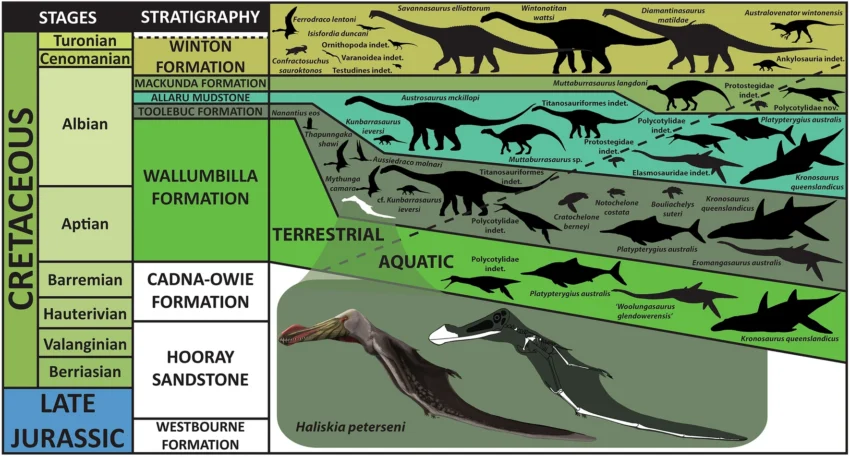
IMAGE: Diagram of the stratigraphy and fauna of the Australian Eromanga Basin. Photo: Adele H. Pentland, Stephen F. Poropat, Ruairidh J. Duncan, Alexander W. A. Kellner, Renan A. M. Bantim, Joseph J. Bevitt, Alan M. Tait & Kliti Grice / Wikimedia, taken 2024-06-12, CC BY 4.0