
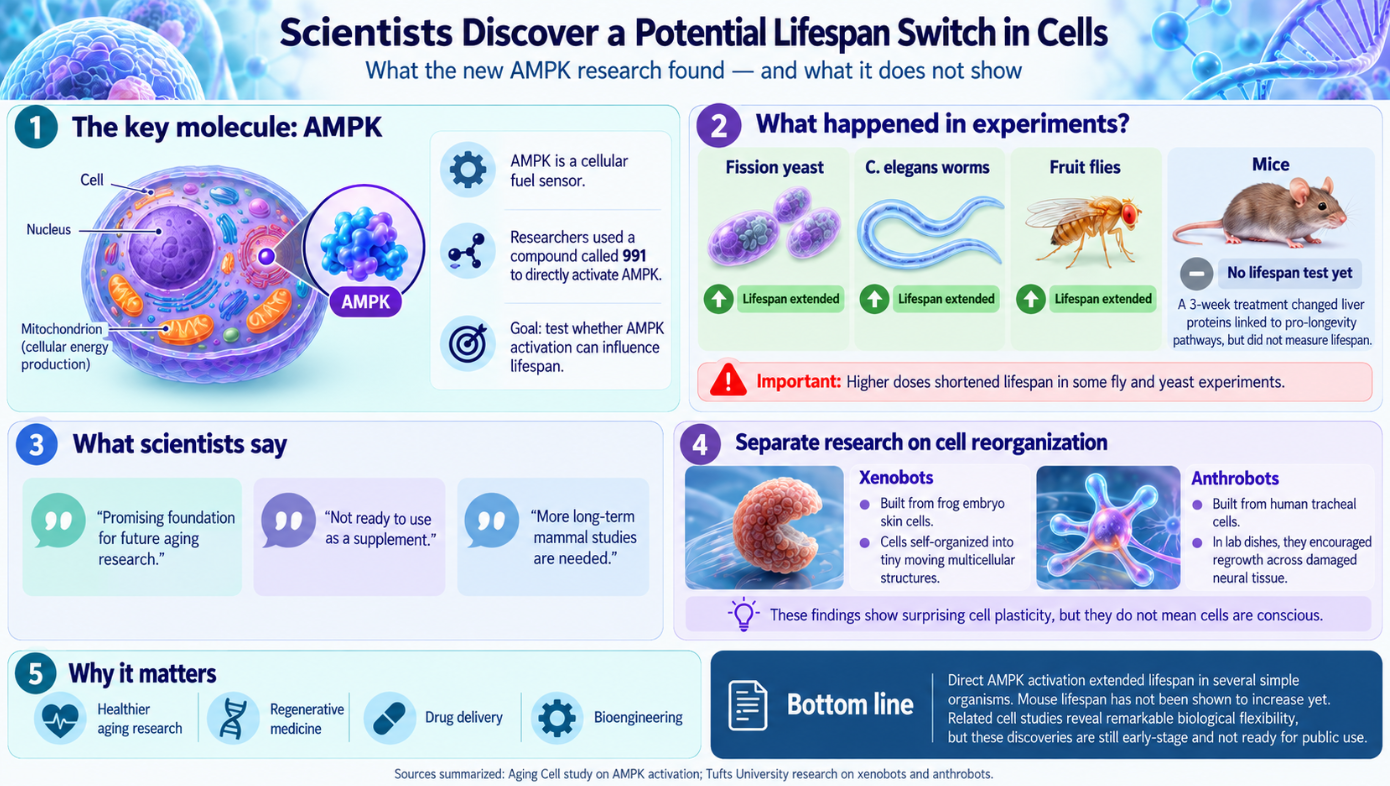
Researchers found that directly activating AMPK extended lifespan in yeast, worms and fruit flies. The findings are promising but do not yet show that the same approach extends life in mammals.
Scientists have identified a cellular switch that may help extend lifespans in multiple organisms. The enzyme AMPK acts as a fuel sensor inside cells and researchers found that manipulating it can influence how long organisms live. In experiments with fruit flies as well as worms and fission yeast researchers observed that a compound extended lifespan.
When the same compound was tested on mice the researchers did not measure lifespan and instead found short-term protein changes associated with pro-longevity pathways. The team behind the research noted that while they have known for years this switch is connected to aging it should not be used as a supplement yet. They emphasized that the findings offer a foundation for future studies into whether directly targeting AMPK could help people live longer and healthier lives.
Separately researchers at Tufts University and the University of Vermont have shown that cells can reorganize after being removed from an organism.
Skin cells taken from frog embryos were able to form new structures that moved and performed functions not seen in the original animal. These cells did not just survive but reorganized into new multicellular units with behaviors they had never displayed before. The structures formed by these cells were called xenobots and later versions used cilia for movement in a way that was different from their original roles.
Human tracheal cells were also used to create similar structures known as anthrobots which could move and encourage regrowth across damaged neural tissue in lab settings. The research has prompted broader questions about how much biological activity can persist after an organism dies. Studies of post-mortem tissues show that some gene activity can persist or change for a time after organismal death.
The study of these reorganizing cells is part of a broader field called synthetic morphology which looks at how cells form new structures. Tufts University biologist Michael Levin has suggested that cells may have a basic form of cognition. By this definition cells can sense their environment and react without needing a nervous system.
However no evidence shows that these cellular behaviors involve consciousness or subjective experience. Two different views exist on what these findings mean for understanding biological systems. One sees the behavior as evidence of primitive cognition while another explains it through chemical and physical processes.
The term ‘autonomy’ in this context refers to self-directed biological activity and not awareness or intention.
Potential uses of this research include regenerative medicine as well as drug delivery systems and bioengineering. These applications are not ready for public use yet. Some researchers have raised questions about how these discoveries change our understanding of death itself.
IMAGE: DNR Art Department