
Arizona State University researchers have developed a programmable DNA assembly system that could advance nanotechnology, molecular electronics, medical diagnostics, and the development of new materials.
Researchers at Arizona State University have developed a technique for constructing complex three-dimensional structures using microscopic, cube-shaped DNA building blocks. The technology allows scientists to design individual components that automatically assemble into predetermined shapes when combined in a liquid solution. Researchers demonstrated the method by creating intricate geometric structures, reconfigurable assemblies, and a three-dimensional junction of carbon nanotubes. The findings were published in the scientific journal Science Robotics on November 25, 2026.
The research was led by Associate Professor Petr Šulc, working with scientists and students from Arizona State University and Emory University. Doctoral students Thong Diep and Hao Liu were the study’s first authors. Their work addresses a major challenge in nanotechnology: constructing increasingly complex structures without having to position each microscopic component individually.
Using DNA as a Construction Material
DNA is widely recognized as the molecule responsible for carrying genetic information, but its chemical properties also make it useful as a construction material. DNA contains four chemical bases that pair in predictable combinations, allowing researchers to design strands that recognize and attach to complementary sequences. Scientists can use these interactions to control how artificial molecular structures form.
An established technique known as DNA origami involves folding a long strand of DNA into a predetermined shape using shorter strands that hold the structure together. Researchers have previously used this method to create microscopic containers, geometric objects, and experimental drug delivery systems. However, the length of the DNA scaffold can limit the dimensions of individual structures.
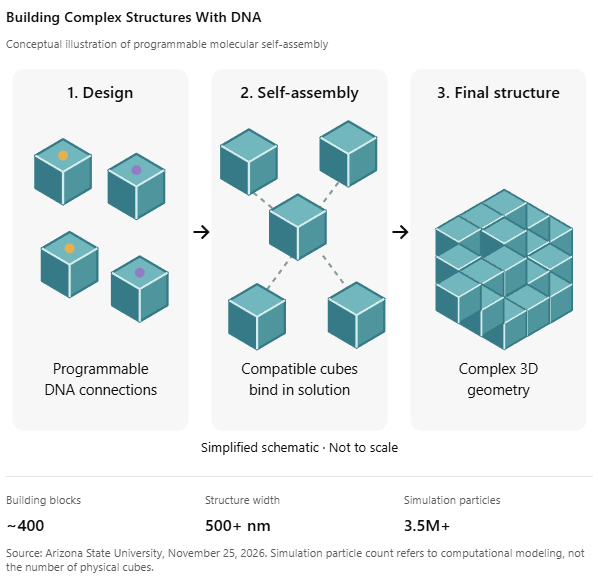
The new platform addresses this limitation by joining multiple cube-shaped units into larger assemblies. Each cube contains specially designed molecular connections that determine which neighboring components it can attach to. Researchers can therefore construct larger objects by controlling the interactions between smaller, reusable building blocks.
Computer Simulations Guide Molecular Assembly
One of the greatest difficulties in molecular construction is preventing components from connecting incorrectly. Unlike conventional manufacturing, scientists cannot physically position individual DNA cubes at such a small scale. The cubes move through a solution, collide with one another, and attach when compatible molecular connections meet.
To overcome this challenge, the researchers developed a computational method called the minimal kit design principle. Scientists begin with the desired final structure and use mathematical optimization to identify the smallest practical collection of different building blocks needed to construct it. Computer simulations help identify potential assembly errors before researchers manufacture the DNA components.
The team used Arizona State University’s high-performance computing infrastructure to conduct detailed molecular simulations. According to the university, some simulations involved more than 3.5 million particles and required powerful graphics processing units. These calculations helped researchers evaluate how individual components would interact under different conditions.
Creating a Complex Menger Cube
Among the structures produced during laboratory experiments was a Menger cube, a three-dimensional fractal characterized by repeating geometric openings. The structure resembles a large cube assembled from smaller cubes, with deliberately arranged empty spaces extending through its interior. Its intricate geometry makes it a useful demonstration of the platform’s ability to create complicated nanoscale objects.
The researchers assembled a structure containing approximately 400 DNA building blocks and measuring more than 500 nanometers across. A nanometer is one-billionth of a meter, placing the completed structure well below the thickness of a human hair. The research team described the achievement as the largest three-dimensional noncrystalline assembly produced in DNA nanotechnology.
Examining these delicate structures required specialized imaging methods. Researchers used cryogenic electron microscopy for smaller objects and scanning electron microscopy for larger assemblies. Preparing the larger specimens involved applying a protective silicate coating that preserved their shape without concealing important structural details.
Structures That Can Change Their Shape
The research team also demonstrated that DNA assemblies could be modified after their initial construction. By introducing additional cubes designed to displace existing components, scientists were able to alter selected sections of an assembled object. The process relies on molecular recognition rather than mechanical tools to exchange components.
One experimental structure resembled a small humanoid figure whose limbs and head could be repositioned through these molecular exchanges. Researchers referred to the demonstration as a dancing robot, although it was not an independently functioning robotic device. The experiment demonstrated how future molecular machines might be designed to undergo controlled structural changes.
Building Three-Dimensional Molecular Electronics
Working with researchers at Emory University, the team demonstrated that DNA building blocks could also carry materials other than DNA. The scientists attached carbon nanotubes to selected components and assembled them into a three-dimensional junction. Carbon nanotubes are extremely small cylindrical carbon structures with properties that make them attractive for experimental electronic materials.
Conventional electronic manufacturing relies heavily on patterned layers, while DNA-based construction offers another way to arrange materials in three dimensions. The nanotube demonstration was not a functioning electronic circuit, but it established that the assembly system could position additional materials within a designed structure. Further research will be necessary to determine whether such assemblies can support reliable electronic devices.
Potential Applications and Remaining Challenges
Programmable DNA assemblies could eventually contribute to medical diagnostics, targeted drug delivery, photonics, and advanced materials. Their ability to organize components in three dimensions may also help researchers develop materials with specialized optical or electrical properties. These potential applications remain research goals rather than demonstrated commercial or medical products.
Manufacturing larger structures still presents significant practical challenges, including the preparation of DNA strands, assembly reliability, production costs, and structural stability. The experiments required thousands of DNA strands, along with specialized laboratory procedures and substantial computing resources. Although the minimal kit approach reduces the number of distinct building block designs, it does not eliminate the need for large numbers of individual molecular components.
The research received support from the U.S. Department of Energy’s Basic Energy Sciences program. Šulc has also established an online resource called NANOBASE, where researchers can exchange molecular designs and access previously developed building blocks. The resource is intended to help scientists build upon existing designs rather than independently developing every component from the beginning.
IMAGE: DNR Research