
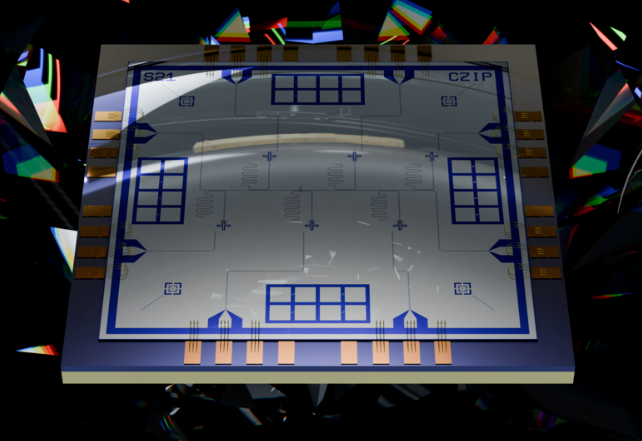
Researchers in Brazil and China have developed a theoretical method that could preserve quantum information during measurement, potentially making future quantum computers simpler and more reliable.
Scientists in Brazil and China have proposed a new way to read information stored in quantum computers while causing very little disturbance to the data. Their method uses a tiny electrical current to reveal a qubit’s condition without requiring the additional quantum bits commonly used in many existing measurement techniques.
The research was conducted by scientists from the University of São Paulo and the Beijing Institute of Technology, with collaborators at other institutions. Published August 5, 2026, in the journal Physical Review B, the study describes a measurement system that could help address one of quantum computing’s most difficult technical challenges.
The method has not yet been demonstrated in a physical device. Its promising results come from theoretical calculations and computer simulations, which suggest that qubit states could be reconstructed with accuracies exceeding 99%.
The findings were described in greater detail by the São Paulo Research Foundation, known as FAPESP, in October.
Why Measuring Quantum Information Is Difficult
Ordinary computers store information using bits that represent either 0 or 1. These values can be read repeatedly without changing the stored information under normal conditions.
Quantum computers use qubits, which behave differently. A qubit can exist in a superposition, meaning its quantum state contains contributions from both 0 and 1.
The proportions of those states and their relationship to each other help determine how a quantum computer processes information.
However, quantum states are extremely sensitive to interference. Interactions with the surrounding environment, including the devices used to measure them, can change the information researchers want to preserve.
A conventional measurement may cause a qubit’s superposition to collapse into one of its possible outcomes. Once that happens, information about the original superposition cannot generally be recovered from that individual measurement.
This creates a challenge for scientists developing quantum computers that must perform calculations while protecting delicate quantum information.
Researchers have developed specialized techniques called quantum nondemolition measurements to reduce unwanted changes during readout.
Many such techniques involve auxiliary quantum systems known as ancillas. These systems interact with the qubit being studied, allowing researchers to obtain information indirectly.
Although useful, ancilla-based methods can require additional hardware, preparation steps and repeated operations. Those requirements increase the complexity of quantum devices.
The new research proposes a different approach.
Using an Andreev Qubit to Reveal Its Own State
The research team focused on an unusual type of qubit known as an Andreev qubit.
Its name comes from Soviet physicist Alexander Andreev, who described an important process involving electrons at the boundary between normal and superconducting materials in 1964.
Andreev states can form in tiny structures connected to superconductors. Under suitable conditions, these states can represent the quantum information stored in a qubit.
In the proposed system, researchers considered a nanoscale structure called a quantum dot, formed within an indium arsenide nanowire.
The quantum dot sits between two superconducting regions. Its electronic states provide the basis for the Andreev qubit.
One important property of this arrangement is its ability to carry a supercurrent.
A supercurrent is an electrical current that flows through a superconducting system without ordinary electrical resistance. This behavior allows electrical signals to persist without the energy losses associated with conventional resistance.
The scientists discovered through their calculations that the supercurrent can carry information about the qubit’s state.
Rather than remaining entirely steady, part of the current oscillates when the qubit is in a superposition.
Those oscillations result from quantum interference between the states making up the superposition.
The researchers propose using this changing current as a signal that reveals the qubit’s condition without directly performing a conventional measurement on the qubit itself.
How the System Reads Quantum Information
The proposed measurement method relies on two components of the electrical current.
The first is a constant component that remains steady over time. The second is an oscillating component that changes as the quantum system evolves.
By analyzing the constant current and the size of the oscillation, researchers can determine the relative contributions of the qubit’s 0 and 1 states.
The timing of the oscillation provides additional information about the phase relationship between those states.
Together, these measurements could allow scientists to reconstruct the qubit’s initial state.
The researchers also identified an unusual physical effect.
In superconducting circuits, an oscillating current is often associated with an applied voltage through a phenomenon called the alternating-current Josephson effect.
In the proposed Andreev system, however, the current could oscillate even without an externally applied voltage.
The oscillation would arise from the qubit’s own quantum evolution.
That distinction is important because it provides a measurable electrical signal directly connected to the quantum information being studied.
A Sensitive Magnetic Sensor Detects the Signal
To read the proposed electrical signal, the researchers incorporated the Andreev qubit into a closed superconducting circuit.
They then positioned a highly sensitive magnetic sensor nearby.
The sensor, called a superconducting quantum interference device, or SQUID, can detect extremely small changes in magnetic fields.
As the supercurrent moves through the circuit, it generates a magnetic field. When the current oscillates, the magnetic field changes as well.
The SQUID detects those variations, allowing researchers to infer the current’s behavior and reconstruct information about the qubit.
José Carlos Egues, a physicist at the University of São Paulo who helped lead the research, compared the arrangement to two compasses.
One represents the qubit, while the other represents the SQUID sensor. The electrical current produces a magnetic field that the sensor can detect.
Because the connection between the sensor and the qubit can be made extremely weak, the researchers expect the measurement process to produce only a small disturbance.
The approach does not eliminate the fundamental effects associated with quantum measurement.
Instead, it attempts to reduce those effects enough that useful information can be collected while the original quantum state remains largely intact.
Simulations Show Promising Accuracy
To evaluate the proposed method, the scientists performed computer simulations that included measurement noise and the influence of the sensor on the quantum system.
The calculations examined whether the qubit’s original state could still be reconstructed under conditions that more closely resemble a practical experiment.
The simulations produced three reported accuracy values:
- 99.52%
- 99.81%
- 99.85%
The different results depended on the number of measurements considered.
According to the FAPESP research summary, these values suggest that the proposed approach could provide highly accurate state reconstruction despite the unavoidable disturbance introduced by measurement.
However, the figures describe simulated reconstruction accuracy rather than performance achieved in an operating quantum computer.
The researchers have not yet constructed and tested the complete measurement arrangement.
That limitation is important because real hardware can introduce additional noise, calibration problems and other complications that may affect performance.
Nevertheless, the team believes its design could be built using technologies already available in laboratories.
SQUID sensors and superconducting circuits are established tools in quantum physics research.
The proposed measurement arrangement would require integrating these components into a suitable geometry and testing whether its predicted behavior occurs experimentally.
Potential Benefits for Quantum Computing
If the system works as predicted, it could simplify certain kinds of quantum measurement.
A major advantage would be removing the need for auxiliary qubits in the proposed Andreev-qubit readout process.
Eliminating those additional components could reduce the number of operations and devices required to monitor quantum information.
The researchers also suggest that their method could allow repeated observations without resetting the qubit to its original state after every measurement.
That capability could help scientists track how a quantum system changes over time.
It might also support future research into quantum error correction, which aims to protect information against mistakes caused by noise and unwanted interactions.
Reliable quantum error correction is widely considered essential for building larger quantum computers capable of performing complex calculations.
However, the new proposal is specifically designed for Andreev qubits. The study does not demonstrate that the same technique would work with every type of quantum computing hardware.
It also does not establish that complete quantum calculations can be monitored continuously without affecting their outcomes.
Those possibilities would require further research and experimental testing.
International Research Collaboration
The study was authored by Xian-Peng Zhang, Chuanchang Zeng, Zhen-Biao Yang, José Carlos Egues and Yugui Yao.
Their institutional affiliations include the Beijing Institute of Technology, the Hong Kong University of Science and Technology, Fuzhou University and the University of São Paulo.
Egues and Yao helped lead the research, combining expertise in quantum physics, superconductivity and the theoretical behavior of nanoscale electronic systems.
The study received support from FAPESP, which helps fund scientific research in Brazil.
The researchers’ next major challenge is determining whether the theoretical predictions can be reproduced in laboratory experiments.
A successful test would need to demonstrate the predicted oscillating supercurrent, show that the SQUID can detect it accurately and measure how much the readout process changes the qubit.
For now, the findings offer a promising theoretical route toward reading delicate quantum information with less disturbance and potentially less hardware.
The central question is whether the high accuracy achieved in simulations can also be obtained in a working superconducting device.
IMAGE: Source Own work Author OJB Quantum CC4