
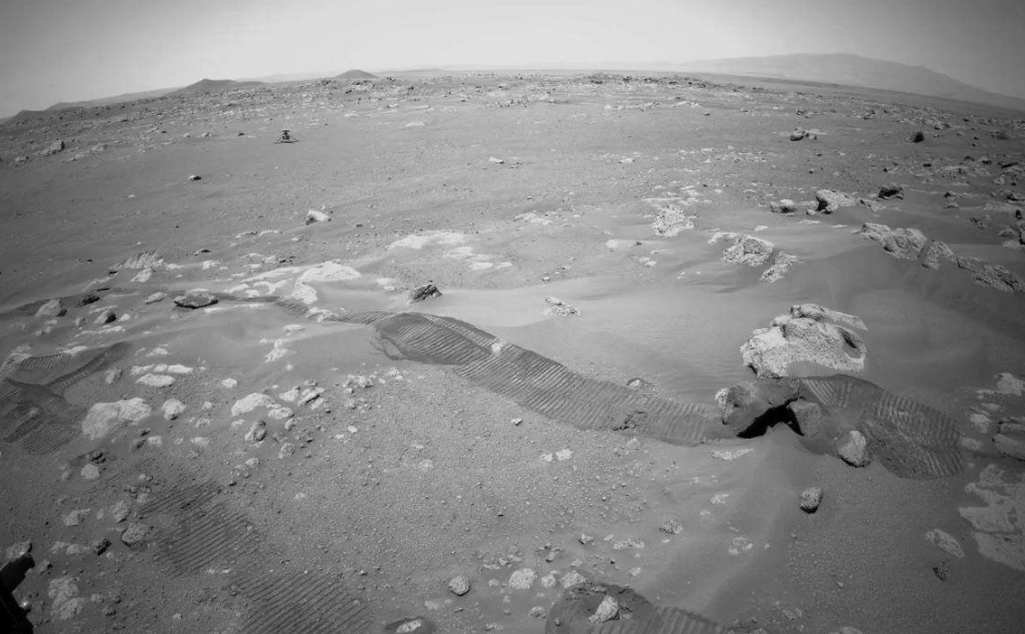
The six-wheeled explorer surpassed Opportunity’s long-standing distance record on October 11, 2026, as it investigates ancient Martian rocks and searches for evidence of past life.
NASA’s Perseverance rover has set a new record for the greatest distance driven by a vehicle on another world. On October 11, 2026, the six-wheeled explorer reached 28.10 miles (45.22 kilometers) on Mars, surpassing the previous record of 28.06 miles (45.16 kilometers) held by NASA’s Opportunity rover.
Perseverance achieved the milestone on its 2,006th Martian day, or sol, after landing in February 2021. It traveled farther in approximately five and a half years than Opportunity managed during nearly 15 years of exploration.
NASA announced the achievement October 12, confirming that Perseverance remains in excellent operating condition. The rover is continuing its investigation of ancient Martian terrain while preparing for further exploration beyond the western rim of Jezero Crater.
The record-breaking drive covered 299.6 feet (91.31 meters) and took Perseverance past Opportunity’s final distance. NASA’s Jet Propulsion Laboratory in Southern California manages the rover’s operations and oversees its continued scientific mission.
The achievement reflects decades of improvements in robotic mobility, navigation software and mission planning. Today’s Mars rovers can travel greater distances while making many driving decisions without waiting for detailed commands from Earth.
Exploring the Ancient Landscape of Mars
Perseverance landed in Jezero Crater on February 18, 2021, with the primary goal of searching for signs of ancient microbial life. Scientists selected the crater because evidence suggests it once contained a lake and a river delta billions of years ago.
Water is considered an important ingredient for life as scientists understand it. Ancient lakebeds and river deposits may preserve chemical or geological evidence of environments that could once have supported microorganisms.
During its early mission, Perseverance explored the crater floor before reaching the remains of an ancient river delta in April 2022. The rover examined rock layers that could provide information about the planet’s wetter past.
Its scientific instruments analyze minerals, chemical compositions and geological structures. Researchers use this information to reconstruct conditions that existed on Mars long before the planet became the cold, dry world observed today.
The rover has since climbed beyond the crater floor and begun investigating terrain along the western rim. Its current exploration area, known as Lac de Charmes, contains rocks estimated to be approximately four billion years old.
Scientists believe some of these formations may preserve evidence from the earliest stages of Martian history. Comparable rocks on Earth have often been altered or destroyed by geological activity, erosion and the movement of tectonic plates.
Perseverance is now traveling toward a location called Idubi. Researchers hope to investigate possible remnants of ancient hydrothermal systems, where heated water may once have interacted with surrounding rocks.
Such environments are scientifically valuable because hydrothermal activity can create chemical conditions favorable to microbial life. Finding evidence of an ancient hydrothermal system would help researchers assess whether the region was once habitable.
NASA has also identified another destination for the extended mission. After exploring Lac de Charmes, Perseverance is expected to continue south along the crater rim toward Rainbow Falls, a large block of ancient crust lifted during the impact that formed Jezero Crater.
Self-Driving Technology Helps Rover Cover More Ground
One of the main reasons Perseverance has traveled so far is its autonomous navigation system, known as AutoNav. The technology allows the rover to evaluate obstacles and select safe routes while traveling across the Martian surface.
Earlier rovers depended more heavily on engineers on Earth to plan their movements. Because signals take several minutes to travel between Earth and Mars, controllers cannot operate a rover as they would a remote-controlled vehicle nearby.
Perseverance uses onboard cameras and computing systems to examine the landscape and build three-dimensional maps. It identifies potential hazards, including rocks and difficult terrain, before determining how to reach destinations selected by mission planners.
NASA reports that Perseverance has completed more than 90% of its driving distance using AutoNav. By comparison, the early autonomous navigation systems aboard Opportunity and its twin rover, Spirit, accounted for approximately 5% of their travels.
The difference in computing capabilities is substantial. NASA’s first Mars rover, Sojourner, evaluated about 20 measurement points when assessing a route, while Perseverance processes approximately 600,000 points with each observation.
These improvements allow the rover to continue moving while calculating its next path. NASA describes the capability as thinking while driving.
Perseverance can cover as much as 1,351 feet (412 meters) during a single Martian day under favorable conditions. Its maximum driving speed is approximately 0.1 miles per hour, much slower than an ordinary walking pace.
Steven Lee, project manager for the Curiosity and Perseverance rovers at NASA’s Jet Propulsion Laboratory, said advances in technology have made longer drives increasingly routine.
The mission originally planned for Perseverance to travel no more than 12.4 miles. Having more than doubled that distance, the rover continues operating with its mobility systems fully functional.
Lee said the successful performance of those systems gives engineers confidence that Perseverance can continue extending the record for years.
Previous Mars Rovers Established the Milestones
Perseverance’s achievement builds on nearly three decades of NASA robotic exploration on Mars. Each generation of rovers has introduced technological improvements that expanded the distances scientists could explore.
Sojourner, the first successful Mars rover, landed in 1997 and traveled approximately 330 feet during its 83-sol mission. Although its total distance was modest, it demonstrated that a wheeled robot could successfully operate on another planet.
Spirit and Opportunity arrived on Mars in January 2004. Both were designed for missions lasting just 90 Martian days, but they continued operating far beyond their expected lifetimes.
Spirit traveled 4.8 miles before its mission ended. Opportunity drove 28.06 miles and operated until a major dust storm interrupted communications in June 2018.
NASA formally declared Opportunity’s mission complete in February 2019 after unsuccessful attempts to restore contact.
Curiosity, which landed in Gale Crater in August 2012, has traveled more than 23.65 miles. It remains active and continues studying Martian geology and environmental history.
Perseverance also surpassed distance records established on the Moon. Apollo 17 astronauts traveled approximately 22.2 miles using their lunar rover in 1972, while the Soviet Union’s robotic Lunokhod 2 covered about 24.2 miles in 1973.
These earlier missions helped establish methods for operating robotic vehicles in environments where direct human control is limited or impossible.
Search for Ancient Life Continues
Distance records are not the primary objective of the Perseverance mission. Its main scientific purpose remains investigating whether Mars once supported microbial life and collecting samples that could help answer that question.
NASA reports that Perseverance has collected 29 rock and regolith samples from locations across Jezero Crater. Regolith refers to the loose soil, dust and broken rock covering the surface.
One of the rover’s most important discoveries involved a rock named Cheyava Falls. Scientists identified chemical and mineral features that may represent a potential biosignature.
A biosignature is a substance, structure or pattern that could indicate biological activity. However, similar features can sometimes form through processes that do not involve life.
NASA has emphasized that the Cheyava Falls findings do not establish that life ever existed on Mars. More research would be needed to determine whether the unusual features have a biological explanation.
Returning samples to Earth could allow scientists to examine Martian material with laboratory instruments too large or complicated to carry aboard a rover.
However, the future of the Mars Sample Return effort remains uncertain. NASA’s fiscal 2026 budget documents called for terminating the existing program because proposed mission designs were considered unaffordable.
The agency has indicated that returning Martian samples could still be pursued through future missions. No confirmed replacement schedule guarantees that Perseverance’s collected samples will reach Earth.
Mission Extended Through 2028
NASA recently approved the first extension of Perseverance’s mission, beginning in October 2026. The extension supports continued scientific work along the rim of Jezero Crater through approximately the end of 2028.
Engineers are also examining how long the rover’s driving equipment can remain reliable in the harsh Martian environment. Dust, extreme temperature changes and rugged terrain place continuing demands on its wheels, motors and electronic systems.
The mission team believes Perseverance could potentially travel considerably farther if its equipment continues performing well. Testing has supported the possibility of a total driving distance exceeding 62 miles (100 kilometers).
For researchers, the expanded driving range provides access to rock formations that would otherwise be difficult to examine during a robotic mission. Each additional destination offers another opportunity to investigate the history of water, geological activity and potentially habitable environments.
Perseverance will continue toward Idubi before heading farther south along the crater rim during its extended mission. Its next scientific investigations will focus on ancient geological formations that may preserve evidence of conditions on Mars billions of years ago.
IMAGE: Credit: NASA/JPL-Caltech · NASA imagery, generally public domain in the United States, subject to NASA’s media-use guidelines.