
Half a century after the first successful landing on Mars, NASA continues to build upon its early achievements. The Viking 1 mission touched down in 1976, marking the beginning of long-term exploration of the Red Planet. That historic event brought back the first detailed color images from Mars and began the search for life beyond Earth. The mission lasted far longer than expected, giving scientists a deeper understanding of Mars than ever before.
Since Viking, NASA has sent several more missions to Mars. Pathfinder arrived in 1997 with a small rover named Sojourner. It found evidence that water once flowed on the surface. This discovery changed how NASA approached Mars exploration. Future rovers like Spirit, Opportunity, Curiosity, and Perseverance have all contributed to this growing knowledge. These machines have explored different regions of Mars and found signs of ancient environments that could have supported life.
Perseverance has become one of the most active rovers on Mars. It recently completed a marathon distance across the Martian surface. The rover has been driving for over five years, covering more ground than any previous mission. Its journey is tracked by orbiters, which capture images showing the path it has taken. Scientists use these tracks to understand how the terrain affects movement and planning.
In addition to rovers, NASA has also explored new ways of moving through Mars’ skies. The Ingenuity helicopter demonstrated that flight is possible in the thin Martian atmosphere. It flew many times over nearly three years, proving that aerial exploration can be useful. Future missions may include more advanced helicopters that could map hidden ice deposits and study weather patterns.
NASA’s work on Mars is not just about robots. The agency also prepares for human missions through simulations. Volunteers are selected to live in isolated habitats that mimic conditions on the Moon or Mars. These tests help researchers understand how people behave under long-term confinement and stress. The goal is to learn how to support crew health during deep space travel.
NASA continues to work with private companies to develop new technologies for space exploration. In 2025, the agency selected proposals from businesses to improve systems for transportation, landing, and energy use. These partnerships help speed up development while reducing costs. Many of these innovations are designed for future missions to Mars and the Moon.
The Viking missions set a foundation for all that followed. Engineers at NASA’s Langley Research Center helped design safe ways to land on Mars. They developed systems for entering the atmosphere, slowing down, and touching down without crashing. These methods are still used today in missions like Curiosity and Perseverance.
Looking ahead, NASA plans more ambitious steps. Missions to Mars will require new tools and techniques. The agency is working on ways to return samples from Mars to Earth for detailed study. It also explores how to build habitats and sustain life on other worlds. These efforts are part of a larger vision that includes not just exploration but eventual settlement.
Even with all these advancements, reaching Mars remains a challenge. The main obstacle is funding. Sending people to another planet requires massive resources. Private companies like SpaceX have proposed plans for large-scale colonization. Their goals include sending thousands of settlers to Mars over decades.
The legacy of Viking 1 lives on in every mission that follows. It showed that Mars could be explored and studied in detail. Today, scientists continue to search for signs of life, using more advanced tools than ever before. Each new rover brings fresh insights into the history and potential of the Red Planet.
As NASA prepares for future missions, it draws on lessons from the past. The early Viking team showed that success comes through careful planning, strong engineering, and teamwork. These principles guide all current efforts to explore Mars. Whether with rovers or humans, the goal remains the same: to understand our place in the universe and expand what we know about other worlds.
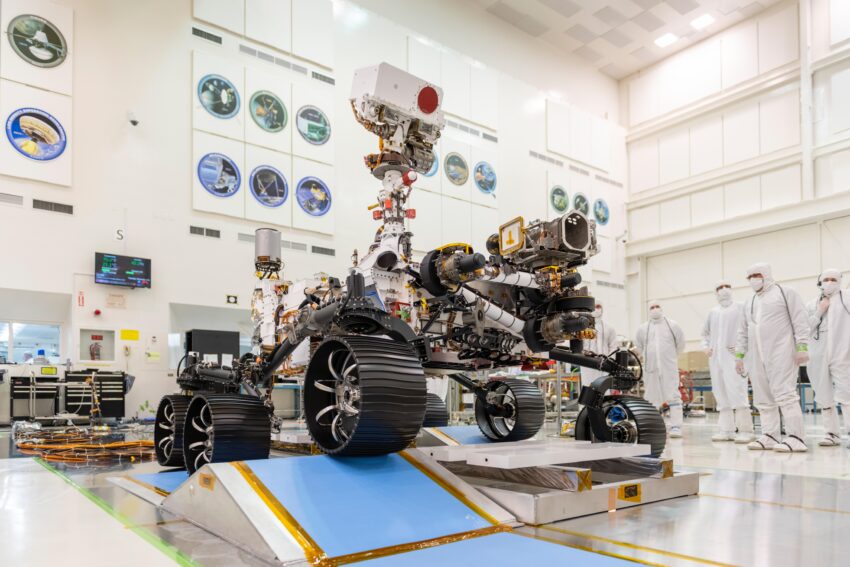
IMAGE: Mars 2020 Rover Is Roving
https://www.jpl.nasa.gov/spaceimages/details.php?id=PIA23499
In a clean room at NASA’s Jet Propulsion Laboratory in Pasadena, California, engineers observed the first driving test for NASA’s Mars 2020 rover on Dec. 17, 2019.
Scheduled to launch as early as July 2020, the Mars 2020 mission will search for signs of past microbial life, characterize Mars’ climate and geology, collect samples for future return to Earth, and pave the way for human exploration of the Red Planet. It is scheduled to land in an area of Mars known as Jezero Crater on Feb. 18, 2021.
JPL is building and will manage operations of the Mars 2020 rover for NASA. NASA’s Launch Services Program, based at the agency’s Kennedy Space Center in Florida, is responsible for launch management.
For more information about the mission, go to https://mars.nasa.gov/mars2020/.. Photo: NASA/JPL-Caltech / Wikimedia, taken 2019-12-17, Attribution
This article passed automated originality and source-verification checks before publishing.