
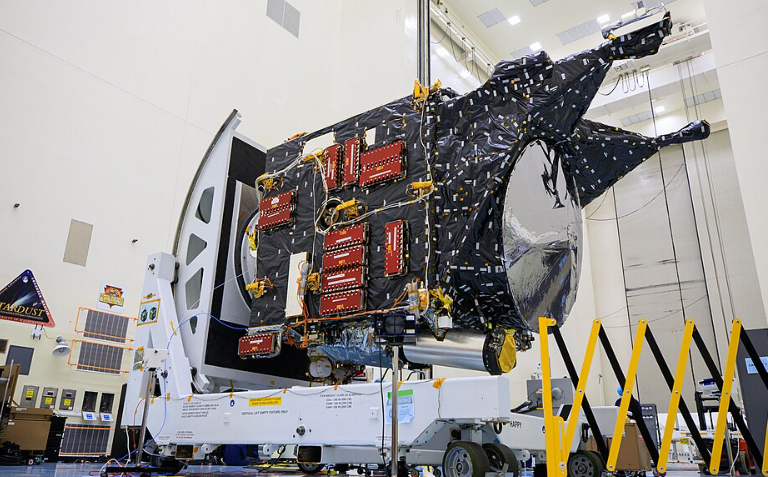
A spacecraft on its way to study a metal-rich asteroid has taken remarkable images of Mars. The Psyche mission used the red planet’s gravity to change its course and speed up for the journey ahead. While doing so, it captured many photos and data points from the planet. These include time-lapse videos showing how Mars appeared as the spacecraft approached and left the area.
The flyby happened on May 15. During that time, Psyche was flying close enough to take detailed pictures of the surface. It also recorded images of Mars’ atmosphere reacting to solar winds and particles hitting its surface. The mission’s instruments were not specifically designed for this kind of planetary study, but they still gathered useful information.
One of the most striking results is a time-lapse video made from daily shots taken over a month. This video shows Mars as it moved across the sky from the perspective of the spacecraft. The angle gave the images an eye-like shape. The video was compressed into one minute and fifteen seconds, showing some of the best views ever taken of Mars from space.
The spacecraft also photographed a large crater named Fournier and a long cliff system called Oenotria Scopuli. It spotted both of Mars’ small moons, Phobos and Deimos, from far away. These images helped test how well the mission’s camera works and prepared it for future searches around the asteroid Psyche.
The mission team didn’t expect to find anything new about Mars itself. But the data adds to what scientists already know. The spacecraft’s instruments were tested during this flyby, especially its camera. Jim Bell, who leads the imaging team, said that the camera delivered rare views of the planet and helped check how sensitive it is to light.
NASA’s Psyche spacecraft was launched in October 2023. It will travel about 2.2 billion miles to reach the asteroid belt between Mars and Jupiter. The goal is to study an object named Psyche, which scientists believe may be a leftover core from an early planet. This mission could help explain how Earth’s own core formed.
The gravity assist maneuver helped Psyche gain speed without using much fuel. It also gave engineers a chance to test the spacecraft’s systems. The mission team at NASA’s Jet Propulsion Laboratory planned this flyby carefully. The spacecraft passed by Mars at about 12,333 miles per hour. It had already been speeding up since launch but needed the extra boost from the planet.
The mission is part of a long effort to explore our solar system. Past missions like Viking gave humanity its first views from the surface of Mars. Since then, many other probes have studied the planet’s geology and climate. Now, Psyche continues that work by capturing new images and data.
In addition to Mars, NASA is working on other space projects. One such mission is NISAR, a satellite that uses radar to observe Earth. It has released early data showing changes in land and ice masses. Some of these images look like natural wonders, including one that resembles a hummingbird.
Another ongoing event is the Perseid meteor shower. Each year, Earth passes through debris left by comet Swift-Tuttle. These particles burn up in our atmosphere, creating bright streaks of light. The peak viewing time for this year’s shower is early morning hours around August 12 or 13.
The Perseids are named after the constellation Perseus, where the meteors appear to come from. They travel at high speed and often leave green trails in the sky. People can watch them without special equipment, though a camera helps capture the moment.
NASA continues to explore both Mars and Earth through its many missions. The Psyche spacecraft is just one part of this broader effort. As it moves toward its final destination, it keeps gathering valuable information about space and our place in it.
IMAGE: Psyche Spacecraft Unwrapped This file is in the public domain in the United States because it was solely created by NASA
This article passed automated originality and source-verification checks before publishing.