
Two spacecraft bound for Mercury have separated from their transport module, marking a key step in a nearly decade-long journey through the solar system. The European Space Agency and Japan Aerospace Exploration Agency jointly launched the mission in 2018, naming it after an Italian mathematician who worked on NASA’s Mariner 10 mission decades ago. Only one other spacecraft, NASA’s Messenger, has ever orbited Mercury, making this second mission a significant step in planetary science.
The BepiColombo mission has already traveled more than six billion miles, using several planetary flybys to adjust its course and reduce speed, according to eastbaytimes.com. The most recent flyby occurred in January 2025, offering high-resolution images of Mercury’s surface features like impact craters and volcanic plains. The spacecraft is now about two million miles from Mercury, with the final approach expected to take place sometime after November.
Once it enters orbit, the two-part spacecraft will split into separate components to study Mercury from different altitudes and angles. The European Mercury Planetary Orbiter, or MPO, will focus on the planet’s surface, magnetic field, and interior structure, according to a report from Space.com. The Japanese Mercury Magnetospheric Orbiter, or Mio, will concentrate on the planet’s magnetosphere and how it interacts with solar wind.
The mission is designed to answer questions about Mercury’s formation, its unusual magnetic field, and the presence of ice in permanently shadowed craters. Scientists are especially eager to examine Mercury’s surface for elements that may have been vaporized from rocks, a puzzle left unsolved by the Messenger mission. The planet presents a strange mix of conditions, with surface temperatures reaching over 800 degrees Fahrenheit while its poles remain extremely cold.
Engineers had to design the spacecraft to withstand intense heat, comparing the challenge to operating in a very hot oven. The mission has cost about 7 billion euros and is expected to provide new insights into the inner solar system’s history. Although instruments have been active during flybys, most of the science work will begin once the spacecraft enters orbit.
The data collected by BepiColombo will help scientists understand how Mercury formed and why it differs so much from other rocky planets. The mission is expected to reveal more about the planet’s magnetic field, which is offset from its core in a way that has puzzled scientists. One of the most exciting aspects of the mission is the chance to observe Mercury’s southern hemisphere in detail for the first time.
The spacecraft’s cameras have already captured images of deep craters where water ice may exist in permanently shadowed regions. The mission’s success depends on the ability of both spacecraft to function properly under extreme conditions near the sun. This is not just another planetary mission, but a complex effort to unlock one of the solar system’s most mysterious worlds.
The scientific community is watching closely as BepiColombo prepares to enter Mercury’s orbit and begin its detailed exploration.
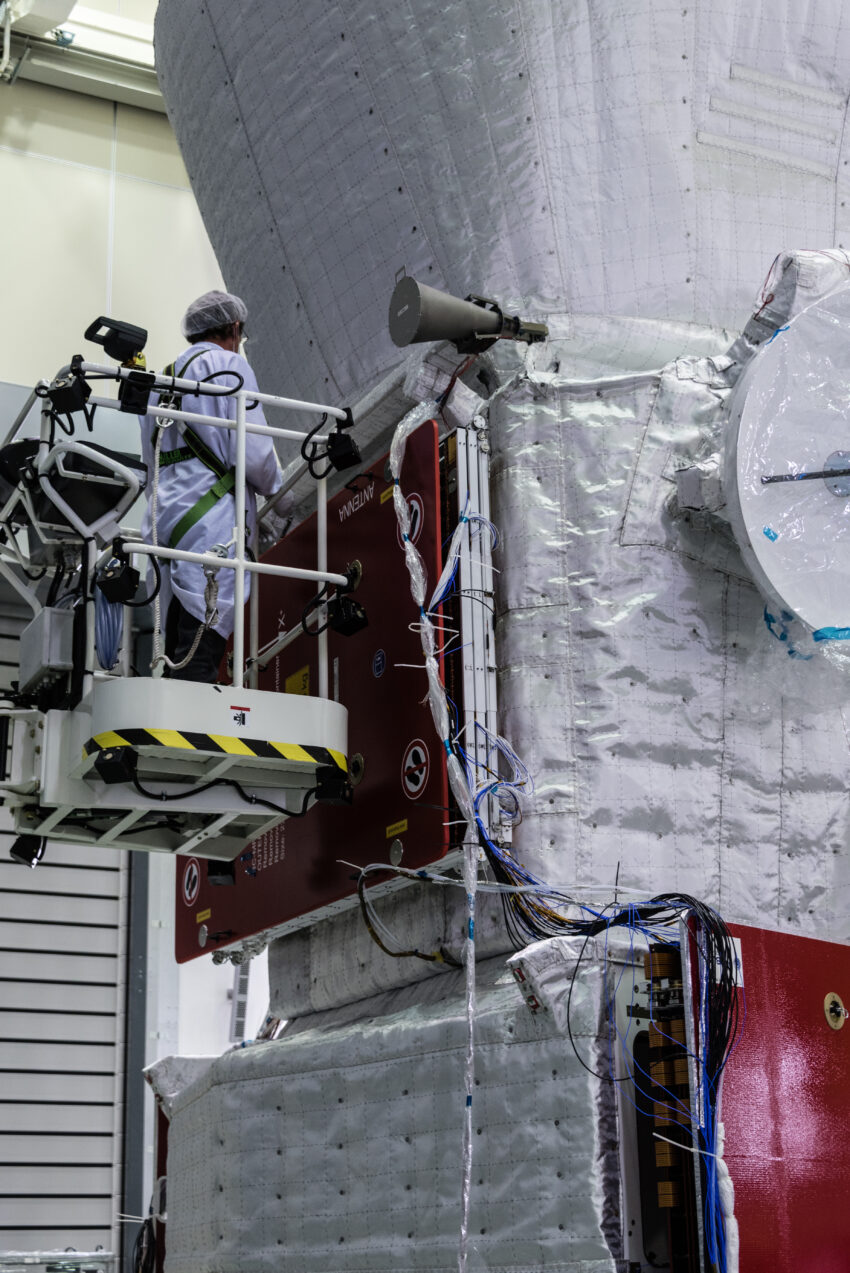
IMAGE: Examining the BepiColombo stack in ESA’s test centre. The person gives a sense of scale of the full spacecraft stack, which is more than 6 m high.
Although not fully visible in this view, the Mercury Transfer Module is at the bottom, the Mercury Planetary Orbiter is in the middle, and the Mercury Magnetospheric Orbiter’s Sunshield and Interface Structure is seen at the top. The red panels are covers protecting the folded solar wings, and will be removed before flight. The white covering on the spacecraft is a thermal blanket to help protect the craft from the high temperatures that will be experienced operating close to the Sun. The horn-shaped object on the corner of the Mercury Planetary Orbiter is the spacecraft’s medium gain antenna; it is fixed to a boom that will be deployed after launch.. Photo: ESA–C. Carreau / Wikimedia, taken 2017-07-05, CC BY-SA 3.0 igo