
The New Horizons spacecraft has emerged from a nearly yearlong sleep in deep space. It was placed into hibernation mode on August 7, 2025, and woke itself up on June 23, 2026. The probe is now more than 5.9 billion miles from Earth. Flight controllers at Johns Hopkins Applied Physics Laboratory confirmed that all systems are in good health. The spacecraft has been operating normally since waking up.
This was the longest hibernation period for New Horizons. It has entered this state many times during its journey. Hibernation helps reduce power consumption and extends the mission life of the probe. During these periods, most of the spacecraft remains unpowered. However, it continues to collect data using its instruments.
The spacecraft launched in 2006 and became the first to explore Pluto up close in 2015. It later flew by a Kuiper Belt object named Arrokoth in 2019. Since then, New Horizons has continued traveling through space. It is now approaching the edge of the solar system. The area it is heading toward is known as the heliopause. This is where the sun’s influence ends and interstellar space begins.
New Horizons is not the only spacecraft working far from Earth. The Voyager probes are also in deep space, but they have been operating for decades. New Horizons is currently the farthest active spacecraft in our solar system. It is on a trajectory that will take it through the outer layers of the sun’s influence.
The probe’s instruments continue to gather data even while hibernating. These include sensors measuring plasma and space dust. The data collected during sleep periods will now be transmitted back to Earth. It takes about 8 hours and 52 minutes for signals from New Horizons to reach mission control on Earth. This delay increases as the spacecraft moves farther away.
Scientists plan to study hydrogen gas in the outer heliosphere using an ultraviolet spectrograph. They also want to analyze solar wind and energetic particles. The data will help understand how the sun interacts with space beyond its edge. The probe’s mission is not over yet. It may continue to explore other objects in the Kuiper Belt.
New Horizons has been in hibernation 23 times since launch. Each time, it wakes up on schedule. The spacecraft uses stored commands to restart itself. Mission operators check health and safety data before beginning science operations. This process ensures everything is working properly before collecting more information.
The probe’s journey through space has taken it past the orbit of Pluto. It is now traveling in a region filled with icy bodies. These objects are remnants from the early solar system. Some may be similar to Arrokoth, which New Horizons studied closely in 2019. The spacecraft could encounter more of these distant worlds in the future.
New Horizons has already made history by exploring Pluto and Arrokoth. Its next steps will help scientists understand what lies beyond our solar system. It is designed to keep operating as long as possible. The mission team is updating systems to support continued operations. This includes software upgrades and new autonomy logic for the spacecraft.
The probe’s long journey has shown how far humans can send machines into space. Its success reflects years of planning and engineering. The data it sends back helps expand knowledge about our solar system and beyond. Scientists look forward to more discoveries from this distant explorer.
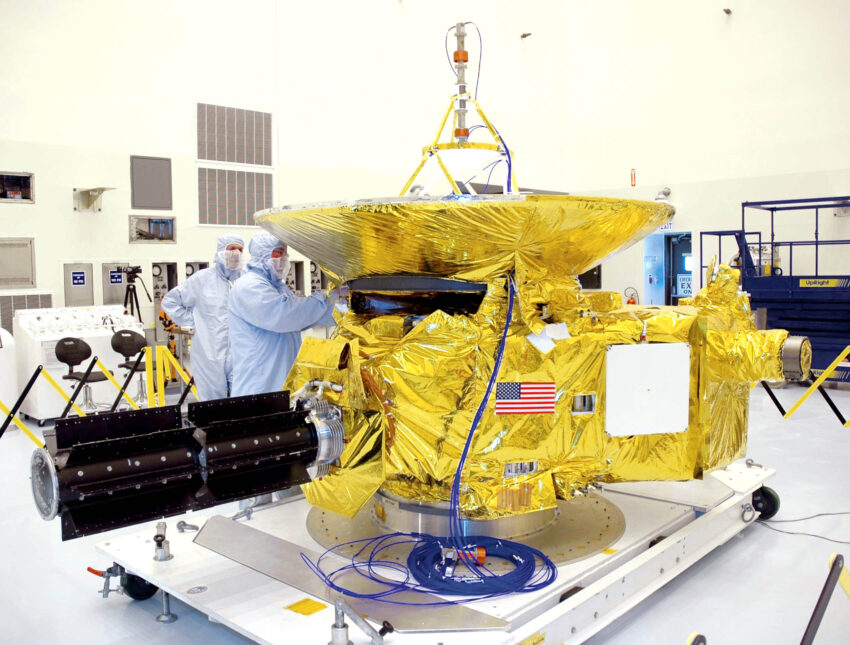
IMAGE: In the clean room at KSC’s Payload Hazardous Servicing Facility, technicians prepare the New Horizons spacecraft for a media event. Photographers and reporters will be able to photograph the New Horizons spacecraft and talk with project management and test team members from NASA and the Johns Hopkins University Applied Physics Laboratory.
The RTG seen in this picture is not the real flying unit and is only a mockup. The real RTG was installed shortly before launch.. Photo: NASA / Wikimedia, taken 2005-11-04, Public domain
IMAGE: In the clean room at KSC’s Payload Hazardous Servicing Facility, technicians prepare the New Horizons spacecraft for a media event. Photographers and reporters will be able to photograph the New Horizons spacecraft and talk with project management and test team members from NASA and the Johns Hopkins University Applied Physics Laboratory.The RTG seen in this picture is not the real flying unit and is only a mockup. The real RTG was installed shortly before launch.. Photo: NASA / Wikimedia, taken 2005-11-04, Public domain
This article passed automated originality and source-verification checks before publishing.