
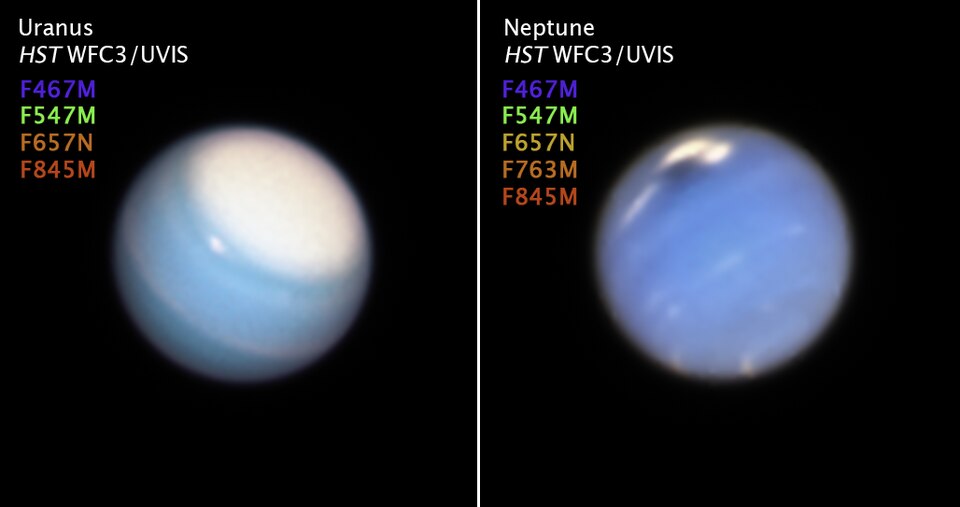
Before the Voyager 2 flyby in the late 1980s, Uranus and Neptune were seen as cold, unremarkable planets at the edge of our solar system. The spacecraft’s visit revealed these worlds to be far more dynamic and complex than previously thought.
Although Voyager confirmed that both planets are ice giants, scientists continue to debate their exact internal makeup, according to Gizmodo. A new study now suggests these distant planets may not have icy interiors after all.
Researchers from the University of California propose that Uranus and Neptune could be better described as magma-ocean giants. This idea comes from a study submitted to The Astrophysical Journal, which explores how these planets’ interiors might work.
NASA’s Voyager 2 remains the only spacecraft to have visited both Uranus and Neptune. On January 24, 1986, it flew within about 50,640 miles of Uranus, discovering 11 new moons and two new rings.
A year later, on August 25, 1989, it passed by Neptune’s north pole, finding six new moons and four ring arcs. Most of what we know about these two planets comes from that single flyby, leaving many mysteries still unsolved.
Because they have never been thoroughly studied, scientists are uncertain where Uranus and Neptune formed in the early solar system. They also do not fully understand why these planets have such chaotic magnetic fields.
Traditionally, scientists believed both worlds have a hydrogen/helium atmosphere covering a thick layer of ice made mostly of water, ammonia, and methane, with a rocky core underneath. However, the new study notes that this three-layer model may not be the only way to explain what scientists observe about these planets.
The researchers also point out that objects from the Kuiper Belt, which are thought to show how the outer solar system formed, are mostly rock rather than ice. For this recent research, scientists modeled different interior structures for Uranus and Neptune.
The model that best fits the data suggests these planets have a well-mixed magma ocean with dissolved hydrogen at the bottom and a hydrogen-rich layer on top. At high pressures, hydrogen can dissolve into magma, forming a fluid that mixes well.
This mixing could help explain the planets’ density, which was once taken as proof of an ice-rich core. Whether scientists will fully accept this new classification is still uncertain.
Still, the findings may help researchers understand similar worlds beyond our solar system known as sub-Neptune exoplanets.
In January 1986, Voyager 2 made its closest approach to Uranus and took the only detailed measurements ever made of that planet, according to a report from SpaceDaily. That flyby remains the only visit to Uranus by any spacecraft so far.
Much of what we know about Uranus depends on that single encounter. A reanalysis from late 2024 suggests this flyby happened at a particularly unusual time.
The team behind the study looked closely at solar wind data from around that period. They found that Voyager 2 passed by during an extreme compression of the solar wind.
The pressure was about 20 times higher than it had been just a week earlier. This timing is rare — the team estimates such conditions occur less than five percent of the time during an eight-month window around Uranus’s orbit.
If this analysis holds true, it changes how scientists interpret the data from that flyby. The unusual solar wind conditions may explain some of the strange features Voyager observed.
Jamie Jasinski, a space plasma physicist at NASA’s Jet Propulsion Laboratory, led the research team. He noted that if Voyager had arrived just a few days earlier, it would have seen a very different magnetosphere.
The study doesn’t argue that all of Voyager’s findings were wrong, but rather how to interpret some of the data. Knowing about the extreme solar wind conditions beforehand would have led scientists to question their measurements more carefully.
The deeper issue is that one flyby cannot tell the difference between a planet’s normal state and an unusual day. This realization supports the idea of sending a spacecraft to orbit Uranus for years instead of just flying by.
The planetary decadal survey has identified an orbiter and probe mission to Uranus as the top priority for future space exploration. Such a mission would be better suited to study long-term changes in the planet’s environment.
The lesson from Voyager is not that it got Uranus wrong, but that one snapshot taken during an extreme event may not reflect what is typical.
IMAGE: A. Simon (NASA Goddard Space Flight Center), and M.H. Wong and A. Hsu (University of California, Berkeley) / Wikimedia Commons (Public domain)
This article passed automated originality and source-verification checks before publishing.