
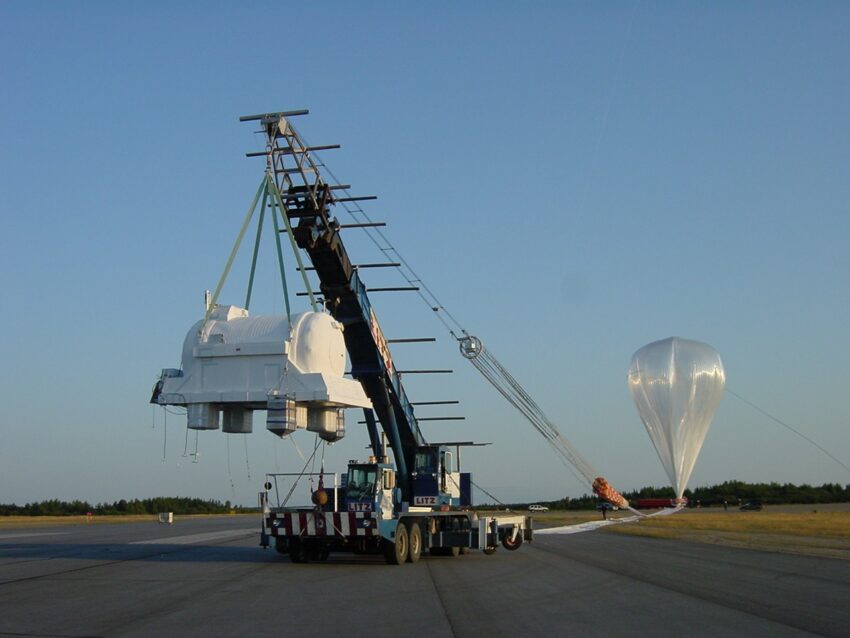
A massive NASA balloon lifted off from the Northwest region of Manitoba, Canada, on August 25, embarking on a journey that reached the outer limits of Earth’s atmosphere. The balloon, with a volume of 60 million cubic feet (1.7 million cubic meters), was the largest ever launched successfully by NASA. It carried a scientific instrument called Low Energy Electrons, or LEE, weighing 1,500 pounds and developed by Dr. Paul Evenson of the University of Delaware.
This flight was part of a series of experiments studying cosmic electrons and was conducted using instruments LEE and AESOP, which were previously flown in earlier missions. The balloon’s design used very thin polyethylene material, similar to a sandwich wrap, and was built to withstand the extreme conditions of high-altitude flight. The system included not only the balloon itself but also a parachute and payload that carried scientific instruments for data collection.
This mission was notable not just for its record-breaking size but also for its potential to advance ultra-violet and x-ray astronomy research. The balloon’s flight lasted over 23 hours, reaching an altitude of nearly 134,000 feet, or about 41 kilometers above the Earth. After completing its scientific mission, a command was sent from the ground to detach the payload from the balloon.
The balloon then began to descend, with a parachute helping to bring the instrument safely back to Earth. Teams of scientists were quickly transported to the landing site to retrieve data tapes and analyze results from the experiment. The LEE instrument was refurbished and launched again on August 25, this time on a balloon with even greater volume.
Previous launches of similar instruments have taken place from the same location in Lynn Lake, Manitoba, over a span of years. The project involved funding and support from both NASA and the National Science Foundation, with the LEE instrument developed by various institutions. Operations for these flights are managed by the National Scientific Balloon Facility in Palestine, Texas, under the oversight of NASA’s Goddard Space Flight Center.
The balloon used for this mission was manufactured at a facility in Sulphur Springs, Texas, which designs and builds NASA’s scientific balloons. In addition to large-scale missions like this one, smaller student-led experiments are also launched from the same facility each year. The Louisiana Aerospace Catalyst Experiences for Students, or LaACES, is a program that allows university teams to design and launch their own scientific instruments.
In May 2026, students from multiple Louisiana universities launched 11 payloads from Palestine, Texas, with each payload designed to study atmospheric science and cosmic rays. Each team went through a rigorous design process that mirrored NASA’s engineering standards before their payloads were cleared for flight. The student teams also received support from facility staff during helium fills and launch operations to ensure safe flights.
After the balloons reached near-space altitudes, they were tracked and recovered successfully within about an hour of landing. Students found great satisfaction in seeing their data behave as expected, which validated their efforts and inspired further interest in science careers. The program helps students understand how real scientific missions are planned, executed, and analyzed, offering a bridge between classroom learning and professional aerospace work.
LaACES has supported more than 500 students over the years and has launched over 60 balloon flights with nearly 135 unique payloads. By offering hands-on experience in scientific ballooning, LaACES helps prepare future scientists and engineers for careers in space research. The program is funded by NASA’s National Space Grant College and Fellowship program through the Louisiana Space Grant Consortium.
NASA continues to use balloons for a wide range of scientific missions, including astrophysics, atmospheric studies, and planetary research. The Hubble Space Telescope has inspired many innovations in space exploration, including educational models like the Lego Icons Hubble set. This Lego model includes detailed representations of key instruments such as the Space Telescope Imaging Spectrograph and Cosmic Origins Spectrograph.
The set also features accurate depictions of guidance sensors, solar array wings, and star trackers used by the real telescope. It includes a display stand with images of famous Hubble discoveries like the Eagle Nebula and Whirlpool Galaxy. The Lego set also includes an astronaut minifigure wearing a spacesuit, representing the crew who performed servicing missions on Hubble.
Designed to scale with minifigures, this model allows fans and students to explore the complexity of one of space’s most important telescopes.
IMAGE: Photo: Wikimedia, taken 2005-05-20, Public domain