
The rover has traveled more than 28 miles across Mars, surpassing Opportunity’s long-standing record. The milestone follows the historic flight achievements of Ingenuity and coincides with NASA’s Jet Propulsion Laboratory anniversary celebrations.
NASA’s Perseverance rover has set a new record for the greatest distance driven by a vehicle on another world, traveling 28.10 miles (45.22 kilometers) across Mars as of October 11, 2026. The achievement surpasses the previous record held by NASA’s Opportunity rover, which explored the Red Planet for nearly 15 years.
Perseverance reached the milestone on its 2,006th Martian day, approximately five and a half years after landing in Jezero Crater on February 18, 2021. The rover continues examining ancient rocks and collecting samples that could help scientists determine whether Mars once supported microbial life.
The record comes during a significant year for NASA’s Jet Propulsion Laboratory (JPL) in Southern California. The facility, which manages the Perseverance mission, celebrated its 90th anniversary with a public open house on October 10 and 11.
Perseverance Breaks Opportunity’s Mars Distance Record
NASA confirmed the achievement on October 12, reporting that Perseverance had traveled farther than any previous rover operating beyond Earth.
Opportunity previously held the record after covering 28.06 miles (45.16 kilometers) between 2004 and 2018. It remained active well beyond its original 90-day mission before losing contact during a major Martian dust storm.
Perseverance exceeded that distance in considerably less time.
According to NASA, the rover completed a drive of approximately 299.6 feet (91.31 meters) on October 11, pushing its total mileage beyond Opportunity’s record.
The achievement demonstrates improvements in robotic navigation, vehicle durability and mission operations.
Perseverance was originally designed to travel approximately 12.4 miles (20 kilometers). Its new record means it has already covered more than twice that planned distance.
The six-wheeled rover remains operational, with NASA expecting it to continue exploring the Martian surface during an extended scientific mission.
Autonomous Driving Technology Helps Rover Travel Farther
One of Perseverance’s most important technological advances is its ability to navigate difficult terrain with limited instructions from Earth.
The rover uses an autonomous navigation system called AutoNav, which allows it to recognize obstacles and plan safe routes while moving.
Earlier Mars rovers depended more heavily on detailed driving commands prepared by engineers on Earth. Perseverance can make many navigation decisions independently.
The system uses onboard cameras and computer processing to create three-dimensional maps of the surrounding terrain. It identifies potentially dangerous rocks, slopes and other obstacles before selecting a route around them.
NASA reports that more than 90% of Perseverance’s total driving distance has been completed using autonomous navigation.
By comparison, Opportunity and its twin rover, Spirit, used early autonomous navigation capabilities for approximately 5% of their travels.
Perseverance can cover as much as 1,351 feet (412 meters) during a single Martian day under suitable conditions.
The increased efficiency allows scientists to reach more distant research locations without spending as much time planning each movement.
This technology may also support future robotic missions exploring environments where communication delays make direct human control impractical.
Rover Searches Ancient Martian Terrain for Evidence of Water
Perseverance is currently investigating an ancient region near the western rim of Jezero Crater.
The rover has been traveling through an area informally called Lac de Charmes toward a location known as Idubi.
Scientists believe these regions contain some of the oldest exposed rocks examined during the mission.
Researchers are particularly interested in finding evidence of ancient hydrothermal activity, which occurs when heated water interacts with rock.
On Earth, hydrothermal environments can provide conditions suitable for microbial life.
Evidence of similar processes on Mars could help researchers understand whether parts of the planet once supported habitable environments.
However, evidence of ancient water or potentially habitable conditions is not proof that life existed on Mars.
Perseverance carries instruments designed to analyze rock chemistry, examine mineral structures and investigate possible signs of past biological activity.
The rover also collects carefully selected rock and soil samples, sealing them in tubes that could eventually be returned to Earth for detailed laboratory analysis.
NASA has extended its exploration plans through 2028, including investigations of additional ancient geological formations.
Ingenuity Mars Helicopter Made History With 72 Flights
Perseverance’s success is closely connected to another achievement in Martian exploration: NASA’s Ingenuity helicopter.
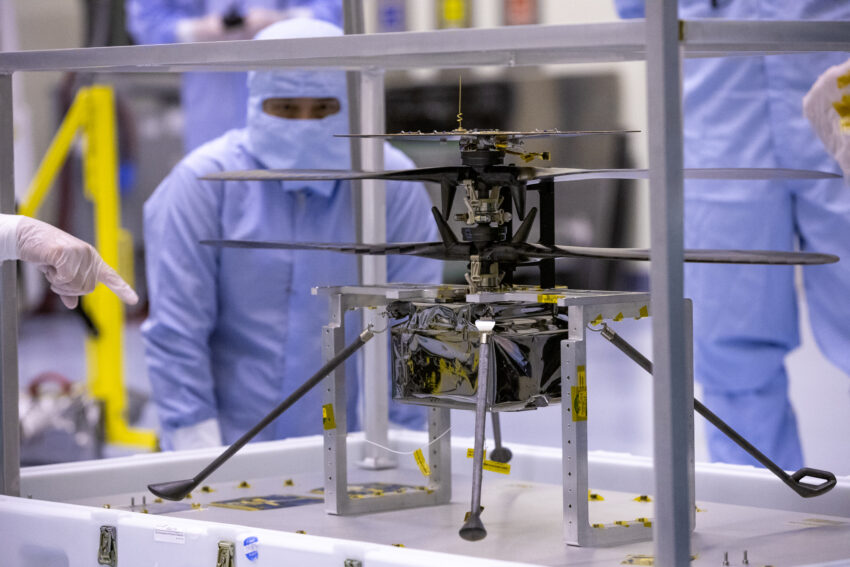
Ingenuity traveled to Mars attached to the underside of Perseverance and became the first aircraft to make a powered, controlled flight on another planet in April 2021.
The small helicopter was originally designed to complete up to five experimental flights over approximately 30 days.
Instead, Ingenuity completed 72 flights and traveled about 10.5 miles (17 kilometers) during nearly three years of operations.
Its flights demonstrated that powered aircraft could operate in Mars’ extremely thin atmosphere.
Ingenuity relied on lightweight construction, rapidly rotating blades and automated flight controls to remain airborne.
The helicopter also helped mission planners gain experience with aerial reconnaissance on another planet.
Engineers tested increasingly demanding flights, including longer journeys and operations over more complicated terrain.
The project eventually became an extended technology demonstration that operated far beyond its initial objectives.
Why Ingenuity’s Mission Ended in 2024
Ingenuity’s final flight took place on January 18, 2024.
During its 72nd flight, the helicopter experienced a hard landing that damaged its rotor blades and prevented further flying.
NASA formally announced the end of its flight mission on January 25, 2024.
Investigators later determined that the helicopter’s navigation system likely struggled to identify surface features in relatively smooth, sandy terrain.
That difficulty may have contributed to inaccurate estimates of its movement and the damaging landing.
Despite the accident, Ingenuity provided an extensive record of successful autonomous flights in an environment where aviation had never previously been demonstrated.
The lessons learned are expected to influence future planetary aircraft designs.
Ingenuity’s mission is complete, but its achievements remain an important part of NASA’s work toward developing new methods of exploring distant worlds.
NASA’s Jet Propulsion Laboratory Celebrates 90 Years
The new Perseverance distance record coincided with the 90th anniversary celebrations of NASA’s Jet Propulsion Laboratory.
Located in La Cañada Flintridge near Pasadena, California, JPL opened its facilities to registered visitors on October 10 and 11, 2026.
The free event, known as Explore JPL, gave members of the public an opportunity to learn about spacecraft development, robotic exploration and mission operations.
Visitors were invited to explore facilities associated with spacecraft assembly, precision manufacturing and communication with robotic missions.
The event featured four main areas: Missions That Changed the World, Moon to Mars, In Flight and Makerspace.
Tickets were made available through advance registration beginning August 29. All available reservations were claimed that morning.
JPL’s origins date to 1936, when a group of researchers began experiments involving rocket propulsion at the California Institute of Technology.
The laboratory later contributed to the launch of Explorer 1, the first successful American satellite, in 1958.
After NASA was established that year, JPL became one of the agency’s major research and mission centers while remaining managed by Caltech.
The laboratory subsequently directed or supported missions involving Voyager, Galileo, Cassini and numerous robotic explorers sent to Mars.
Today, its responsibilities include Perseverance and NASA’s Europa Clipper mission, which is traveling toward Jupiter’s moon Europa.
Perseverance Continues Its Extended Mars Mission
The rover’s record-setting journey is not the end of its scientific work.
NASA plans to continue studying ancient Martian terrain, particularly areas that may preserve evidence of past interactions between water and rock.
Researchers are also investigating minerals such as kaolinite, which can form through chemical processes involving water.
The discoveries could provide additional information about Mars’ environmental history and its potential to support microbial life billions of years ago.
Perseverance’s advanced navigation technology is expected to allow continued long-distance travel as the mission progresses.
NASA engineers are evaluating the rover’s mechanical systems to understand how much farther it may be capable of driving.
The milestone also provides a practical demonstration of technology that could support future robotic exploration.
While Ingenuity’s flying mission ended in 2024, the helicopter proved that aircraft could expand scientific access to locations beyond a rover’s reach.
Perseverance now holds the off-world driving distance record, while continuing to investigate some of the oldest geological features accessible on Mars.
Its next phase of exploration will focus on ancient terrain around Jezero Crater, where scientists hope to identify more evidence about the planet’s early history.
IMAGE: Functional testing of NASA’s Mars Helicopter and its cruise stage occurred in the airlock inside Kennedy Space Center’s Payload Hazardous Servicing Facility on March 10, 2020. The helicopter was tested on a stand while the cruise stage was tested on the rotation fixture. The helicopter will be attached to the Mars Perseverance rover during its mission, which is part of NASA’s Mars Exploration Program. Perseverance will land on the Red Planet on Feb. 18, 2021. Liftoff aboard a United Launch Alliance Atlas V 541 rocket is targeted for mid-July from Cape Canaveral Air Force Station. NASA’s Launch Services Program based at Kennedy is managing the launch.. Photo: Cory Huston / Wikimedia, taken 2020-03-10, Public domain