
Scientists at Syracuse University have identified a new species of amoeba that can survive in temperatures once thought impossible for complex life forms. The organism, named the fire amoeba, can reproduce at about 145 degrees Fahrenheit and survive brief exposure to temperatures up to 158 degrees Fahrenheit. This discovery challenges previous assumptions about how high temperatures can affect complex cells with nuclei and other internal structures.
The researchers found the amoeba in Lassen Volcanic National Park in northern California, a remote area known for its geothermal features, according to Gizmodo. They collected samples from a hot stream in the park and later observed the amoeba moving and reproducing at high temperatures. Beryl Rappaport, a PhD student in Angela Oliverio’s lab, was the first to notice the amoeba under the microscope.
The team confirmed that this organism can replicate at 145°F and remains active up to 147°F. It also protects itself in water as hot as 158°F by changing shape and forming a protective layer. The fire amoeba’s genome was different from other amoebas, showing unique adaptations for surviving extreme heat.
The organism is formally named Incendiamoeba cascadensis. The name means roughly “fire amoeba of the Cascade mountain range.” It set a new known upper temperature record for reproduction among eukaryotes. The previous record was about 140°F or 60°C and was held by certain fungi and red algae.
Researchers found that the organism expresses genes to maintain cellular integrity and repair DNA at high temperatures. It also has mechanisms for keeping proteins stable, similar to those seen in hardy bacteria and archaea. This finding suggests that complex life may be more adaptable than previously believed.
Researchers also found an enrichment of genes connected with protein maintenance, genome stability and sensing the surrounding environment. The findings may help explain how a cell with complex internal structures can continue functioning at temperatures that would destroy many other eukaryotic cells.
The study was published in the journal Cell, and it highlights how little we still know about life’s limits. Oliverio compared the discovery to breaking a long-standing athletic record, emphasizing that it proves what was once thought impossible is possible. She believes this amoeba could help in developing heat-resistant crops or medicines that work better across a range of temperatures.
The work had previously appeared as a preprint in November 2025. The peer-reviewed study was published in Cell in September 2026. NASA supported the research because studying the limits of life on Earth can also help scientists consider where life might survive beyond Earth.
Debashish Bhattacharya, an evolutionary biologist at Rutgers University who was not involved in the study, said it can be difficult to turn discoveries involving unusual organisms into practical advances but that such discoveries can still reveal important possibilities. He noted that some other extremophiles have more compact genomes while this amoeba has a larger genome than its relatives. Researchers are continuing to look for other heat-tolerant microbes and organisms that could reveal how common these adaptations are.
They also plan to study related species more closely to learn more about how they evolved these heat-tolerant features. The fire amoeba’s name reflects its ability to thrive in extreme heat, and it may be just the first of many such organisms. Oliverio said that more complex life forms capable of surviving high temperatures are likely still undiscovered.
Rappaport has said future work will examine the amoeba’s closest relatives to determine how its heat tolerance evolved. Researchers could then compare those species to determine which biological features are responsible for surviving extreme temperatures.
The discovery opens new doors for understanding how life adapts to extreme environments on Earth and beyond.
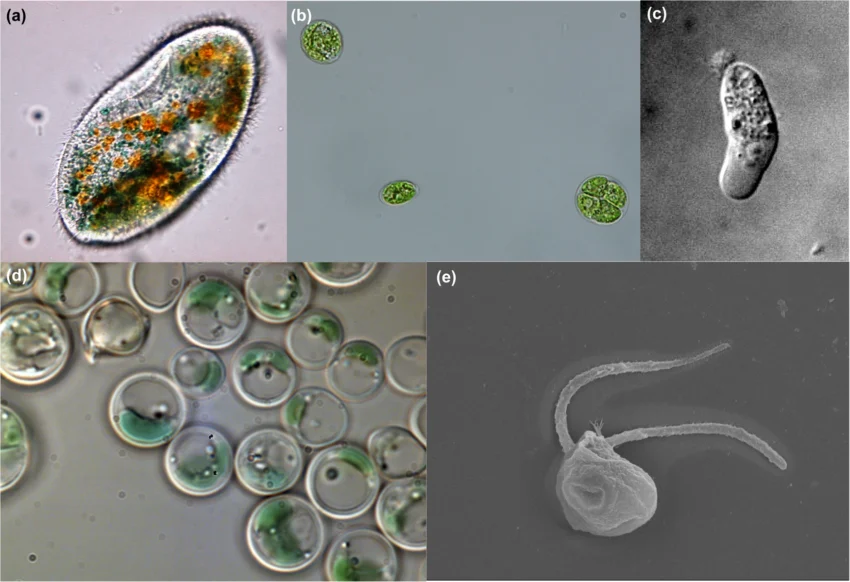
IMAGE: Examples of protists highlighting the morphological diversity of extremophiles. a Frontonia sp., an alkaliphilic ciliate from soda lakes in Kenya. Light microscope image courtesy of Geoffrey Odhiambo Ong’ondo (Egerton University). b Chlamydomonas pitschmanii Ettl, a strain of thermoacidophilic green algae isolated from hot spring soils. Light microscope image courtesy of Antonino Pollio (University of Naples Federico II). c Tetramitus thermacidophilus strain BSL, an amoeboflagellate from an acidic geothermal lake (Boiling Springs Lake) at Lassen Volcanic National Park in northern California, USA. DIC image courtesy of Gordon Wolfe (California State University, Chico), photographed by Billie Reeder. d Galdieria sulphuraria, a mixotrophic species of thermoacidophilic red algae, here growing under illumination. Light micrograph courtesy of Gerald Schöenknecht (Oklahoma State University, Heinrich-Heine-Universität Düsseldorf). e Halocafeteria seosinensis, a halophilic, heterotrophic nanoflagellate isolated from a saltern in Korea. SEM image courtesy of Jong Soo Park (Kyungpook National University).. Photo: Hannah B. Rappaport & Angela M. Oliverio / Wikimedia, taken 2023-08-16, CC BY 4.0