
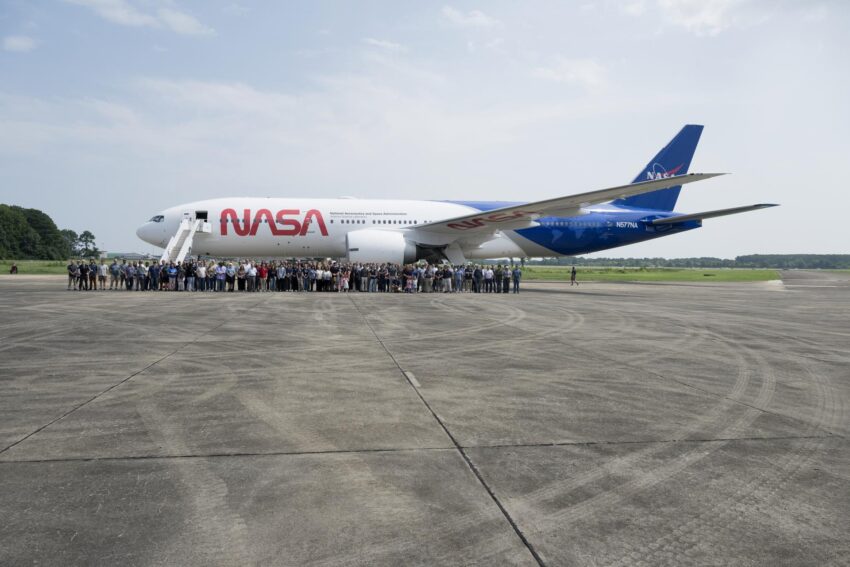
NASA’s Boeing 777-200ER has returned to the agency’s Langley Research Center in Hampton, Virginia, after receiving a new paint job. The aircraft was flown from a maintenance facility in Texas to Virginia’s Langley Research Center, where it arrived in August. The plane now features the iconic NASA logo and a world map on its fuselage, wings, and tailfin as part of its updated livery.
This new appearance marks the completion of extensive upgrades to the aircraft, including updates to communications systems, data arrays, and operator facilities, according to popsci.com. The Boeing 777 replaces NASA’s retired Douglas DC-8 flying laboratory, which had served the agency for over 35 years, according to a report from wavy.com. The DC-8 contributed to many scientific breakthroughs before its retirement in 2024, including early studies of Earth’s environmental systems.
NASA acquired the B777 to expand its research capabilities and support long-term scientific missions. The aircraft will be used for a wide range of Earth science projects when it begins operations from Langley in 2027. Once operational, the plane can carry 50 to 100 operators for up to 18 hours of continuous flight at a maximum altitude of 43,000 feet.
It will house a payload of 75,000 pounds of scientific instruments designed to study atmospheric chemistry, biology, ecology, oceanography, and more. The research plane will support satellite sensor calibration, data product validation, and field studies related to Earth system processes. NASA said the data collected during these missions will help improve computer models and support important decisions in environmental science.
Before arriving at Langley, the aircraft received ground maintenance in the hangar as part of its final preparations. The B777’s final flight to Langley was piloted by NASA pilot Taylor Thorson, who noted it marked his last time flying the aircraft. NASA’s Airborne Science Program will use the plane for global research missions that span multiple scientific disciplines.
The agency’s upcoming Earth science missions include studies in archaeology, hydrology, meteorology, soil science, and volcanology. NASA continues to prepare the aircraft for its role in future research projects that will advance understanding of Earth’s systems. The plane is now nearing the end of its upgrade phase and is expected to enter service in 2027.
IMAGE: NASA B777-200ER (N577NA) arrived at Langley Research Center’s Hangar with new paint livery Aug 12. It was flown by NASA pilot Taylor Thorson, as this marks his final flight. Photo Credit NASA/ Mark Knopp. Photo: NASA, Mark Knopp / Wikimedia, taken 2026-08-11, Public domain