
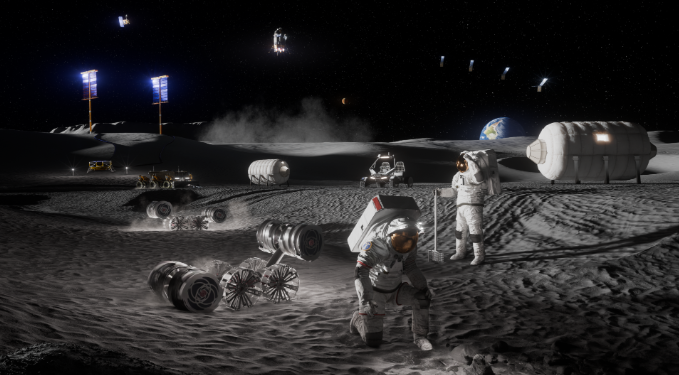
NASA invites students to design solutions for a permanent lunar outpost while recruiting its next astronaut class, with application deadlines in December 2026 and January 2027.
NASA has launched a $1 million competition inviting students to help solve the challenges of building a permanent base on the Moon. The agency announced the Moon Base Student Challenge on November 8, 2026, during its MAX POWER aerospace expo at Kennedy Space Center in Florida.
The announcement came one day after NASA reopened astronaut applications for the first time since 2024. Together, the initiatives aim to attract future scientists, engineers and explorers as the agency prepares for a sustained human presence near the Moon’s South Pole.
NASA Administrator Jared Isaacman introduced the student competition at the Kennedy Space Center Visitor Complex. The event brought together students, families and space enthusiasts interested in the agency’s plans for human exploration beyond Earth.
Students Compete for $1 Million in Moon Base Prizes
The Moon Base Student Challenge is open to eligible teams from U.S. high schools and post-secondary educational institutions. NASA is offering $1 million in total competition prizes to encourage students to develop practical solutions for living and working on the lunar surface.
Students will work in teams to address six major technical areas: power generation and storage, construction, life-support systems, surface mobility, communications networks and astronaut safety.
These challenges reflect the problems NASA must solve before astronauts can safely remain on the Moon for extended periods. Unlike short visits during the Apollo program, a permanent lunar outpost would require systems capable of operating through extreme temperatures, radiation exposure and extended periods without direct sunlight.
One particularly difficult problem involves generating and storing electricity during the lunar night. Most locations on the Moon experience approximately two weeks of darkness during each lunar day-night cycle, making reliable energy storage essential.
The challenge also encourages students to consider how astronauts would obtain supplies, maintain equipment and protect themselves from the Moon’s harsh environment. Teams are expected to develop realistic concepts rather than simply propose futuristic designs.
According to NASA, participants will gain experience in activities used by aerospace professionals, including evaluating engineering trade-offs, preparing concept proposals and presenting technical recommendations.
Students do not need previous specialized engineering experience to participate. The competition is designed to welcome students from academic, technical and vocational backgrounds.
Isaacman encouraged young people to contribute their ideas before entering the professional workforce. He emphasized that creativity, teamwork and a willingness to solve difficult problems are valuable skills for future space exploration.
Carlos García-Galán, manager of NASA’s Moon Base Program, said students can offer perspectives that established engineering teams might overlook. Their proposals could help NASA explore new approaches to supporting astronauts on the lunar surface.
Registration remains open through January 25, 2027. Interested teams can review the eligibility requirements and official competition rules through NASA’s Moon Base Student Challenge website.
NASA Reopens Applications for Future Astronauts
Alongside the student competition, NASA has begun recruiting its next class of astronaut candidates. Applications opened November 7, with the agency seeking people who could eventually participate in missions to the Moon, low Earth orbit and beyond.
The application deadline is December 3, 2026, at 11:59 p.m. Eastern Standard Time. Candidates must submit their materials through the federal USAJOBS employment website.
Applicants must be U.S. citizens and generally hold a master’s degree in a qualifying science, technology, engineering or mathematics field. Certain medical qualifications, doctoral studies and recognized test pilot training can satisfy the educational requirement.
NASA also requires at least three years of relevant professional experience after completing the qualifying degree, although separate experience standards apply to pilots and some medical professionals. Candidates must pass the agency’s long-duration spaceflight physical examination.
The agency evaluates additional qualities such as leadership, communication, judgment and teamwork. These skills are important because astronauts must work closely with colleagues in isolated and demanding environments.
Those who advance through the initial application process will undergo interviews and assessments at Johnson Space Center in Houston. NASA expects to announce its next astronaut candidate class in fall 2027, although the schedule could change.
Selected candidates are expected to report for training during winter 2027–2028. The training program generally lasts about two years and includes spacewalking, robotics, flight operations and other essential astronaut skills.
Acceptance into the astronaut candidate program does not guarantee an immediate spaceflight assignment. Graduates must complete training and wait for selection to an appropriate mission.
NASA Expands Plans for a Permanent Lunar Base
NASA’s latest announcements support a broader effort to establish a lasting human presence on the Moon. The agency intends to use its Artemis missions to develop the equipment, transportation systems and operational experience required for a lunar outpost.
The Moon’s South Pole is a leading destination because some permanently shadowed craters may contain deposits of water ice. These resources could eventually provide drinking water, breathable oxygen and ingredients for rocket propellant.
Certain elevated areas near the poles also receive sunlight for extended periods, offering potential advantages for solar energy systems. However, the region presents difficult terrain, extremely cold shadowed areas and substantial communications challenges.
NASA plans to address these problems through a series of robotic and crewed missions. Each mission is intended to test equipment and develop capabilities needed for more ambitious operations.
The agency’s current schedule calls for Artemis III to launch in 2027 as a demonstration mission in low Earth orbit, rather than a lunar landing. Its astronauts will test critical systems and procedures associated with commercial lunar landers.
Artemis IV is targeted for early 2028 and is planned to return astronauts to the lunar surface. Two crew members would descend near the South Pole while the remaining crew members stay in lunar orbit.
These dates remain targets rather than guaranteed launch schedules. Mission readiness, equipment testing and safety reviews will determine when the flights can proceed.
Commercial Companies Receive New Lunar Assignments
NASA announced additional investments in lunar transportation and infrastructure during MAX POWER on November 7. The agency selected eight companies eligible to compete for future commercial lunar delivery missions.
The companies include Blue Origin, Firefly Aerospace, Intuitive Machines, ispace-U.S., Lockheed Martin, Northrop Grumman, SpaceX and Voyager Technologies.
The new Commercial Lunar Payload Services contract framework has a maximum combined value of $10 billion over 10 years. That amount represents a contracting ceiling, not money already paid or guaranteed to the selected companies.
NASA also announced plans to proceed with PROMISE, a nuclear-powered robotic rover designed to explore the lunar South Pole. The rover will investigate the surface and subsurface while searching for evidence of water ice and other potentially useful resources.
PROMISE will use components and technology developed for NASA’s Mars rovers. Its nuclear power system is intended to help it operate during long periods of darkness and inside permanently shadowed regions.
The agency is targeting late 2028 for the rover’s launch. Blue Origin received a $94 million base contract to deliver the rover, with an additional contract option tied to performance.
Other announced projects involve lunar communications, transportation and surface power systems. NASA selected SpaceX for a demonstration involving the deployment of communications infrastructure in the region between Earth and the Moon.
These projects are designed to establish capabilities astronauts will need before a permanent base can become operational. They are still in different stages of development, and a completion date for the Moon Base has not been established.
Two Opportunities to Participate in Future Space Exploration
The student competition and astronaut recruitment effort offer different ways to become involved in NASA’s lunar ambitions. The challenge allows students to develop ideas and technical skills, while astronaut recruitment seeks experienced professionals capable of completing demanding space missions.
Both programs arrive as NASA prepares its next phase of Artemis operations. The agency’s plans depend on solving practical problems involving energy, transportation, communications and human safety.
Students interested in the Moon Base Challenge have until January 25, 2027, to register. Professional astronaut applicants face an earlier deadline of December 3, 2026, as NASA begins selecting candidates for its next astronaut class.
IMAGE: NASA