
NASA details a 2027 crewed docking test, redesigned SpaceX and Blue Origin lunar landers, and a faster development strategy aimed at returning astronauts to the Moon in 2028.
NASA has outlined new plans to return American astronauts to the Moon in 2028, including a crewed test flight in Earth orbit next year and redesigned lunar landing systems. The agency presented the updated strategy on October 23, 2026, at Kennedy Space Center in Florida, where Administrator Jared Isaacman and senior officials described efforts to accelerate the Artemis program.
Under the revised schedule, Artemis III will launch in 2027 as an Earth-orbit demonstration mission, while Artemis IV is targeted to make the first crewed lunar landing since Apollo 17 in 1972. NASA is working with SpaceX and Blue Origin to test essential equipment, simplify spacecraft operations and reduce the risks involved in sending astronauts to the Moon’s South Pole.
The agency is maintaining its early 2028 landing target rather than announcing a newly guaranteed launch date. Meeting that goal will depend on spacecraft testing, lander development and the successful completion of several complex operations.
Artemis III Will Test Two Lunar Landing Systems
NASA plans to send four astronauts into low Earth orbit aboard the Orion spacecraft for a mission lasting approximately 14 days. The crew will launch on the Space Launch System rocket from Kennedy Space Center and conduct docking demonstrations with test vehicles developed by Blue Origin and SpaceX.
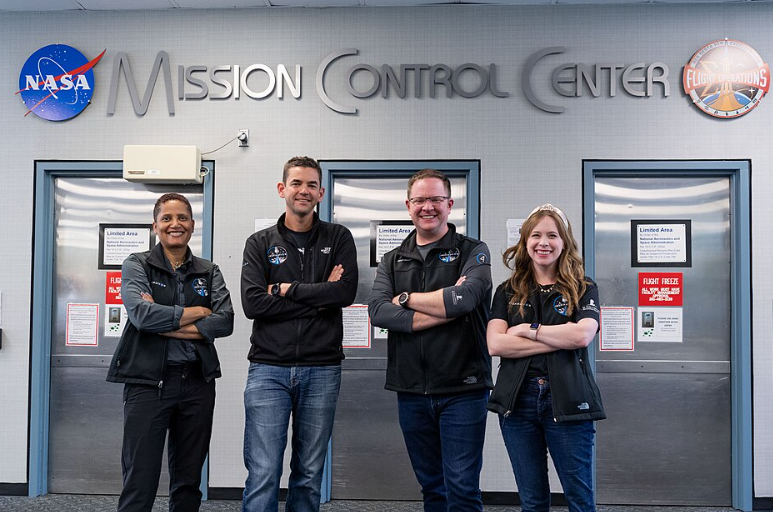
The astronauts selected for Artemis III are NASA’s Randy Bresnik, Frank Rubio and Andre Douglas, along with European Space Agency astronaut Luca Parmitano. Their assignment will focus on testing spacecraft systems and procedures needed for future lunar landings rather than traveling to the Moon.
Blue Origin’s Blue Moon lander test vehicle is expected to launch first and enter Earth orbit. Once NASA confirms that the spacecraft is functioning properly, Orion will launch with the astronauts and begin preparations for a rendezvous.
The two spacecraft will dock, allowing the crew to enter the Blue Moon test vehicle and evaluate systems needed for future missions. Astronauts and ground controllers will examine how the vehicles operate together and practice procedures that will be required during lunar expeditions.
After completing the Blue Origin demonstration, Orion will separate and prepare for another docking test. SpaceX plans to launch a Starship lander test vehicle that will provide NASA with an opportunity to evaluate a different spacecraft design.
Orion will dock with the Starship test vehicle for a demonstration expected to last up to two hours. Unlike the Blue Moon operation, the astronauts will not enter Starship during this test.
NASA wants to examine spacecraft communications, guidance systems, software performance and the forces produced during docking. These tests will help engineers identify problems before crews attempt similar operations much farther from Earth.
The spacecraft can remain in orbit for up to 30 days if additional schedule flexibility is needed. The longer operating capability provides a margin for conducting the demonstrations and responding to unexpected technical problems.
SpaceX and Blue Origin Revise Their Moon Landing Plans
NASA has also approved major changes to how commercial lunar landers will transport astronauts to the Moon. Both companies are developing spacecraft capable of carrying crews from Orion to the lunar surface and returning them to lunar orbit.
SpaceX continues to develop a modified version of Starship for lunar operations. Its approach requires transferring large amounts of extremely cold rocket propellant between spacecraft in Earth orbit.
Under the revised plan, several tanker vehicles will deliver fuel to a waiting propellant depot. The depot will then supply the Starship lunar lander with enough propellant for its journey.
Once refueled, the Starship lander will rendezvous with Orion and its crew in Earth orbit. The two spacecraft will dock before Starship performs an engine burn to send the combined vehicles toward the Moon.
The spacecraft will travel to low lunar orbit, where two astronauts will transfer to Starship for their descent to the surface. The other two astronauts will remain aboard Orion while their colleagues conduct the lunar exploration mission.
Blue Origin is pursuing a different approach for its Blue Moon Mark 2 lander. The company plans to use three transfer stages to move the spacecraft from Earth orbit toward the Moon without depending on orbital refueling for the initial crewed landing.
The transfer stages will operate in sequence, separating as their fuel is exhausted. Blue Moon will eventually enter an elliptical orbit around the Moon, where it can rendezvous with Orion and receive astronauts.
Two crew members will then descend to the lunar surface while the others remain in orbit. Following their exploration activities, the surface crew will return to Orion before beginning the journey home.
NASA has not yet assigned either company to the first 2028 crewed landing. The agency intends to select the lander based on demonstrated readiness, giving it an alternative if one system encounters significant development problems.
NASA Works to Speed Up Hardware Development
The agency is also changing how it manages equipment production and mission preparation. Officials described efforts to reduce processing times, accelerate hardware manufacturing and improve coordination between NASA facilities and private contractors.
Work is continuing on the Space Launch System, the powerful rocket designed to send Orion and its astronauts into space. NASA has been examining ways to simplify the rocket’s configuration while maintaining the performance required for lunar missions.
The agency has been considering options for future upper-stage propulsion, including existing hardware and potential alternatives based on United Launch Alliance technology. These studies are part of broader efforts to increase launch opportunities and reduce schedule risks.
NASA’s preparations extend beyond rockets and spacecraft. Ground systems, docking equipment, communication networks and astronaut training must all be ready before the missions can proceed.
The changes follow a broader restructuring of the Artemis program announced earlier in 2026. NASA shifted Artemis III away from its previous lunar landing assignment and introduced the Earth-orbit demonstration to test commercial systems before attempting a crewed landing.
The decision allows engineers to gain operational experience with both commercial landers before committing astronauts to a lunar descent. It also provides additional opportunities to address technical concerns while remaining closer to Earth.
New Spacesuits Designed for Early Moonwalks
NASA is working with Axiom Space to prepare spacesuits for the first Artemis surface missions. The company is developing a lighter configuration intended for shorter early moonwalks, alongside a more capable suit designed for extended lunar operations.
The simplified suit, known as the Sortie configuration, is intended to reduce the equipment required for initial surface activities. NASA expects early astronauts to conduct approximately two moonwalks lasting about two hours each.
During these excursions, astronauts will collect samples, evaluate equipment and test how their spacesuits perform in the lunar environment. The information will help engineers prepare for longer expeditions in future missions.
Working on the Moon presents hazards that are different from those encountered in Earth orbit. Astronauts must contend with abrasive lunar dust, extreme temperature changes and the need to move safely across uneven terrain.
Spacesuits must provide oxygen, temperature regulation and protection while allowing astronauts to walk, bend and operate tools. Reducing suit weight and complexity could make early missions easier to prepare without eliminating the need for extensive safety testing.
The Moon’s South Pole Remains the Destination
Artemis IV is expected to carry astronauts toward the lunar South Pole, a region that has become a major focus of international exploration. Scientists are particularly interested in permanently shadowed craters where water ice may be preserved.
Water ice could provide valuable scientific information about the Moon’s history. If future technology makes extraction practical, lunar water might also support astronauts and help produce oxygen or rocket propellant.
NASA’s broader objective goes beyond a single landing. The agency hopes to establish a sustained human presence through repeated missions, surface equipment, scientific investigations and eventually a lunar base.
NASA is also targeting a second crewed lunar landing opportunity in 2028 through Artemis V. That schedule remains ambitious and depends on the development of multiple spacecraft and supporting systems.
The updated plan reflects NASA’s effort to move faster while testing essential technology before astronauts travel to the lunar surface. Officials say the revised mission sequence will allow engineers to gather critical information and maintain competition between commercial lander providers.
The next major milestone is Artemis III in 2027, when four astronauts are scheduled to test docking operations with Blue Origin and SpaceX vehicles in Earth orbit. The results will help determine whether NASA and its partners are ready for the first Artemis lunar landing in 2028.
IMAGE: Source flickr.com Author NASA/Norah Moran CC0