
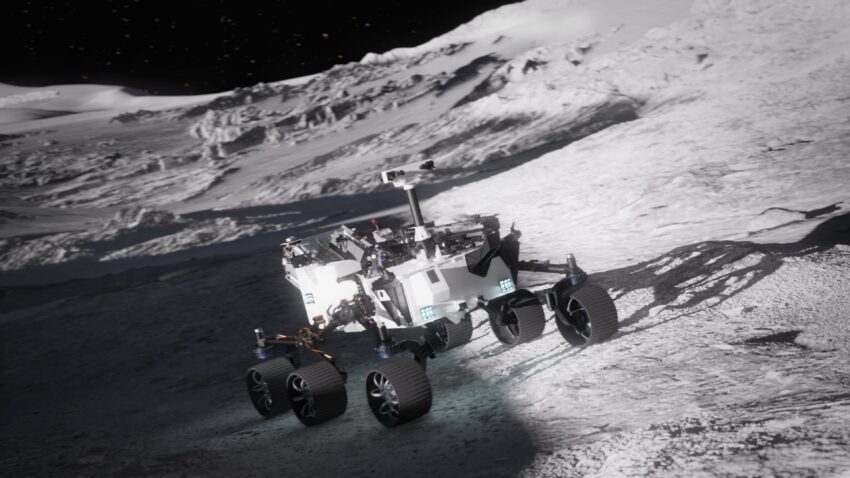
NASA has selected eight commercial partners for future lunar deliveries and awarded Blue Origin a $94 million contract to transport the nuclear-powered PROMISE rover to the Moon’s South Pole.
NASA announced a major expansion of its lunar exploration program Saturday, November 7, 2026, selecting eight companies for a new cargo delivery program and advancing plans for a nuclear-powered rover. The projects are intended to help establish a sustained human presence near the Moon’s South Pole.
The announcements include a Commercial Lunar Payload Services contract framework worth up to $10 billion over 10 years. NASA also awarded Blue Origin a $94 million base contract to deliver the PROMISE rover, which is being developed to investigate lunar resources and operate in extreme conditions.
The agency presented the plans during the MAX POWER aerospace expo and air show at Kennedy Space Center in Florida. The announcements cover robotic exploration, cargo transportation, communications, power systems and technologies needed before astronauts can begin extended surface operations.
NASA Administrator Jared Isaacman described the approach as a series of missions that build on previous accomplishments. The agency intends to test equipment, learn from each flight and gradually expand its ability to operate on the lunar surface.
The awards represent important steps toward a future Moon base, although they do not mean a permanent lunar settlement has already been built or fully funded. Most of the announced projects still require development, testing and successful launches.
Eight Companies Selected for Lunar Cargo Deliveries
NASA selected eight companies to compete for future lunar delivery missions under its Commercial Lunar Payload Services 2 program, known as CLPS 2.
The selected companies are Blue Origin, Firefly Aerospace, Intuitive Machines, ispace-U.S., Lockheed Martin Space, Northrop Grumman Space Systems, SpaceX and Voyager Technologies.
These companies will be eligible to compete for assignments transporting scientific instruments, technology demonstrations and infrastructure to the Moon. Their responsibilities may include designing, building and operating the robotic landers needed to complete deliveries.
The new contract has a combined maximum value of $10 billion over 10 years. That amount represents the program’s spending ceiling, not money automatically awarded to every selected company.
NASA uses commercial lunar delivery contracts to purchase transportation services rather than developing and operating every spacecraft itself. The approach allows companies to offer different landing technologies and gives the agency several potential providers.
The agency also increased the ceiling of its existing CLPS contract from $2.6 billion to $4.2 billion. That agreement remains active through November 2028, with additional time permitted to complete previously awarded deliveries through November 2033.
The expanded program is designed to support more frequent lunar missions as NASA prepares equipment for future human exploration. Each successful delivery could provide new scientific information or demonstrate technology needed for larger operations.
PROMISE Rover Will Explore the Moon’s South Pole
A central part of the announcement is PROMISE, which stands for Polar Rover for Observation, Mapping, and In-Situ Exploration.
The six-wheeled, nuclear-powered vehicle will investigate the Moon’s South Pole region, where scientists believe water ice and other valuable materials may exist. NASA plans to use the information to identify potential resources, evaluate landing sites and prepare for future infrastructure.
PROMISE will carry a drill capable of investigating lunar material approximately three feet below the surface. It will also include spectrometers to analyze chemical composition, temperature and radiation sensors, and cameras for examining the surrounding terrain.
The rover is being designed to operate during the long lunar night and inside permanently shadowed regions. These areas present major challenges because sunlight is unavailable and temperatures can become extremely low.
Unlike solar-powered vehicles, PROMISE will rely on a radioisotope thermoelectric generator. This system produces electricity from heat released during the natural decay of radioactive material, allowing the rover to operate without continuous sunlight.
The generator is not a conventional nuclear reactor. Its primary advantage is providing dependable electrical power and heat in places where solar panels would be ineffective.
NASA’s Jet Propulsion Laboratory in Southern California will manage the mission and construct the rover. Engineers will reuse hardware developed for the Curiosity and Perseverance Mars rover programs, including spare components and engineering test equipment.
The approach is intended to reduce costs and shorten development because much of the technology has already been tested. Engineers must still adapt the equipment to the Moon’s environment, which differs significantly from conditions on Mars.
PROMISE will also demonstrate radiation-tolerant computing and advanced autonomous navigation. These systems could help future robotic explorers work with less direct human intervention.
NASA is targeting late 2028 for launch, followed by an approximately 18-month surface mission. The schedule remains a target and could change as development progresses.
Blue Origin Receives $94 Million Delivery Contract
Blue Origin will be responsible for transporting PROMISE to the lunar South Pole using its Blue Moon Mark 1 cargo lander.
NASA awarded the company a $94 million base contract, with a potential additional $140 million option tied to performance. The new agreement expands a task order issued in May 2026 for the delivery of two lunar terrain vehicles.
The Mark 1 lander is designed to carry substantial cargo to the lunar surface. Its role in the PROMISE mission will be to deliver and deploy the rover so it can begin scientific operations.
The contract is part of the first phase of NASA’s Moon Base program. Early robotic missions are expected to examine the environment and test technologies before crews begin extended stays.
Water ice is a particularly important target. If accessible deposits can be located and processed, they could eventually help supply drinking water, oxygen and materials used to produce rocket propellant.
However, confirming that ice exists in a region does not automatically mean it can be extracted economically or safely. PROMISE is intended to gather information needed to evaluate those possibilities.
NASA Expands Transportation and Communications
The agency also announced six task orders under its Venture-Class Acquisition of Dedicated and Rideshare launch services program.
Arrow Science and Technology, Blue Origin and Impulse Space received awards to support the integration and transportation of Moon Base cargo. The six task orders have a combined value of approximately $1.3 billion.
These missions will test transportation between Earth and the Moon, including orbital transfer vehicles that move equipment through space before lunar landers complete the final descent.
Some missions will support CAPSTONE 02, which will test navigation, communications and spacecraft maneuvers near the Moon. Others will transport MoonFall robotic drones intended to explore terrain that conventional rovers may struggle to reach.
NASA also selected SpaceX for a communications demonstration scheduled for 2028. Under the plan, a Starship spacecraft will deploy communications satellites into the region between Earth and the Moon.
Reliable communications will be essential for supporting astronauts, robotic vehicles and mission controllers during extended operations. The demonstration is intended to provide information for developing a broader lunar communications network.
Power Systems Will Support Future Lunar Operations
NASA announced additional technology awards for a project known as the Mini-Communications and Solar Tower, or miniCAST.
Honeybee Robotics, a Blue Origin company, will provide energy storage capabilities. Redwire will contribute power generation components, while Yank Technologies will develop wireless power-transfer hardware.
Engineers at NASA’s Marshall Space Flight Center in Alabama will assemble and test the equipment before it is delivered to the Moon.
The demonstration is intended to evaluate how power and communications systems could support surface operations. NASA expects the initial work to focus on individual components rather than a fully integrated lunar power network.
The agency also plans to seek proposals for larger integrated power systems in early 2027. Such infrastructure would be needed to support habitats, scientific instruments, communications equipment and vehicles during extended human missions.
NASA Opens Applications for New Astronaut Class
Alongside the lunar technology announcements, NASA opened applications for its next astronaut candidate class.
The agency currently has 32 active astronauts and expects to expand its workforce as Artemis missions become more complex. Applicants must submit their materials by 11:59 p.m. Eastern time on December 3, 2026.
NASA’s previous astronaut class was announced in September 2025, when 10 candidates were selected from more than 8,000 applicants. The new recruitment is intended to prepare personnel for future lunar operations and eventual missions to Mars.
Candidates must meet requirements involving education, professional experience and physical fitness. Selected applicants undergo extensive training before becoming eligible for flight assignments.
The Associated Press reported that NASA expects to select the new candidates in late 2027, with training beginning in early 2028. Completing the training does not guarantee an immediate assignment to space.
The astronaut recruitment and robotic mission awards reflect different parts of the same exploration strategy. While companies develop transportation and infrastructure, NASA must prepare crews to operate safely in the challenging lunar environment.
The next major milestones include testing the equipment, developing PROMISE for its targeted 2028 launch and awarding specific missions under the expanded cargo program. Whether the agency can establish a lasting lunar outpost will depend on the performance of these systems, available funding and the results of upcoming Artemis missions.
IMAGE: Artist’s rendering of NASA’s Polar Rover for Observation, Mapping, and In-Situ Exploration (PROMISE) on the lunar surface. The nuclear-powered rover is being developed to explore the Moon’s South Pole region, where it will investigate the lunar surface and subsurface, assess potential resources, and conduct scientific observations in challenging environments, including permanently shadowed regions.. Photo: NASA Headquarters / Wikimedia, taken 2026-11-07, Public domain