

A clinical trial involving 120 patients found that imdatifan produced measurable tumor responses in 22% of participants, with responses lasting a median of 28.6 months.
An experimental oral medication called imdatifan has shown promising results in patients with advanced kidney cancer who previously received standard treatments. In an early-stage clinical trial involving 120 participants, approximately 22% experienced significant tumor shrinkage. Among patients who responded to treatment, the median duration of response was 28.6 months. The findings were published on November 27, 2026, in the scientific journal Nature Cancer.
The clinical trial was led by Dr. Toni K. Choueiri of the Dana-Farber Cancer Institute in Boston, Massachusetts. Researchers evaluated the medication, also known as NKT2152, in patients with advanced clear cell renal cell carcinoma, the most common form of kidney cancer. Although the results support continued investigation, larger clinical trials will be necessary to establish how the medication compares with existing treatment options.
Targeting a Protein That Helps Cancer Grow
Imdatifan works by blocking a protein called hypoxia-inducible factor-2 alpha, commonly abbreviated as HIF-2α. This protein helps regulate how cells respond to oxygen availability and influences biological processes involving blood vessel formation and metabolism. In many clear cell kidney tumors, excessive activity of this protein contributes to cancer growth.
A gene known as von Hippel-Lindau, or VHL, normally helps regulate HIF-2α. When this gene becomes inactive, the protein can accumulate inside cells and activate processes that support tumor development. Medications that inhibit HIF-2α are designed to interfere with this biological mechanism rather than attack rapidly dividing cells indiscriminately.
Imdatifan belongs to a newer generation of targeted cancer medications designed to inhibit HIF-2α with high potency and selectivity. Its development builds on earlier discoveries that established the importance of oxygen-sensing mechanisms in cancer biology.
Clinical Trial Shows Encouraging Tumor Responses
The researchers conducted a combined phase 1 and phase 2 clinical trial across multiple medical centers. Participants received imdatifan without another anticancer medication being added as part of the experimental treatment. Different dosing regimens allowed investigators to examine safety, drug exposure, and preliminary evidence of effectiveness.
The combined objective response rate was 22%, meaning that approximately one in five patients experienced tumor shrinkage meeting established clinical measurement criteria. An objective response does not necessarily mean that all cancer has disappeared. Patients whose tumors remain stable may also experience clinical benefits even if they do not meet the criteria for an objective response.
The researchers reported a median progression-free survival of 9.2 months. This measurement reflects the length of time patients remained alive without documented worsening of their cancer. Among those whose tumors responded, the median response duration of 28.6 months indicated that some patients experienced sustained benefits.
These measurements describe different aspects of treatment effectiveness and should not be confused with overall survival. The study does not establish that imdatifan extends patients’ lives compared with other available medications.
Researchers Monitor Treatment Side Effects
Safety was an important consideration because HIF-2α plays a role in normal biological functions as well as cancer development. The most frequently reported adverse events included anemia, fatigue, and hypoxia, a condition involving insufficient oxygen availability in the body.
Anemia occurs when the body has insufficient healthy red blood cells or hemoglobin to transport oxygen effectively. Patients may experience tiredness, weakness, or shortness of breath. These effects are particularly relevant to medications that interfere with pathways involved in oxygen regulation and red blood cell production.
The investigators described the medication’s overall safety profile as manageable and generally consistent with previous research involving similar inhibitors. However, manageable side effects do not mean that treatment is free of serious risks. Additional studies will help establish the medication’s long-term safety and identify patients who may be particularly vulnerable to complications.
Blood Test Could Help Monitor Treatment
The research team also investigated kidney injury molecule-1, or KIM-1, as a potential blood-based marker of treatment response. A biomarker is a measurable biological characteristic that can provide information about a disease or the effects of medical treatment.
Dr. Wenxin Xu of Dana-Farber led the biomarker portion of the study. Researchers found that circulating KIM-1 levels decreased alongside tumor size among patients who responded to imdatifan. This association suggests that blood testing could provide additional information about how tumors react to treatment.
Currently, physicians frequently use medical imaging to assess changes in tumor size during cancer treatment. A reliable blood marker could complement imaging and help identify changes in disease activity between scans. However, further research is needed before KIM-1 can be used routinely to select patients for imdatifan or guide decisions about continuing treatment.
Building on Nobel Prize-Winning Research
The development of HIF-2α inhibitors follows decades of scientific investigation into how cells detect and respond to oxygen levels. In 2019, Dana-Farber researcher William G. Kaelin Jr. shared the Nobel Prize in Physiology or Medicine with Sir Peter Ratcliffe and Gregg Semenza for discoveries involving these biological mechanisms.
Their research contributed to the development of belzutifan, an earlier HIF-2α inhibitor marketed under the name Welireg. In December 2023, the U.S. Food and Drug Administration approved belzutifan for patients with advanced renal cell carcinoma following certain immunotherapy and targeted treatments.
Imdatifan is being investigated as another medication targeting the same biological pathway. Although its design aims to improve drug activity and selectivity, the current trial did not directly compare imdatifan with belzutifan. Consequently, researchers cannot yet determine whether the newer medication offers better effectiveness or fewer side effects.
Further Clinical Trials Will Be Necessary
The study was funded by NiKang Therapeutics, the pharmaceutical company developing imdatifan. Its open-label design meant that participants and investigators knew which medication was being administered. The trial also lacked a separate comparison group receiving another treatment, limiting the ability to establish relative effectiveness.
Future research could examine whether imdatifan works more effectively in combination with other cancer medications or in patients who have received fewer previous treatments. Scientists may also investigate whether KIM-1 measurements can identify individuals most likely to benefit from HIF-2α inhibition.
Imdatifan remains an investigational medication rather than an established treatment for kidney cancer. Further controlled clinical trials will be needed to confirm its effectiveness, determine its optimal use, and establish whether its benefits justify regulatory approval.
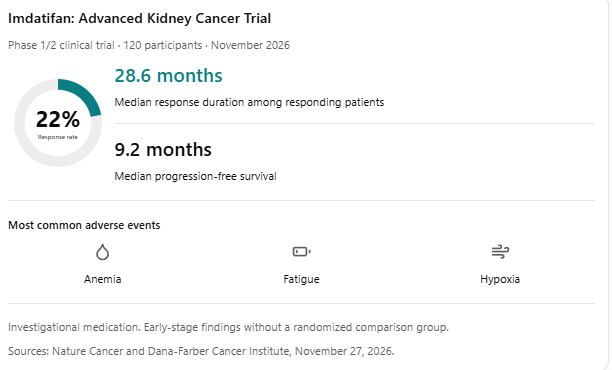
IMAGE: Portrait of Toni Choueiri, oncologist, at the American Society of Clinical Oncology 2025 Genitourinary Cancers Symposium.. Photo: Kevin Payravi / Wikimedia, taken 2025-02-13, CC BY-SA 4.0