
From the snowy parade of 1989 to the dangerous balloon accident of 1997 and the devastation of Superstorm Sandy, New York City has repeatedly faced extreme weather. The historic postponement of the 100th Macy’s Thanksgiving Day Parade raises questions about the city’s emergency preparedness and remaining vulnerabilities.
For more than a century, the Macy’s Thanksgiving Day Parade has survived snowstorms, bitter cold, heavy rain, dangerous winds, and even a global pandemic. However, a powerful coastal storm approaching New York City has forced organizers to postpone the celebration for the first time in its history.
The 100th parade, originally scheduled for Thursday, November 26, 2026, will now take place Saturday, November 28. Forecasts calling for wind gusts of up to 65 mph, heavy rainfall, and coastal flooding prompted the unprecedented decision.
The postponement reflects lessons learned from previous parade accidents and destructive storms. It also raises an important question about whether New York City’s infrastructure and emergency services are prepared for another major weather event.
The Beginning of an American Tradition
The first Macy’s parade took place on November 27, 1924. Originally called the Macy’s Christmas Parade, the event featured floats, performers, and animals borrowed from the Central Park Zoo.
Giant character balloons became part of the celebration in 1927. They eventually replaced live animals as one of the parade’s most recognizable attractions.
The parade was suspended from 1942 through 1944 during World War II, when materials such as rubber and helium were needed for military purposes.
In 2020, the COVID-19 pandemic forced organizers to significantly reduce the event’s size and eliminate traditional crowds. Despite those disruptions, weather had never previously forced organizers to reschedule the parade.
A Century of Unpredictable Parade Weather
New York City’s Thanksgiving weather has varied considerably throughout the parade’s history.
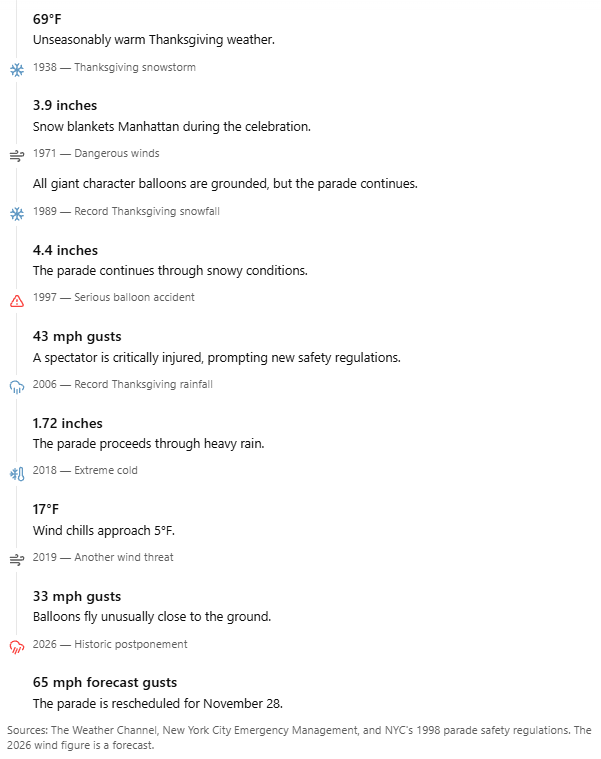
In 1933, temperatures reached an unusually warm 69 degrees Fahrenheit. Just five years later, Thanksgiving brought 3.9 inches of snow to Central Park.
The 1971 parade encountered winds strong enough to ground every giant character balloon. However, marching bands, floats, and other performers continued along the route.
Thanksgiving Day in 1989 brought 4.4 inches of snow, establishing a snowfall benchmark for the celebration.
Rain presented another challenge in 2006, when Central Park recorded 1.72 inches of precipitation on Thanksgiving Day. Organizers allowed the parade to continue despite the unpleasant conditions.
In 2018, temperatures fell to around 17 degrees during the parade, with wind chills approaching 5 degrees. Performers and spectators endured bitter cold, but the giant balloons remained part of the celebration.
The 1997 Accident That Changed Parade Safety
One of the most consequential weather-related incidents occurred during the 1997 Thanksgiving parade.
Strong winds pushed the Cat in the Hat balloon into a lamppost, breaking off part of the structure. Falling debris critically injured a spectator.
The accident prompted Mayor Rudy Giuliani to establish a task force to review balloon operations and public safety.
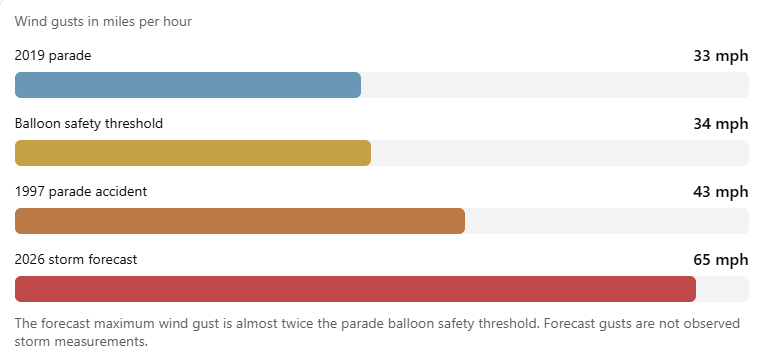
New regulations introduced in 1998 prohibited large balloons from operating when sustained winds exceeded 23 mph or gusts exceeded 34 mph.
Additional measures included closer wind monitoring, restrictions on balloon dimensions, and improved procedures for controlling balloons during unfavorable weather.
Those precautions were tested again in 2019, when strong winds forced handlers to keep the giant balloons unusually close to the ground.
The forecast for Thanksgiving 2026 substantially exceeds the established wind limits, making postponement a practical safety measure.
New York’s History of Destructive Storms
Beyond Thanksgiving celebrations, New York City has experienced numerous weather disasters that have exposed weaknesses in its transportation systems, buildings, and coastal infrastructure.
The Great Blizzard of March 1888 deposited approximately 21 inches of snow in Central Park. The storm disrupted transportation and communication throughout the city.
In January 2016, another powerful winter storm brought 27.5 inches of snow to Central Park, establishing a snowfall record for the location.
However, some of the city’s most destructive modern weather events have involved flooding rather than snow.
Superstorm Sandy Changed Coastal Preparedness
On October 29, 2012, Superstorm Sandy brought devastating coastal flooding to New York City.
Seawater entered subway tunnels, flooded homes, damaged electrical infrastructure, and disrupted transportation. Entire waterfront neighborhoods experienced extensive destruction.
According to the New York City Comptroller’s Office, Sandy killed 43 city residents and caused an estimated $19 billion in damage.
The disaster prompted major investments in coastal protection, infrastructure improvements, and emergency planning.
However, subsequent storms demonstrated that protecting the city against seawater alone would not eliminate its vulnerability to flooding.
Hurricane Ida and the 2023 Floods
The remnants of Hurricane Ida brought extreme rainfall to New York City on September 1, 2021. Water rapidly entered streets, subway stations, and basement apartments.
Thirteen New Yorkers died during the flash floods.
Another major rainfall event struck on September 29, 2023. Flooding affected 45 subway stations, while transportation authorities pumped approximately four million gallons of water from the subway system.
A subsequent investigation by the city comptroller identified shortcomings in emergency communications and flood preparedness.
The events demonstrated how intense rainfall can overwhelm urban drainage systems even when a major coastal storm surge is not present.
How New York Is Preparing for Thanksgiving
Mayor Zohran Mamdani activated the city’s Flash Flood Emergency Plan on Monday, ahead of the approaching Thanksgiving storm.
The administration placed its Downed Tree Task Force on alert Tuesday. Emergency Operations Center procedures are scheduled for activation Thursday to coordinate municipal agencies, transportation authorities, and utility companies.
City crews have been clearing blocked drainage infrastructure, while construction sites have been instructed to secure loose materials.
Officials are particularly concerned about coastal flooding during Thursday’s high tides. Vulnerable neighborhoods around Jamaica Bay and the Bronx waterfront could experience up to 2.5 feet of inundation.
Residents of basement apartments in flood-prone areas have been advised to prepare to move to higher floors before water enters their homes.
Is New York City Prepared?
New York has expanded its coastal protection efforts considerably since Sandy.
In July 2026, the city announced an expansion of its Bureau of Coastal Resilience. Its responsibilities include 15 active infrastructure projects intended to reduce flooding risks.
The approximately $1.45 billion East Side Coastal Resiliency project incorporates floodwalls, raised parkland, and movable flood barriers along Manhattan’s eastern waterfront.
The city also announced completion of the first phase of its Battery Coastal Resilience project in June.
Nevertheless, major coastal protection projects remain under development. Flood defenses also cannot eliminate every risk associated with intense rainfall, aging drainage infrastructure, or damaging winds.
New York has taken meaningful steps to prepare for Thursday’s storm. Postponing the parade demonstrates how emergency planning can reduce exposure to avoidable hazards.
The effectiveness of those preparations will become clearer as the storm moves through the city. Saturday’s rescheduled parade will depend on improving weather, safe streets, and the ability of emergency crews to restore normal operations.
FEATURE IMAGE: DNR Art Department