
Skip to content
Digital News Report Logo
Menu
  • News
  • Business
  • Science
  • Entertainment
  • Health
  • Sports
  • Audio Books
  • Quizzes
  • Videos
Menu

Home » Science » Scientists Identify First Type-I Superconductor That Breaks Time-Reversal Symmetry

Scientists Identify First Type-I Superconductor That Breaks Time-Reversal Symmetry

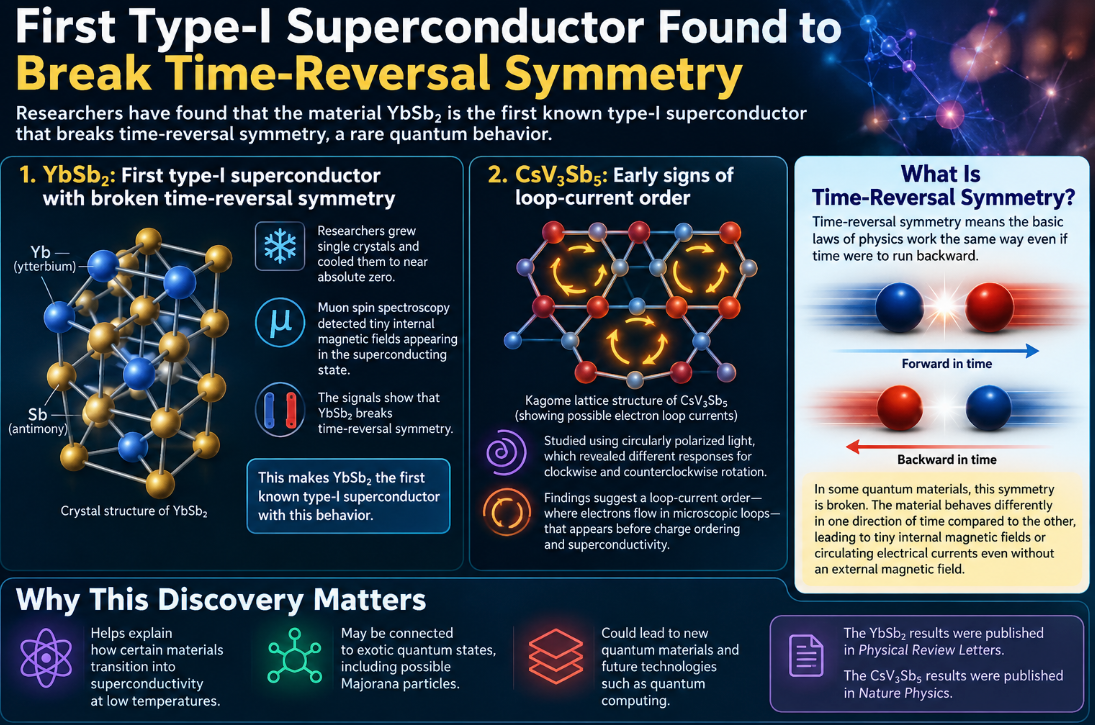
Landscape infographic explaining how YbSb₂ became the first known type-I superconductor found to break time-reversal symmetry, with diagrams of its crystal structure, muon spin measurements, CsV₃Sb₅ loop-current research, and a simple explanation of time-reversal symmetry.
By Digital News Editorial Team on October 4, 2026

Researchers found evidence that YbSb₂ breaks time-reversal symmetry as it becomes superconducting. The result marks the first known example of this behavior in a type-I superconductor.

What Is Time-Reversal Symmetry?

Time-reversal symmetry is the idea that the basic laws governing a physical system would still work if time were imagined to run backward.

A simple example is a video of two billiard balls colliding. If the video were played backward, the motion could still look physically possible. In many microscopic systems, the equations describing particles behave in a similar way.

Some quantum materials break this symmetry. Their particles can organize in a way that distinguishes one direction of time from the other. This can create tiny internal magnetic fields or circulating electrical currents even when no external magnetic field is applied.

In a superconductor, broken time-reversal symmetry is especially unusual. It suggests that the paired electrons responsible for superconductivity may be arranged in a more complex way than in conventional superconductors. Scientists study this behavior because it can be connected to exotic quantum states and possibly to Majorana particles that could someday have applications in quantum computing.

Physicists have identified the first known type-I superconductor that breaks time-reversal symmetry. The material is ytterbium diantimonide or YbSb₂. The research was led by Anshu Kataria of the Indian Institute of Science Education and Research Bhopal.

They grew single crystals of YbSb₂ and tested its behavior as it cooled to near absolute zero. Measurements confirmed that the material behaves as a type-I superconductor. Muons were used to detect extremely weak magnetic fields within the material during its transition into the superconducting state.

The researchers found spontaneous internal magnetic fields appearing just below the superconducting transition. This provides evidence that YbSb₂ breaks time-reversal symmetry in its superconducting state. The team plans further experiments using angle-resolved photoemission spectroscopy and scanning tunneling microscopy to explore what causes the symmetry breaking.

These studies may reveal whether surface states predicted for such materials actually exist.

A separate team led by Yeongkwan Kim at the Korea Advanced Institute of Science and Technology studied time-reversal symmetry breaking in the kagome metal cesium vanadium antimonide. The material was examined using circularly polarized light to detect subtle changes in how it interacts with electromagnetic fields as temperature drops. This method allowed the team to observe a clear difference in behavior depending on whether the electric field rotated clockwise or counterclockwise.

The findings suggest that loop-current order—a state where electrons flow in microscopic loops—exists in this material and appears before other ordered states like charge ordering and superconductivity. This breakthrough could help scientists better understand how certain materials transition into superconductivity at lower temperatures.

The YbSb₂ results were published in Physical Review Letters while the separate cesium vanadium antimonide study appeared in Nature Physics.

IMAGE:  DNR Art Department

  1. Scientists Visualize Key Quantum State in High-Temperature Superconductors
  2. Scientists Unlock Quantum Superchemistry
  3. Scientists Identify Brain Cells That Sustain Motivation
  4. Scientists Detect Radio Waves Directly From Exoplanet for First Time
  5. Quantum Physics: Bose-Einstein Condensation of Dipolar Molecules

Live Results Search

Categories

Important Information

This site is for informational purposes only.  Always check with your doctor or  legal council before making any medical or legal decisions.

loader-image
San Francisco, US
3:22 pm, October 5, 2026
temperature icon 73°F
broken clouds
Humidity 56 %
Pressure 1012 mb
Wind 17 mph
Wind Gust: 0 mph
Visibility: 0 km
Sunrise: 7:08 am
Sunset: 6:47 pm
Weather from OpenWeatherMap


©2026 Digital News Report | Design: Newspaperly WordPress Theme