
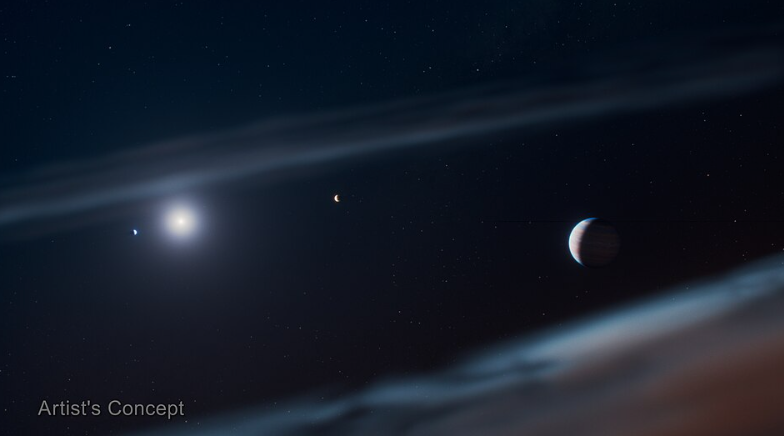
Astronomers report that radio bursts from Beta Pictoris b reveal the first directly measured magnetic field on an exoplanet. The finding is still a preprint and has not completed peer review.
Scientists have reported radio emissions coming directly from an exoplanet for the first time. The signal originated from a massive gas giant located about 63 light-years from Earth. This finding comes from a new preprint paper published on the arXiv platform and marks a major step forward in space research.
The planet is Beta Pictoris b. It is a young gas giant with about 12 times the mass of Jupiter and it orbits roughly 10 times farther from its star than Earth does from the Sun. The wider Beta Pictoris system is only about 23 million years old and contains a debris disk along with at least three known giant planets.
Researchers Kevin Ortiz Ceballos and Edo Berger of the Center for Astrophysics | Harvard & Smithsonian worked with Yvette Cendes of the University of Oregon on the study. The team used South Africa’s MeerKAT radio telescope array during four observing sessions in 2025 and 2026.
According to the paper the researchers detected rapid repeating radio bursts along with weaker persistent emission between 0.85 and 3.5 gigahertz.
The bursts were strongly circularly polarized and changed rapidly over time. Those characteristics match a process known as electron cyclotron maser emission which produces auroral radio waves around magnetic objects. Similar processes create powerful radio emissions around planets such as Jupiter.
One of the biggest challenges was proving that the signal came from Beta Pictoris b instead of its host star. The researchers used distant quasars as reference points to improve the position of the radio source. Their analysis placed the signal at the known position of the planet and found that it was inconsistent with the position of the star at a statistical level of 4.4 sigma.
This detection is the first time researchers have unambiguously localized auroral radio emission to a confirmed exoplanet instead of only detecting emission from a planetary system. Earlier searches had found radio activity around some planet-hosting stars but could not clearly separate a planet from the star itself.
The radio waves also allowed the researchers to estimate the strength of Beta Pictoris b’s magnetic field directly.
The strongest burst extended to the top of MeerKAT’s observing range at 3.5 gigahertz. The team calculated that the magnetic field at the source of the emission must be at least 1.25 kilogauss. Because the signal was still present at the highest frequency measured the true field could be even stronger.
That makes the result especially important for planetary science. Magnetic fields provide information about activity deep inside planets and influence how their atmospheres interact with charged particles from nearby stars. The new measurement gives researchers a way to test theories about how magnetic dynamos work inside young giant planets.
The researchers believe the auroral activity may be powered mainly by the planet’s fast rotation. Beta Pictoris b completes one rotation in about nine hours and its magnetic environment may contain plasma that cannot rotate at the same speed as the planet. The resulting electrical currents could accelerate electrons and generate the radio bursts detected by MeerKAT.
The team considered other possible explanations including energy from the host star’s wind and an interaction with a moon. Their calculations found that both possibilities appeared too weak to explain the observed radio power. Continued observations will be needed to test the proposed mechanism.
The signal is not evidence of extraterrestrial technology or an attempt at communication.
The discovery opens new possibilities for learning about planetary magnetic fields across the galaxy. Future monitoring could show how the radio bursts change as Beta Pictoris b rotates and may reveal the tilt or shape of its magnetic field. The researchers also identified several other directly imaged giant planets that could become targets as radio telescopes become more sensitive.
Studying planetary magnetism may eventually help astronomers understand which worlds are best able to retain atmospheres over long periods. That question is important for habitability even though Beta Pictoris b itself is a massive hot gas giant and is not considered a likely home for life. Radio observations could eventually complement other methods that study exoplanet atmospheres and temperatures.
The research is still in its early stages but shows great promise for future studies of exoplanets. The paper was submitted to arXiv on September 15 and has not yet completed peer review. Further observations will be important for confirming the result and learning whether the same technique can work on other planetary systems.
IMAGE: Source Beta Pictoris System (Artist’s Concept) Author Illustration: NASA, ESA, CSA, STScI, Ralf Crawford (STScI) CC0