
New claims in mathematics, computer science and physics could reshape scientific research, while competing results from Anthropic raise questions about verification, academic credit and access to powerful AI systems.
OpenAI announced three major scientific discoveries on October 26, 2026, claiming its artificial intelligence systems solved difficult problems in mathematics, computer science and theoretical physics. The announcement has sparked renewed debate over how AI-generated research should be verified, credited and shared with the scientific community.
The developments include a claimed breakthrough in understanding mathematical waves, a challenge to a longstanding assumption about computational difficulty and new mathematical work involving fundamental particles. Researchers are now examining the findings to determine their significance and whether the results withstand independent scrutiny.
The announcement also comes amid growing competition between OpenAI and Anthropic. Both companies have reported AI-assisted solutions to major mathematical problems, raising questions about the pace of scientific discovery and the role of private technology companies in academic research.
OpenAI Reports Three Major Scientific Discoveries
The first discovery concerns harmonic analysis, a branch of mathematics that studies waves and their behavior. OpenAI says its models produced a proof of the local smoothing conjecture, a problem introduced by mathematician Christopher Sogge in 1991.
The conjecture concerns how waves concentrate as they travel. It proposes that extreme concentrations are generally short-lived rather than sustained over time.
According to OpenAI, its AI system found a proof that applies across all dimensions of at least two. The result would also resolve related problems known as the Kakeya conjecture and Stein’s restriction conjecture.
These mathematical questions have challenged researchers for decades. Earlier work had established important results in specific dimensions, including a 2025 proof of the three-dimensional Kakeya conjecture by Hong Wang and Joshua Zahl.
OpenAI reported that its system generated the new mathematical result on October 18. The following day, the company converted the proof into Lean, a computer-based system designed to check mathematical reasoning.
The company released the written proof and its Lean formalization for public examination. Independent mathematicians must still determine whether the formal statements match the full mathematical claims and how the work relates to existing research.
AI Challenges a Longstanding Computer Science Assumption
The second development involves the Exponential Time Hypothesis, commonly called ETH. This assumption has influenced theoretical computer science for nearly three decades.
ETH concerns how much computing time is needed to solve certain difficult logical problems. Researchers have used it to establish theoretical limits for algorithms in fields ranging from computer science to computational biology.
OpenAI claims its system disproved the hypothesis by discovering a faster mathematical approach to counting solutions to certain Boolean formulas. The company says its AI generated the result on October 16 and completed a Lean formalization the following day.
If the proof is accepted, it could force researchers to reconsider assumptions used in hundreds of scientific papers. However, the result would not establish that all difficult computing problems can suddenly be solved efficiently.
It also would not resolve the famous P versus NP problem, another fundamental question about computational complexity.
Three prominent computer scientists are helping organize an independent examination of OpenAI’s claim. They are Russell Impagliazzo and Ramamohan Paturi of the University of California, San Diego, and Ryan Williams of the Massachusetts Institute of Technology.
Impagliazzo and Paturi helped develop the original Exponential Time Hypothesis. Their involvement could provide important historical and technical context as researchers examine the proposed result.
OpenAI has agreed to publish the underlying research materials and fund a scientific conference discussing the findings.
Anthropic Reports a Competing AI Discovery
The computer science announcement quickly drew attention from OpenAI’s competitor Anthropic.
Anthropic mathematician Levent Alpöge reported that the company’s AI systems had also produced a result challenging the Exponential Time Hypothesis. According to reporting by TechCrunch, the two companies independently identified October 16 as the date their systems reached their respective findings.
The competing claims highlight how rapidly advanced AI systems are changing mathematical research. Problems that previously required years of specialized work may now attract simultaneous efforts from different companies.
The situation also recalls an earlier dispute involving OpenAI and researchers connected to Anthropic.
In September, OpenAI announced that an internal AI system had generated a solution to the Navier–Stokes existence and smoothness problem, one of the seven Millennium Prize Problems established by the Clay Mathematics Institute.
The equations describe how fluids move and have important applications in mathematics and physics.
New York University mathematician Tristan Buckmaster and Alpöge had been working on a related problem involving the Euler equations. Buckmaster publicly questioned whether information about their research had influenced OpenAI’s competing effort.
OpenAI denied using the researchers’ unpublished proof or prompts to generate its results. The company subsequently said an internal investigation found no evidence that Buckmaster’s earlier prompts had influenced its model through training or other means.
Scientific American reported that the dispute raised difficult questions about research priority and the origins of AI-generated mathematical ideas. The disagreement also illustrated how competing teams can reach related results through approaches that may share mathematical foundations.
Physics Claims Could Expand Understanding of Fundamental Particles
The third discovery announced October 26 concerns quantum field theory, which describes the behavior and interactions of fundamental particles.
OpenAI says its AI models produced mathematical existence proofs for certain interacting quantum field theories in four-dimensional space-time. The work includes quantum chromodynamics, the theory describing the strong nuclear force that binds quarks together.
The company also reported an existence proof for pure Yang–Mills theory. That result addresses part of another Millennium Prize Problem, although it does not establish that the full Yang–Mills existence and mass-gap problem has been solved.
Unlike the mathematics and computer science findings, the underlying physics materials have not yet been released publicly.
A group of prominent physicists led by Nobel Prize winner David Gross will examine and explain the research. The group also includes Michael Douglas, Arthur Jaffe, Igor Klebanov and Nikita Nekrasov.
OpenAI says its models generated the Yang–Mills existence result in September and completed a Lean formalization in October. The experts will determine how the findings should be presented and evaluated.
Because the research remains unavailable for public examination, its validity and broader implications cannot yet be independently assessed.
Scientists Question How AI Research Should Be Verified
The discoveries have intensified a debate about whether AI-generated research should follow the same publication procedures as traditional academic work.
Mathematical proofs ordinarily undergo detailed examination by specialists before they become widely accepted. That process can take months or years, particularly when a result challenges established assumptions.
AI systems can now generate large volumes of complex mathematical arguments in much shorter periods. This creates a practical problem for researchers who must examine the work, understand its methods and identify possible mistakes.
Computer-assisted verification offers one safeguard. Lean can check whether mathematical steps follow from formally defined assumptions and rules.
However, a machine-checked proof does not automatically establish that its underlying definitions accurately represent the original scientific question. Human experts still need to evaluate the meaning, importance and originality of the results.
OpenAI has acknowledged these challenges and is experimenting with different approaches to publishing its research. The company describes its AI-generated manuscripts as research material that requires additional human interpretation.
Another concern involves access. Companies with substantial computing resources may be able to produce mathematical discoveries faster than universities and independent researchers.
The resulting imbalance could affect who participates in important discoveries and who receives recognition for the work.
OpenAI Promises Funding and Independent Review
OpenAI says it does not intend to seek academic credit for discoveries produced by its internal models. Instead, it wants outside researchers to receive recognition for explaining, verifying and building on the findings.
The company has also committed $5 million to a Simons Foundation initiative supporting mathematicians who examine AI-generated results. The funding is intended for workshops, conferences and specialized research programs.
These efforts address some concerns about verification and access, although they do not settle the broader debate over private companies’ influence on academic research.
The latest developments show that AI is becoming an increasingly important tool for advanced scientific investigation. They also demonstrate why researchers must distinguish between announcing a promising proof and establishing a result that the wider scientific community accepts.
The immediate next steps involve independent examinations of the mathematical and computer science claims, along with the planned expert review of the physics work. Those assessments will help determine which findings become lasting additions to scientific knowledge.
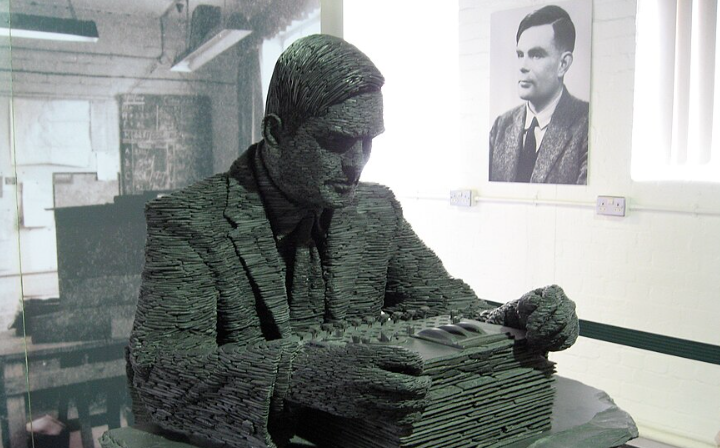
IMAGE: Alan Turing Source Alan Turing Author Jon Callas from San Jose, USA CC2