
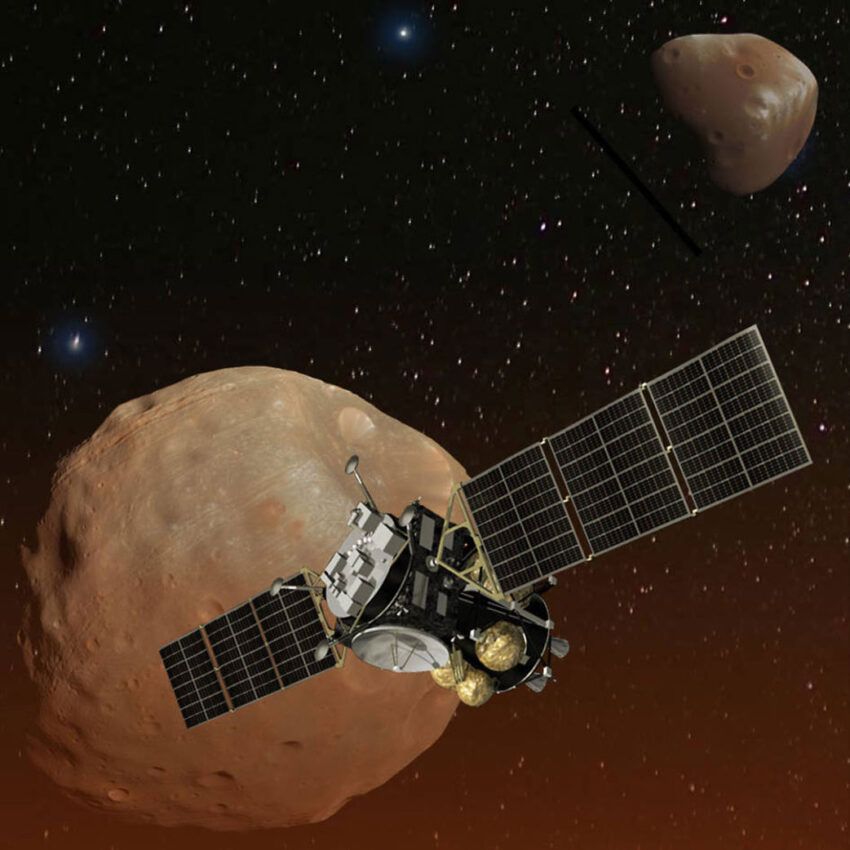
JAXA’s MMX spacecraft will target Mars’s larger moon, gather at least 10 grams of material and return the samples to Earth in 2031.
Japan is preparing to launch its Martian Moons eXploration spacecraft on a five-year mission to collect samples from Phobos, the larger of Mars’s two small moons. The JAXA-led mission is scheduled to lift off aboard an H3 rocket from Tanegashima Space Center at 4:41:03 a.m. Japan time on October 20, 2026.
Known as MMX, the mission would become the first to return material from the Martian system if it succeeds. JAXA says the spacecraft will travel to Mars, study both Phobos and Deimos, land on Phobos, collect at least 10 grams of material and bring the samples back to Earth in 2031.
The central scientific question is how Mars’s two moons formed.
Researchers have long debated two main possibilities. Phobos and Deimos may be asteroids captured by Mars’s gravity, or they may have formed from debris after a large object struck Mars early in the planet’s history. Laboratory analysis of material from Phobos could help scientists distinguish between those explanations.
JAXA project manager Yasuhiro Kawakatsu has described the Martian moons as among the most important unexplored targets in the solar system. Although spacecraft have studied Mars for decades, neither Phobos nor Deimos has been examined with the kind of surface sampling planned for MMX.
The mission is expected to reach the Mars region in August 2027. MMX will then move into a quasi-satellite orbit that keeps it near Phobos while cameras and other instruments map the moon’s shape, surface, composition and gravity.
Phobos is an irregular body roughly 20 to 30 kilometers across. It travels only about 6,000 kilometers above the Martian surface and circles Mars roughly three times each Earth day. Its low gravity creates both opportunities and engineering problems for a landing spacecraft.
JAXA says the MMX spacecraft consists of propulsion, exploration and return modules and weighs about five metric tons. It carries a suite of scientific instruments supplied by Japan and international partners, including NASA, France, Germany and the European Space Agency.
NASA contributed the MEGANE gamma-ray and neutron spectrometer, which will measure elements near the surface of Phobos. NASA also supplied a pneumatic sampling system developed by Honeybee Robotics and will provide communications and navigation support through the Deep Space Network.
A small French-German rover named Idefix is scheduled to reach the surface before the main spacecraft. The rover is designed to examine the terrain, gather measurements and help mission planners understand the surface conditions MMX will face during later landing operations.
The rover will not be the main sample-return vehicle. JAXA plans for the MMX spacecraft itself to conduct two soft landings on Phobos, spending about two to three hours on the surface during sampling operations.
One sampling system will use pressurized gas to stir loose surface material into a collection container. A Japanese coring mechanism is designed to dig about two centimeters below the surface, allowing scientists to obtain material that has been less exposed to space weathering.
JAXA’s target is at least 10 grams of Phobos material. That is far more than the tiny asteroid samples returned by Japan’s first Hayabusa mission and would give laboratories around the world enough material for several types of chemical and mineral analysis.
Scientists are also interested in material from Mars that may have reached Phobos after large impacts blasted rocks and dust off the planet. JAXA officials estimate that Martian material could account for about 0.1 percent of the sample collected from Phobos.
That small fraction could still be scientifically valuable. Grains knocked off Mars may preserve evidence about the planet’s past surface environment, including chemical signs connected to ancient water, organic material or possible biosignatures.
The mission must overcome the unusual conditions on Phobos, where gravity is about one two-thousandth of Earth’s. A spacecraft that touches down too quickly could bounce away from the surface, so MMX uses four landing legs with shock-absorbing features and must choose a relatively flat landing area.
Idefix is also designed for the moon’s weak gravity. Its wheels are intended to maintain traction at very low speeds, and the rover can right itself if it lands in an awkward position.
After completing its work at Phobos, MMX is also expected to make observations of Deimos during a flyby. Those measurements could help researchers compare the two moons and test whether they share a common origin.
The spacecraft is scheduled to leave the Martian system in 2030 for the roughly one-year journey back to Earth. Near Earth, the return module will release a heat-protected capsule containing the samples, with recovery planned in Australia in 2031.
The mission builds on Japan’s experience with asteroid sample returns. Hayabusa brought particles from asteroid Itokawa to Earth in 2010, while Hayabusa2 returned samples from asteroid Ryugu in 2020.
MMX also follows several unsuccessful attempts to reach Phobos, including Russia’s Phobos-Grunt mission, which failed after its 2011 launch. A successful Japanese mission would mark the first sample return from a moon of Mars and the first return of material from the Martian system.
NASA said this week that the mission could also support preparations for future human exploration of Mars by improving knowledge of the planet’s moons and testing technologies for deep-space operations. MMX includes a Japanese radiation monitor intended to gather data relevant to the environment future crews could face.
JAXA plans to spend about three years operating around the Martian moons before sending the return module home. If the launch and mission proceed as scheduled, scientists could have the first pieces of Phobos in Earth laboratories in 2031.
IMAGE: Artist’s concept of Japan’s Mars Moons eXploration (MMX) spacecraft, carrying a NASA instrument to study the Martian moons Phobos and Deimos.. Photo: NASA / Wikimedia, taken 2017-11-16, Public domain