
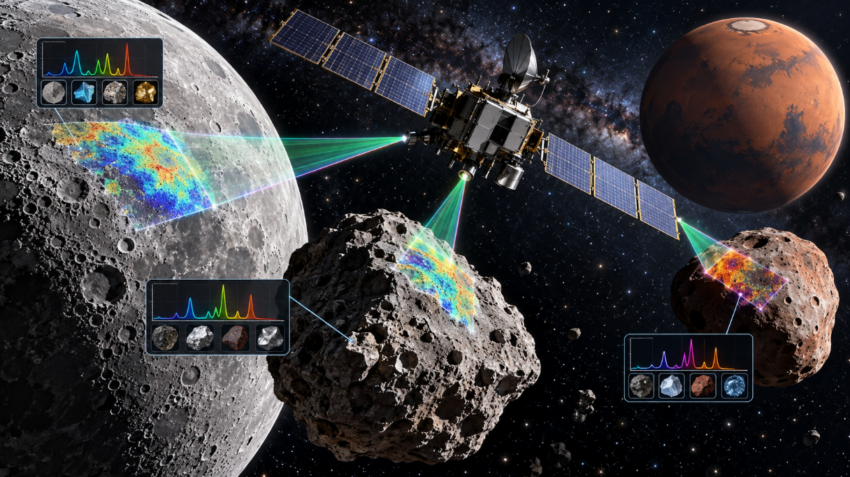
NASA has approved funding for an early-stage project named Interworld Slingshot Resource Surveys, which aims to develop methods for identifying minerals across the solar system. The mission concept is part of a broader strategy that includes plans to build a lunar base in the 2030s. This new initiative is not meant to carry out full-scale space mining operations right away but instead serves as a Phase 1 study for a future Discovery-class mission. The project is exploring whether Raman spectroscopy — a technique used on Mars by NASA’s Perseverance rover — can work from a distance in space.
Raman scattering produces very faint signals, making detection difficult even for advanced instruments, according to tech.yahoo.com. Only about one photon in ten trillion gets scattered through Raman effects during a light interaction with matter. Earlier tests by the project team reached distances of around 120 meters using long-range Raman techniques.
The spacecraft would survey multiple targets in a single mission including the moon, a near-Earth asteroid, and Phobos. The funding for this Phase 1 effort received up to $175,000 over nine months. Next steps involve applying for more substantial Phase 2 funding from the same program, which could support a two-year development cycle.
The project is being developed under NASA’s NIAC program. NIAC has supported many projects over time, but few have progressed beyond the early research stage into actual space missions. The Slingshot concept will focus on how light particles are used in a spectrometer to detect materials from orbit or flyby. It also studies laser systems, spacecraft pointing mechanisms, and orbital navigation needed for such missions.
The overall goal is to prove that a small spacecraft can travel far and collect useful data about mineral resources on other worlds. This effort could help prepare for future lunar bases and space mining operations by showing what kinds of resources might be available.
The project team believes that the biggest obstacle to space mining may be the cost of proving there is anything worth extracting. By demonstrating remote sensing capabilities from orbit or flyby, this mission could lay groundwork for more ambitious missions in the future. It also aims to see if current technologies can be adapted to identify valuable materials like helium-3 on the lunar surface.
The idea is not only to map minerals but also to understand how best to approach such surveys from a distance. This research could help nations like the United States secure access to key resources before competitors like China do.
The long-term vision includes using similar methods to survey other worlds beyond Earth’s orbit. The project is still in its early planning stages and will require further development before it could launch. However, the initial funding allows researchers to begin testing how light-based techniques can be applied in deep space environments.
If successful, this approach could revolutionize how scientists explore and assess planetary surfaces without needing to land on them. The mission concept is being developed by a team that includes experts from SETI Institute and other organizations involved in space science.
This work reflects NASA’s growing interest in both exploration and resource utilization as part of its long-term goals for the solar system.
IMAGE: DNR Art Department