
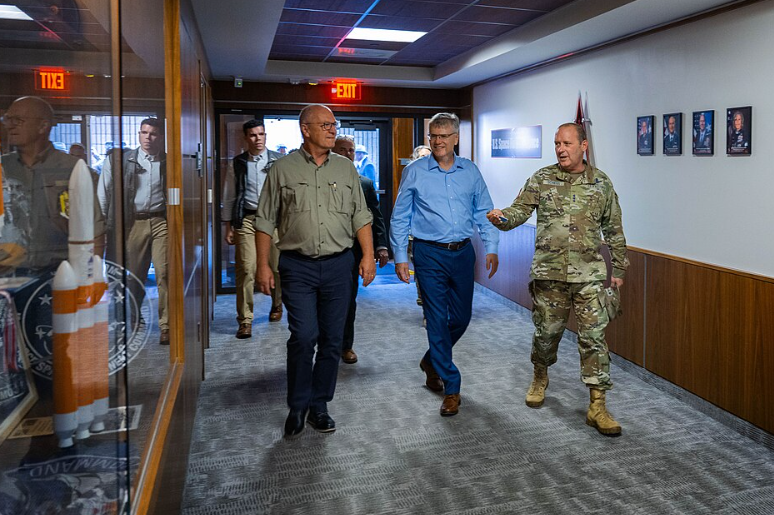
The US Space Force has confirmed it operates weapons in orbit as part of its deterrence strategy against potential adversaries. Air Force Secretary Troy Meink made the first public acknowledgement on September 14, and Chief of Space Operations Gen. Douglas Schiess repeated it the following day. Schiess said the goal is to defend the joint force from space-enabled attacks. He emphasized that space control capabilities are vital for defending against hostile actions from other nations.
The Space Force said its broader space-control mission can employ both kinetic and non-kinetic methods to disrupt, degrade, or destroy adversary capabilities. Officials have not said whether the weapons now in orbit are kinetic or non-kinetic. The Space Force has demonstrated its ability to respond quickly to on-orbit threats, as seen during the Victus Haze mission earlier this year, according to a report from defenseone.com. That mission showed how the service can launch and react to a threat in just 17 hours.
General Schiess said the US must continue expanding its advantage in space to stay ahead of growing threats. He noted that adversaries are rapidly building counter-space systems aimed at targeting the U.S. space advantage. The Space Force is not only monitoring the space domain but also ready to defend it when needed.
While the service’s capabilities are strong, funding remains a challenge. Currently, about ten percent of its programs are on hold due to a lack of a full fiscal 2027 defense spending bill. A stopgap measure signed September 2 will keep the federal government funded through December 11 after fiscal 2027 begins on October 1.
Despite the funding issues, the Space Force continues to assert its readiness and strength in space. Schiess said that during Operation Epic Fury, the joint force made clear that it could not move forward without Space Force capabilities.
He added that the service is working to maintain a strong position in space as a deterrent. The Space Force said its broader space-control mission can include both defensive and offensive capabilities at the direction of combatant commands.
Officials have not disclosed what the current on-orbit weapons are, how many exist, or how they work. Officials also have not said that the current orbital weapons are missile interceptors. The separate Golden Dome program is planned to include future space-based interceptors.
The service’s leadership believes that its presence in space is necessary to defend US interests and assets. Schiess called space both a battlefield and the backbone of the joint force.
The US Space Force is not alone in its focus on space security, as other nations are also investing heavily in counter-space technologies. China, for example, has publicly stated its opposition to weaponizing outer space, The Hill reported. After the U.S. announcement, China said it opposed an arms race in outer space and attempts to turn space into a war zone. Russia also criticized the announcement and called for space to remain free of weapons. The 1967 Outer Space Treaty prohibits nuclear weapons and other weapons of mass destruction in orbit but does not ban conventional weapons there.
However, the US Space Force continues to assert that it is prepared to defend against any threats in orbit. The service’s leadership has made clear that deterrence is not just a goal but a core mission. It also emphasized that the US must be able to defend its satellites and other space assets from hostile actions.
The Space Force’s strategy is to remain strong in space so that adversaries are less likely to attempt attacks. Schiess cited adversaries’ ability to grapple satellites and move them to different orbits as one reason the U.S. needs defensive capabilities. Reuters reported that China demonstrated in 2022 that one of its satellites could grapple another spacecraft and move it in orbit.
The US Space Force’s role in national defense has grown significantly since its creation as a military branch. It is now seen as essential for the joint force to function effectively across all domains.
Despite ongoing budget concerns, the Space Force remains committed to defending US interests in space. Its leaders continue to stress that maintaining a strong posture is key to deterring potential adversaries.
IMAGE: Public Domain : ID 250828-X-VE588-3039
This article passed automated originality and source-verification checks before publishing.