
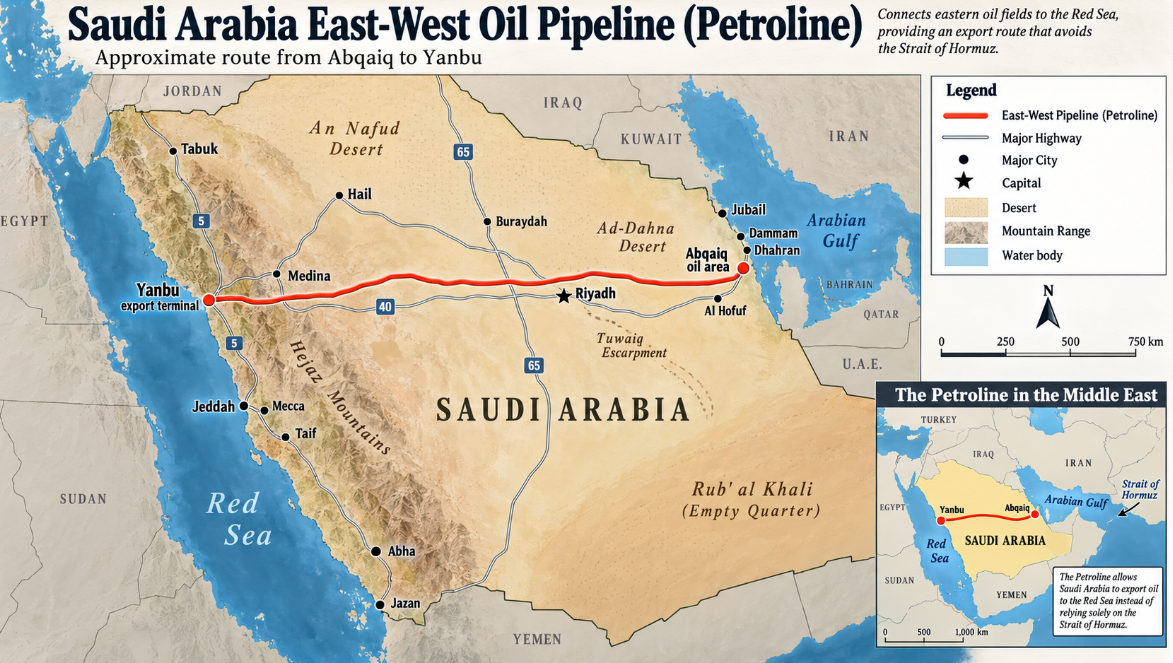
Saudi Arabia has shut down its major East-West oil pipeline as a precaution after a series of attacks by Houthi rebels, according to the Ministry of Energy. The decision came on Friday following growing concern over the security situation in Yemen, where Houthi forces have made significant advances. Houthi fighters were seen checking weapons during a mobilization campaign in Sanaa, the capital of Yemen, according to a photo from the Associated Press. The pipeline, which carries about seven million barrels of oil per day, had already been operating at full capacity earlier this year due to disruptions in shipping through the Strait of Hormuz.
Saudi Crown Prince Mohammed bin Salman has reportedly urged President Donald Trump to take military action against Iran-backed Houthi rebels, according to CBS News. Two sources familiar with the matter told CBS News that the crown prince had pressed the president for a response to recent Houthi gains along Yemen’s Red Sea coast. Despite this pressure, no direct military action has been confirmed by the United States so far. U.S. Central Command officials were reportedly in Saudi Arabia on Friday for coordination talks related to the situation. One source said that Iran is under pressure from its allied groups, including Hezbollah and Hamas, and may respond if Houthi forces are attacked. The source added that Iran might retaliate by targeting Saudi Arabia if it
Saudi Arabia has shut down its major East-West oil pipeline as a precaution after it was attacked by drones launched from Iraq, according to Saudi officials. Saudi Arabia said the drones came from Iraq but has not publicly identified who carried out the attack. The decision came on Friday following growing concern over the security situation in Yemen, where Houthi forces have made significant advances. Houthi fighters were seen checking weapons during a mobilization campaign in Sanaa, the capital of Yemen, according to a photo from the Associated Press. The pipeline, which carries about seven million barrels of oil per day, had already been operating at full capacity earlier this year due to disruptions in shipping through the Strait of Hormuz. Aramco said in May that the pipeline reached its maximum capacity of 7 million barrels per day during the first quarter.
Saudi Crown Prince Mohammed bin Salman has reportedly urged President Donald Trump to take military action against Iran-backed Houthi rebels, according to CBS News. Two sources familiar with the matter told CBS News that the crown prince had pressed the president for a response to recent Houthi gains along Yemen’s Red Sea coast. Despite this pressure, no direct military action has been confirmed by the United States so far. CBS News reported that Trump declined direct U.S. military involvement and instead offered intelligence and targeting support. U.S. Central Command officials were reportedly in Saudi Arabia on Friday for coordination talks related to the situation. One source said that Iran is under pressure from its allied groups, including Hezbollah and Hamas, and may respond if Houthi forces are attacked. The source added that Iran might retaliate by targeting Saudi Arabia if it feels the Houthis are under threat. Iran’s allies in the region have been building a coalition to protect the Houthis from possible U.S. or allied strikes.
The Houthis recently seized the strategic port of Mokha, which has strengthened their control over the Bab al-Mandeb Strait. The Yemeni government reported that Houthi forces have also taken control of two remaining islands in the strait, increasing their influence over this key shipping route. The Houthis also seized Perim, also known as Mayun Island, which sits in the Bab al-Mandeb Strait. Oil prices have risen to around $100 per barrel recently, with some analysts warning they could climb to $120 if fighting continues in the Persian Gulf and Red Sea. Brent crude settled at $104.61 per barrel on Friday after reaching nearly $110 during the week.
Houthi fighters loyal to their leadership gathered for a rally in Sanaa on September 10, 2026, according to a photo from Axios. The situation has drawn attention to the broader regional conflict involving Iran and its proxies in Yemen.
In recent years, the ongoing civil war in Yemen has already left many people displaced, bombed, starved, and impoverished, according to a report from the BBC. Analysts say that the Houthis are no longer isolated, as they have gained support from other regional actors. Hisham al-Omeisi, a senior analyst at the European Institute of Peace in Brussels, said that Houthi forces are now entrenched along the Red Sea coast. The National Resistance coalition, which previously held significant territory along Yemen’s Red Sea coast, has lost ground to the Houthis. The BBC reported estimates that the Houthis captured as much as 130 kilometers, or 81 miles, of strategically important coastline during their rapid advance.
President Trump recently spoke at a Republican midterm convention and emphasized the strength of U.S. military capabilities. He said that the U.S. military is strong and has been used more than expected in recent operations. Earlier this week, Iran launched missile attacks on a U.S. military base in Jordan, damaging several American aircraft. More than thirty Patriot missiles were fired by U.S. forces in Jordan to defend against those strikes. One A-10 Thunderbolt suffered major wing damage and about eight F-15s sustained lighter damage before being returned to service.
The developments highlight the deepening role of Iran in regional conflicts and its growing influence over allied groups like the Houthis. Reuters reported that Iranian weapons and advice played an important role in the latest Houthi offensive, although Tehran publicly denies directing the Houthis as a proxy force.
IMAGE: DNR Art Department