
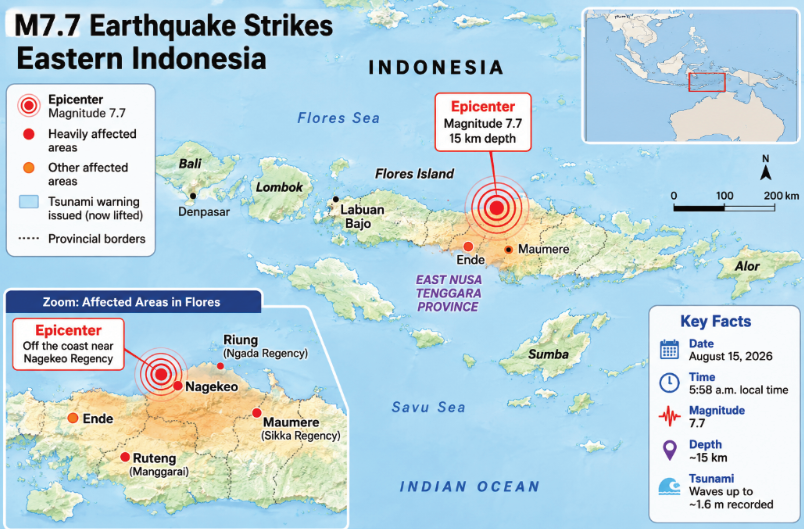
A powerful magnitude 7.7 earthquake struck eastern Indonesia early Saturday, killing at least 47 people, damaging hundreds of homes and forcing thousands of residents to evacuate. Rescue crews continued searching damaged buildings and remote communities on Flores Island as strong aftershocks shook the region.
The earthquake struck near Flores in East Nusa Tenggara province at about 5:58 a.m. local time on Aug. 15. Indonesia’s Meteorology, Climatology and Geophysics Agency, known as BMKG, placed the epicenter about 30 kilometers northeast of Mbay in Nagekeo Regency and measured the depth at 15 kilometers. The U.S. Geological Survey also measured the earthquake at magnitude 7.7, placing it at a depth of about 10 kilometers and approximately 68 kilometers north-northwest of Ende.
The shallow undersea earthquake prompted Indonesian authorities to issue tsunami warnings for several areas. Residents along vulnerable coastlines were told to evacuate or move away from beaches and riverbanks. BMKG recorded tsunami waves at several monitoring locations, including a wave measuring 0.94 meters at Maurole in Ende Regency.
The Associated Press reported that a tsunami measuring about 1.61 meters, or 5.3 feet, reached the coastal area of Riung in Ngada Regency. Boats were pushed ashore and mud and debris covered parts of the community. Other tsunami waves were detected around Flores and neighboring islands.
BMKG later ended the tsunami warning after determining that the immediate threat had passed. The agency officially announced the end of the warning at 7:31 a.m. Western Indonesian Time.
Attention then turned to searching for survivors and assessing damage across Flores.
Indonesia’s National Disaster Management Agency, or BNPB, reported that rescuers had recovered at least 47 bodies. At least 50 people had been taken to hospitals, according to the Associated Press. Some of the worst destruction was reported in Sikka, Manggarai and East Manggarai regencies.
Maumere, the main city in Sikka Regency, was among the communities hit hard by the earthquake. Rescue officials earlier reported finding 20 people dead there, while crews searched damaged structures for additional victims. Some people remained trapped beneath rubble.
Landslides have complicated the emergency response. Roads leading toward Nagekeo, the region closest to the epicenter, were blocked, while mobile communications were disrupted. Rescue teams attempting to reach the area by road were unable to get through in the first hours after the disaster, and another team was attempting to reach the region by ferry.
The Trans-Flores highway was also blocked by earthquake-triggered landslides in parts of Ende Regency. Power outages further complicated communication between communities and emergency officials. Authorities deployed helicopters and a rescue vessel to help move supplies and reach isolated areas.
Preliminary figures show extensive damage. BNPB reported that 157 homes were heavily damaged, 41 suffered moderate damage and another 148 sustained lighter damage. The earthquake also damaged 87 schools, 18 health facilities, five places of worship and six government or office buildings.
About 2,000 residents were reported to have evacuated their homes, with many remaining in temporary shelters or outside because of fears of additional earthquakes.
Those concerns continued throughout Saturday. BMKG recorded hundreds of aftershocks following the main earthquake. The Associated Press reported at least 235 aftershocks, with the strongest reaching magnitude 6.2.
The disaster also affected areas beyond the immediate epicenter. Strong shaking was reported throughout East Nusa Tenggara and West Nusa Tenggara and in parts of South Sulawesi. Labuan Bajo, the tourism center used by many visitors traveling to Komodo National Park, also experienced the earthquake.
Indonesia is one of the most seismically active countries in the world because it lies along the Pacific Ring of Fire, where several tectonic plates and major fault systems meet. Flores itself has experienced devastating earthquakes before. A major earthquake and tsunami struck the region in 1992 and killed about 2,500 people.
The latest casualty and damage figures remain preliminary. Landslides, damaged roads and disrupted communications have prevented rescue teams from immediately reaching some remote communities, meaning the full extent of the disaster may not be known until officials gain access to those areas.