
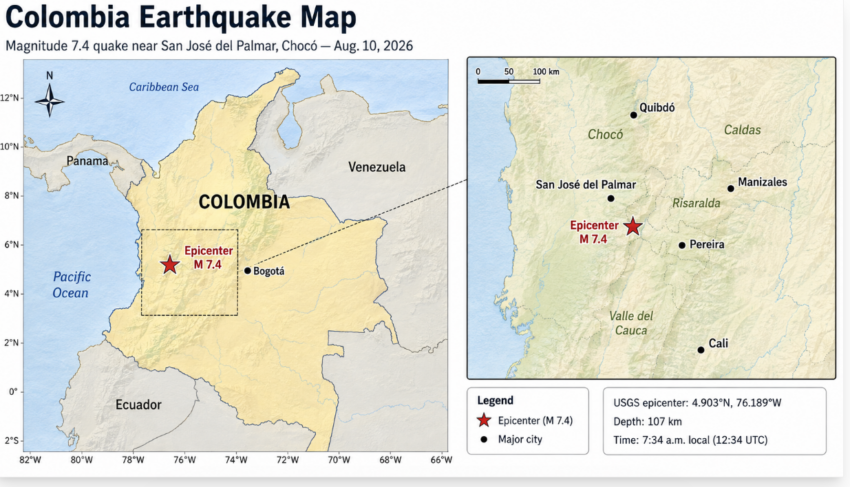
A powerful magnitude 7.4 earthquake struck western Colombia Monday morning, Aug. 10, killing at least 111 people and injuring dozens more as buildings collapsed across several cities and rescue crews searched through rubble for survivors.
The earthquake struck at approximately 7:34 a.m. local time. The U.S. Geological Survey placed the epicenter about 5 kilometers, or 3 miles, east of San José del Palmar in Colombia’s Chocó department. The USGS measured the earthquake at a depth of about 107 kilometers, or 66 miles.
The Colombian Geological Service also measured the earthquake at magnitude 7.4, with a depth of about 103 kilometers. The agency said it was the strongest earthquake recorded in Colombia during the 21st century.
At least 111 people had been confirmed dead and 87 injured by Monday evening, according to a report by Reuters citing Colombian President Abelardo de la Espriella. The government declared a national state of emergency as authorities mobilized rescue workers, medical personnel and other resources to the hardest-hit areas.
Damage was reported across much of western Colombia, particularly in Cali, Pereira, Quibdó and Manizales. The Associated Press reported that approximately 1,600 buildings had been damaged, including at least 61 that completely collapsed. Officials warned that the casualty figures could change as emergency workers reached damaged communities and searched buildings where people were believed to be trapped.
Cali, Colombia’s third-largest city, suffered extensive damage. Residents and rescue crews formed lines to move concrete and debris by hand while searching collapsed structures. Local authorities reported hundreds of damaged buildings in the city, with people believed to remain trapped at several locations.
Pereira, located in Colombia’s coffee-growing region, was also among the hardest-hit cities. Buildings and homes collapsed, while damage was reported at the city’s airport. Reuters-verified video showed a four-story building that had collapsed in Pereira as rescuers continued searching for survivors.
In Manizales, part of a tower of the city’s neo-Gothic cathedral collapsed during the shaking, sending debris onto nearby streets. Authorities urged residents to remain cautious because of the possibility of additional earthquakes.
Conditions were particularly difficult in Chocó, the department containing the earthquake’s epicenter. Communications outages prevented authorities from immediately determining the full extent of the damage in some remote communities. Much of the region is mountainous or covered by dense jungle, and some communities can only be reached by limited roads, boats or aircraft.
The earthquake was strong enough to be felt hundreds of miles away in Bogotá, where people evacuated homes and office buildings. Shaking was also reported in neighboring Ecuador and Panama, although the Associated Press said only minimal damage was initially reported outside Colombia.
Air transportation was disrupted while engineers inspected airports for structural damage. Reuters reported that operations were suspended at airports serving Pereira, Manizales, Quibdó, Armenia, Cartago and Buenaventura.
Aftershocks continued throughout the day. The Colombian Geological Service initially reported 18 aftershocks and warned that additional tremors were likely. Reuters later reported that the number had reached 21 by late Monday.
Colombia experiences frequent earthquakes because several tectonic plates interact beneath and around the country. The Colombian Geological Service says approximately 2,500 earthquakes are detected in the country during an average month, although most are small and are not felt by residents.
Western Colombia has experienced deadly earthquakes before. In January 1999, a magnitude 6.2 earthquake devastated the country’s coffee-growing region, particularly around Armenia and Pereira, killing more than 1,000 people. Monday’s earthquake was considerably stronger.
International assistance was beginning to arrive Monday night. According to a report by the Associated Press, the United States announced $15.5 million in emergency assistance for shelter, food and other earthquake response needs. Governments elsewhere in Latin America, including Mexico, El Salvador and Chile, also offered assistance.
Search-and-rescue operations were continuing Monday night, and authorities warned that the death and injury totals remained preliminary as crews attempted to reach isolated communities and people still trapped beneath collapsed buildings.