
President Donald Trump announced on Truth Social that he had paused 50% tariffs on certain Canadian imports as the two countries worked toward finalizing a trade deal. The decision came just hours before the tariffs were set to take effect at midnight, giving both sides more time for negotiations.
Canada has committed to removing discriminatory or unequal trade practices on American goods like dairy, automobiles, and liquor, according to the White House website. The USTR office congratulated Trump on social media for the progress made in the talks, according to The Hill. The White House statement said the deal would include market access for American goods, economic security commitments, digital trade alignment, and other provisions to protect both U.S. workers and Canadian partners.
Canadian Prime Minister Mark Carney said the country remained focused on building a stronger economy while negotiations continued. Trump and Carney had spoken by phone on Monday and Tuesday in the days leading up to the tariff deadline.
Canadian officials reportedly aimed to stop the Section 338 tariffs but also sought reductions in existing Section 232 tariffs on steel and aluminum. The U.S. Trade Representative Jamieson Greer had defended the tariffs as a response to Canada’s previous retaliatory actions after Trump imposed tariffs on nearly all countries last year.
Greer told reporters that the U.S. would take action if needed, but the pause allowed for further discussions. Trump’s threat to use Section 338 of the Tariff Act of 1930 marked a sharp shift from past U.S.-Canada trade relations, according to a report from NPR. This law was passed during the Great Depression when Congress sought to protect American industries by imposing high import taxes on goods from around the world.
Known as the Smoot-Hawley tariffs, these measures are widely criticized for worsening the global economic downturn. Section 338 tariffs have never been used before in U.S. history, and no investigation is required to justify them.
The tariffs could last indefinitely and apply to a broad range of Canadian exports, including items like hockey sticks and cement. Canada’s economy is heavily dependent on trade with the U.S., with nearly 72% of its goods exports going to America last year.
The political timing was also critical, as importers were already under pressure to avoid passing higher prices to consumers ahead of the November midterm elections. Canadian Chamber of Commerce President Candace Laing said the three-day delay gave businesses some relief but emphasized that a final agreement was still needed.
She noted that the current uncertainty was not ideal and urged negotiators to reach a deal quickly. Trump has made tariffs a central part of his second-term economic strategy, calling the trade deficit a national emergency.
The Supreme Court had previously ruled that Trump’s earlier tariffs were unconstitutional and struck down those tariffs. In response, Trump turned to Section 338 as a new legal tool to pressure Canada for concessions.
The U.S. is currently renegotiating the USMCA trade agreement, which Trump had previously pushed Canada to accept during his first term. The threat of Section 338 tariffs gave the U.S. additional leverage in negotiations with Canada.
Both countries had strong incentives to avoid a trade conflict that could harm their economies and political stability. The pause in tariffs allowed time for both sides to continue discussions without immediate economic consequences.
Canada has not yet officially confirmed all the specific commitments it made during the negotiations. Mark Carney said that while substantial progress had been made, important work remained before a final agreement could be reached.
Both leaders had spoken multiple times in recent days about the ongoing talks, including a call on Tuesday afternoon. The situation underscores how trade tensions between the U.S. and Canada are being shaped by broader political dynamics.
Trump’s approach to Canada has been notably more confrontational than past administrations, with repeated comments about turning Canada into America’s 51st state. The tariffs were part of Trump’s broader push to reshape trade policies and reduce reliance on foreign imports.
The U.S. government’s use of Section 338 was a rare move that drew attention from economists. The delay in implementing the tariffs also gave businesses more certainty as they prepare for potential changes in trade policy.
Both countries are now focused on finalizing a deal that addresses U.S. concerns while preserving Canadian economic interests.
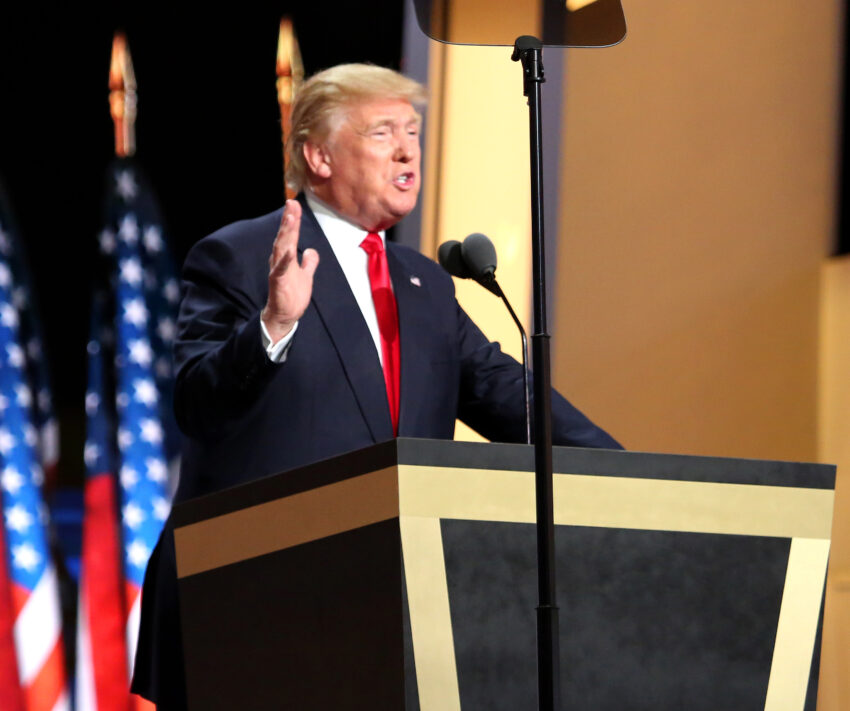
IMAGE: Trump promised to bring sweeping political change, to create wealth, and to make America safe again in a speech that excited delegates on the fourth and final day of the convention. (A. Shaker/VOA). Photo: Ali Shaker/VOA / Wikimedia, taken 2016-07-21, Public domain