
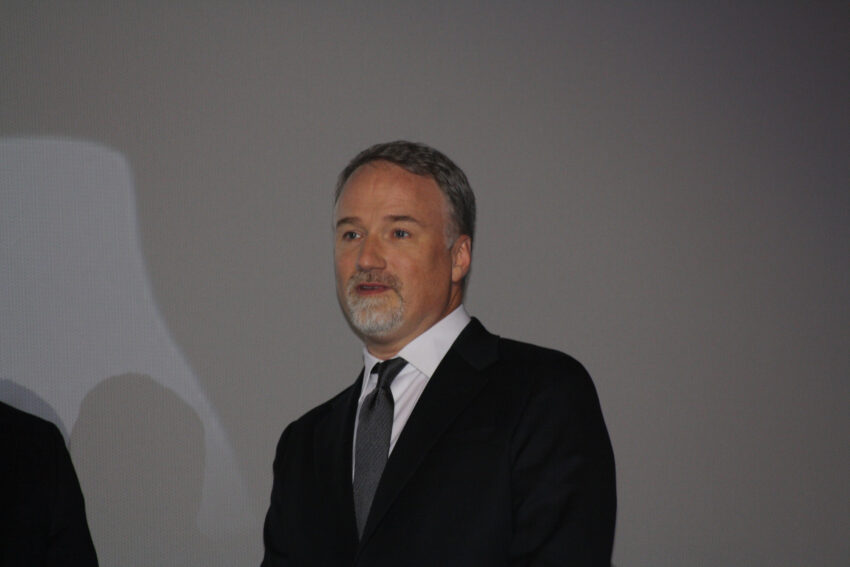
The director argues that artificial intelligence can enhance actors’ performances and give filmmakers greater creative flexibility without replacing human talent.
Director David Fincher has defended his use of artificial intelligence in The Further Mis-Adventures of Cliff Booth, arguing that the technology can enhance filmmaking without eliminating the need for human performers. His remarks come as Hollywood continues to debate the role of AI in entertainment and its potential impact on creative professionals.
The film stars Brad Pitt, who returns as the Hollywood stuntman introduced in Quentin Tarantino’s 2019 movie Once Upon a Time in Hollywood. The new film opened in IMAX theaters on November 25, 2026, ahead of its December release on Netflix.
How Fincher Used Artificial Intelligence
During an appearance on The Ringer’s The Big Picture podcast, Fincher explained how artificial intelligence helped his production team overcome challenges involving dialogue and on-screen performances.
Filmmakers often record multiple versions of the same scene. An actor might deliver the strongest reading of a line during one take but provide a more convincing physical performance during another.
Fincher used AI to combine those elements. The technology allowed editors to adjust an actor’s lip movements to match dialogue recorded separately.
This approach gave Fincher greater freedom when selecting footage for the finished film. Instead of choosing between a stronger visual performance and better dialogue, he could incorporate elements from both.
According to Variety, the actors spent approximately four or five days recording additional dialogue. Fincher also indicated that conventional dialogue replacement accounted for only a small portion of the work.
However, his comments do not establish what percentage of the entire movie contains AI-generated imagery or other artificial intelligence modifications.
Changing the Way Movies Are Made
Fincher believes artificial intelligence could eventually reduce some of the repetitive work involved in film production.
Directors frequently require actors to perform scenes numerous times while cameras capture different angles. Fincher suggested that future technology might allow filmmakers to generate additional perspectives from existing footage.
He also discussed the possibility of correcting minor visual problems without requiring additional filming. Such adjustments could give production teams more time to concentrate on storytelling and other creative decisions.
These possibilities remain different from the confirmed techniques Fincher described using in the Cliff Booth film.
The director emphasized that filmmaking still depends on human performers. Facial expressions, physical movements, emotional reactions and interactions between actors remain essential components of a believable performance.
Hollywood’s Growing Debate Over AI
Fincher’s comments arrive during a period of considerable uncertainty surrounding artificial intelligence in the entertainment industry.
Supporters believe the technology can reduce production costs, improve visual effects and provide filmmakers with additional creative options.
Critics worry that increasingly sophisticated systems could reduce employment opportunities for actors, editors, visual effects artists and other production workers.
There are also concerns about consent, compensation and the ownership of digitally modified performances.
Traditional film editing already involves selecting and combining portions of different takes. However, AI introduces additional questions because it can alter the appearance of a performance beyond what the camera originally recorded.
The distinction becomes particularly important when technology generates movements or expressions that an actor did not physically perform.
Fincher’s approach adds another example to the ongoing discussion about where conventional filmmaking ends and AI-assisted production begins.
Questions About Other Uses of AI
Some viewers who attended early screenings questioned whether artificial intelligence had been used to create other visual elements in the film.
Online discussion included speculation about an unusual horse-drawn carriage appearing in one sequence. However, the appearance of an unusual visual detail does not independently establish that generative AI was responsible.
Podcast host Sean Fennessey explained that his interview with Fincher took place before those allegations emerged. Consequently, the director was not questioned about those specific concerns during the interview.
The full extent of artificial intelligence use throughout the production has not been publicly established.
Brad Pitt Returns as Cliff Booth
Written by Quentin Tarantino and directed by Fincher, The Further Mis-Adventures of Cliff Booth returns audiences to Hollywood in 1977.
The story takes place eight years after the events of the original film and follows Booth as he navigates a changing entertainment industry and becomes involved in dangerous situations.
The supporting cast includes Elizabeth Debicki, Scott Caan, Carla Gugino, Peter Weller and Yahya Abdul-Mateen II.
The production also reunites Pitt and Fincher, whose previous collaborations include Seven, Fight Club and The Curious Case of Benjamin Button.
Unlike the original movie, which Tarantino directed himself, the new production combines his screenwriting with Fincher’s distinctive directing style.
Netflix scheduled an exclusive two-week IMAX theatrical engagement beginning November 25. The movie will become available to Netflix subscribers on December 23, 2026.
As audiences watch the film, Fincher’s production methods are likely to remain part of the broader discussion about how artificial intelligence should be used in Hollywood.
IMAGE: David Fincher, American film and music video director. Photo: Elen Nivrae from Paris, France / Wikimedia, taken 2012-01-03, CC BY 2.0