
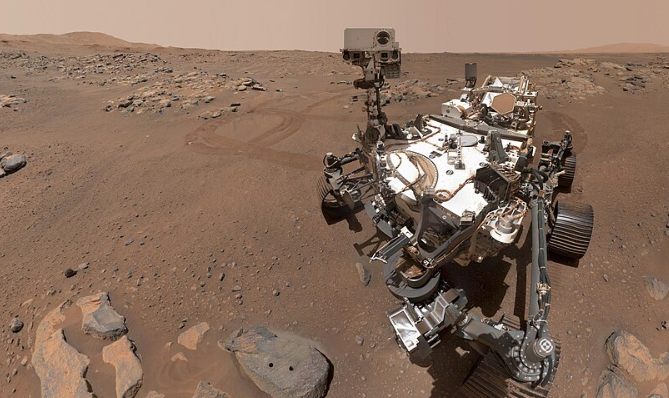
NASA engineers are investigating radio failures aboard the Perseverance rover and a critical mechanical problem affecting the 25-year-old Mars Odyssey orbiter as the agency prepares its next generation of Mars spacecraft.
NASA is confronting technical problems with two of its active Mars missions, forcing the Perseverance rover and Mars Odyssey orbiter to suspend scientific operations. The spacecraft remain in contact with Earth, but engineers are investigating separate equipment failures that threaten their ability to continue normal operations.
NASA announced the problems on November 19, 2026. The difficulties come as the agency prepares new missions to strengthen its scientific and communications capabilities around the Red Planet.
Perseverance remains stable despite its communication problems. However, Odyssey faces a potentially more serious situation involving its limited fuel supply.
Perseverance Experiences Problems With Both Radios
The communication difficulties aboard Perseverance began on October 30, when its primary ultra-high-frequency radio stopped responding to the rover’s main computer.
The rover automatically shut down the malfunctioning radio, activated its backup, and entered a protective operating mode. This automated response prevents equipment failures from causing additional problems.
However, the backup radio subsequently demonstrated reduced transmission power. Engineers suspended the use of both radios while investigating their performance.
Perseverance normally transmits much of its scientific data through spacecraft orbiting Mars. These orbiters collect information from the rover and forward it to receiving stations on Earth.
Without its normal relay capability, Perseverance must communicate directly with Earth through its high-gain antenna.
This alternative connection has a substantially lower data transmission rate. NASA has prioritized engineering information over scientific observations while specialists work to restore normal communications.
The interruption also means Perseverance is temporarily not capturing new photographs with its cameras.
NASA’s Jet Propulsion Laboratory has assigned engineers to investigate whether the backup radio can be returned to service before focusing on the primary unit.
The agency hopes to resume scientific activities by the end of November, although that depends on the results of ongoing tests.
Communication Problems Interrupt a Record-Setting Mission
Perseverance landed in Jezero Crater on February 18, 2021, beginning a mission to investigate the planet’s geological history and search for evidence of ancient microbial life.
The rover has collected rock samples, examined sedimentary formations, and studied environments that once contained liquid water.
In October 2026, Perseverance surpassed the distance record previously held by NASA’s Opportunity rover. The earlier record stood at 45.16 kilometers, or approximately 28.06 miles.
The achievement reflects the rover’s ability to explore increasingly distant locations across difficult Martian terrain.
Its current communication problems do not necessarily mean its scientific instruments or driving equipment have suffered permanent damage. Restoring reliable data transmission remains the immediate priority.
Mars Odyssey Faces a More Urgent Mechanical Problem
NASA’s Mars Odyssey orbiter is experiencing difficulties with the equipment responsible for controlling its orientation.
Odyssey entered a protective operating mode in early November after a reaction wheel stopped rotating. Reaction wheels allow spacecraft to change direction without continuously consuming propellant.
The orbiter originally carried four reaction wheels, providing redundancy if one failed. A previous failure in 2013 had already reduced that number to three.
The latest malfunction leaves Odyssey without enough functioning wheels to maintain its orientation normally.
Keeping the spacecraft properly aligned is essential for directing its solar panels toward the Sun and positioning its instruments toward Mars.
Odyssey must now depend on its hydrazine-powered thrusters for orientation control. This approach consumes fuel that cannot be replenished.
NASA estimates the spacecraft has sufficient propellant for approximately one to two months under these conditions. Engineers are continuing to refine that estimate.
Although Odyssey has exited its protective operating mode, scientific instruments remain offline.
A recent test produced movement in the malfunctioning wheel, providing some encouragement. Engineers must determine whether the component can resume reliable operation before restoring normal mission activities.
Aging Spacecraft Support Mars Exploration
Odyssey reached Mars in October 2001 and has become the longest-operating spacecraft at the planet.
Its scientific contributions include mapping the distribution of elements and minerals across the Martian surface and identifying evidence of water ice beneath the ground.
The spacecraft also provides communications support for missions operating on the surface.
Other spacecraft involved in the Mars communications network include NASA’s Mars Reconnaissance Orbiter and the European Space Agency’s Mars Express and ExoMars Trace Gas Orbiter.
NASA’s Curiosity rover, which landed in 2012, continues exploring the planet. Nevertheless, the increasing age of the equipment supporting surface exploration presents challenges for future missions.
The difficulties follow the loss of NASA’s MAVEN spacecraft, which stopped communicating with Earth on December 6, 2025.
NASA officially ended that mission on June 3, 2026, after determining the spacecraft could not be recovered.
Ars Technica reported that investigators identified a computer restart and incorrect orientation information as factors in the spacecraft’s failure. The underlying cause remains uncertain, with radiation interference and a software problem among the possibilities.
NASA Develops Nuclear-Powered Spacecraft for Future Missions
While engineers attempt to recover existing equipment, NASA is developing a new spacecraft called Space Reactor-1 Freedom, or SR-1 Freedom.
The mission is intended to demonstrate nuclear electric propulsion beyond Earth orbit. NASA is targeting a launch in late 2028.
The agency announced on November 24 that a major engineering review had established several important elements of the spacecraft’s design.
The project involves cooperation between NASA, the US Department of Energy, and commercial partners.
Under the current mission plan, the spacecraft will activate its nuclear reactor after leaving Earth orbit. Solar power will support its journey during periods when the reactor is inactive.
Engineers are also developing improved communications equipment and systems to remove excess heat generated by the reactor.
NASA awarded a $39.3 million contract to Johns Hopkins University’s Applied Physics Laboratory to develop the nuclear power module’s heat management system.
Three New Helicopters Will Explore Mars
SR-1 Freedom will transport a scientific payload called SkyFall, consisting of three helicopters developed from the technology used in NASA’s Ingenuity helicopter.
Ingenuity demonstrated that powered flight was possible in the thin Martian atmosphere. It completed 72 flights before its mission ended in January 2024.
The SkyFall helicopters are intended to conduct scientific investigations across previously unexplored terrain.
Their planned responsibilities include examining geological formations, studying the planet’s climate history, and searching for evidence of underground ice.
Such information could help NASA identify locations suitable for future robotic and human exploration.
However, the new missions remain under development and cannot provide immediate assistance to the spacecraft currently experiencing difficulties.
For now, NASA’s most pressing objectives are restoring Perseverance’s radio communications and determining whether Odyssey’s malfunctioning reaction wheel can be recovered. The results of those investigations will help determine how much longer both missions can continue contributing to Mars exploration.
IMAGE: Source https://photojournal.jpl.nasa.gov/mission/Mars%2B2020%2BRover Author NASA CC0