
Two studies published in 2026 offer possible explanations for the unusual yellow crystals discovered in Gale Crater, revealing new clues about the Red Planet’s ancient chemistry.
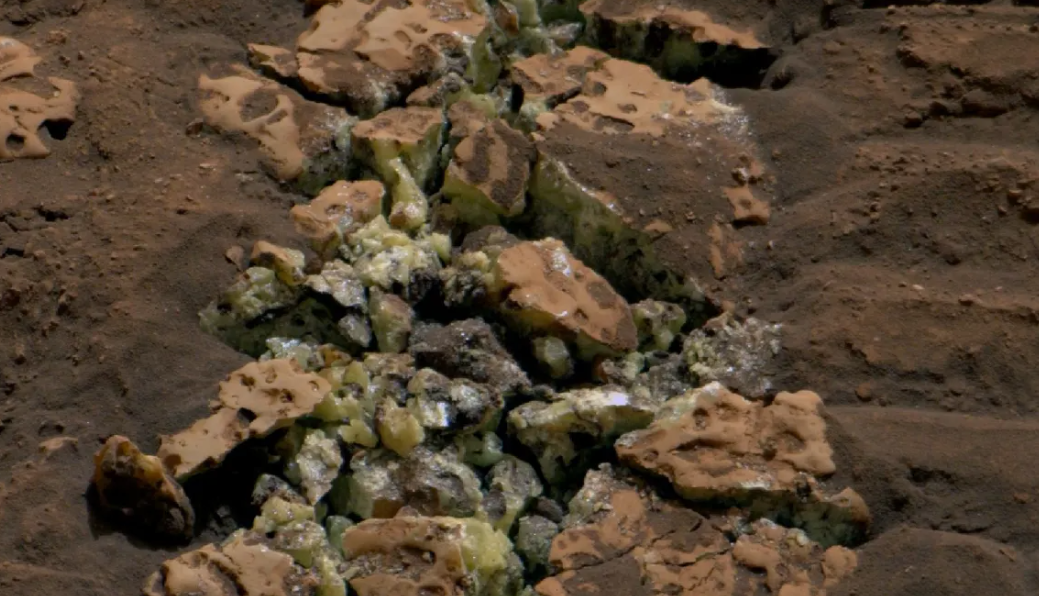
NASA’s Curiosity rover made an unexpected discovery on Mars when it accidentally crushed a rock and exposed bright yellow crystals of pure sulfur. The discovery occurred on May 30, 2024, in the Gediz Vallis channel within Gale Crater. Two scientific studies published in 2026 have since investigated how the unusual material might have formed.
The finding marked the first confirmed detection of elemental sulfur in its pure form on Mars. Although scientists had previously identified sulfur-containing minerals across the planet, the presence of concentrated sulfur crystals presented a geological mystery. The new research suggests that ancient volcanic gases or chemical reactions involving water could explain the deposits.
Curiosity Accidentally Reveals Yellow Sulfur Crystals
Curiosity was traveling through Gediz Vallis, a channel carved into the slopes of Mount Sharp, when one of its wheels rolled over a relatively ordinary-looking rock. The stone broke apart, exposing yellow crystals that stood out against the surrounding reddish-brown terrain.
The rover subsequently examined the broken material using instruments mounted on its robotic arm. Its Alpha Particle X-ray Spectrometer, known as APXS, helped researchers determine that the crystals consisted of elemental sulfur rather than a more familiar sulfur-containing mineral.
NASA released images of the discovery in July 2024, showing the exposed crystals and surrounding rock fragments. Scientists also identified many similar light-colored stones scattered across the nearby terrain, suggesting the discovery was not an isolated occurrence.
A later scientific assessment described a field of sulfur-bearing rocks covering approximately 2,100 square meters. The scale of the deposit made the finding especially interesting because such concentrations require particular chemical and geological conditions.
Ashwin Vasavada, Curiosity’s project scientist at NASA’s Jet Propulsion Laboratory, compared finding the sulfur-rich stones to discovering an oasis in a desert. The comparison reflected how unexpected the material was in a region where scientists had not anticipated finding it.
Why Pure Sulfur on Mars Is Unusual
Sulfur itself is not rare on Mars. Previous missions have identified sulfate minerals, which contain sulfur chemically combined with oxygen and other elements. These materials commonly form when mineral-rich water evaporates or reacts with surrounding rocks.
Elemental sulfur is different because it consists of sulfur atoms without those additional chemical components. On Earth, deposits can develop through volcanic activity, reactions involving underground water and other chemical processes.
Some sulfur deposits also form through microbial activity, making the element important to research into environments that might support life. However, the discovery of sulfur alone does not establish that living organisms were ever present.
The location of the crystals created another puzzle. Scientists had not found clear evidence of the kinds of high-temperature volcanic or hydrothermal conditions commonly associated with some terrestrial sulfur deposits.
Researchers therefore began examining whether the material could have formed through different pathways under ancient Martian conditions. The surrounding geology, including evidence of erosion and past water movement, offered important clues.
Scientists Propose an Ancient Volcanic Gas Origin
One explanation emerged from research led by planetary scientist Scott VanBommel of Washington University in St. Louis. The study, published in Science on August 20, 2026, examined the sulfur deposit and its geological setting.
The researchers determined that the sulfur-bearing stones probably formed in or near their present location rather than being carried across the landscape from a distant source. Their interpretation was based on the distribution of the rocks and characteristics of the channel where they were discovered.
The team proposed that ancient volcanic activity released sulfur-bearing gases beneath the Martian surface. Those gases could have traveled upward through underground materials before cooling and becoming trapped beneath frozen ground.
As erosion gradually carved deeper into Gediz Vallis, pressure on the underground deposits may have decreased. The resulting changes could have allowed sulfur-bearing material to move toward the surface and eventually accumulate as elemental sulfur.
This explanation connects the discovery to Mars’ ancient volcanic history without requiring an active volcano at the precise location of the sulfur deposits.
However, the process remains a scientific hypothesis rather than an established account of what occurred. Researchers have not directly observed the proposed sequence, and the existing geological evidence does not establish a single definitive formation mechanism.
Laboratory Experiments Reveal Another Possible Explanation
A separate study published July 21, 2026, in Geophysical Research Letters investigated whether elemental sulfur could form through chemical reactions involving water. Instead of analyzing only Martian rocks, the researchers recreated selected chemical conditions in laboratory experiments.
The scientists examined reactions between dissolved sulfide and chlorate, a chemical compound considered a possible oxidizing agent in Martian environments. The experiments took place under acidic, oxygen-free conditions intended to represent certain aspects of ancient Mars.
Researchers conducted the tests over 54 days, varying the concentration of chlorate and monitoring the materials produced. They discovered that chemical reactions could transform dissolved sulfide into elemental sulfur without requiring biological activity.
The amount of chlorate influenced the results. Lower concentrations generally favored the production of elemental sulfur, while higher concentrations encouraged the formation of sulfate.
These findings established a possible nonbiological pathway for producing sulfur in environments containing water and suitable chemical ingredients. The results also showed how changes in water chemistry could produce different sulfur minerals.
The experiments did not demonstrate that this exact reaction occurred in Gediz Vallis. Instead, they identified a scientifically plausible process that researchers can compare with observations collected by Curiosity.
What the Discovery Means for Ancient Martian Water
Both studies add to a growing understanding of how Mars changed over billions of years. Although the planet is now cold and dry, its surface preserves extensive evidence of ancient rivers, lakes and interactions between water and rock.
Curiosity has explored Gale Crater since landing in August 2012. The rover’s primary mission is to investigate whether environmental conditions on ancient Mars could have supported microbial life.
The sulfur deposits provide additional information about the chemical processes that may have operated after sediments accumulated in the crater. They also suggest that the movement of underground fluids could have influenced the surrounding landscape.
Gediz Vallis is particularly valuable because it cuts through rock layers representing different periods of Martian history. Researchers believe parts of the channel were shaped by flowing water, debris flows and erosion.
The combination of these features provides an opportunity to examine how the planet’s geological conditions evolved. The sulfur crystals add another piece of evidence to that history, although their precise age and formation conditions remain uncertain.
Sulfur is essential to life on Earth because it contributes to proteins and important biological reactions. Nevertheless, scientists emphasize that the existence of elemental sulfur on Mars is not evidence that the planet once hosted organisms.
The laboratory findings demonstrate why caution is necessary. Processes that do not involve living organisms can also produce materials associated with biological activity.
Curiosity’s Instruments Help Scientists Investigate
Curiosity carries several instruments designed to study Martian rocks, sediments and atmospheric conditions. Its APXS instrument measures the chemical composition of materials, while cameras provide detailed views of geological structures and surface features.
The rover’s Mast Camera photographed the exposed sulfur crystals on June 7, 2024. The images helped scientists identify the appearance and distribution of the material before examining the broader surrounding landscape.
Researchers also used observations from Curiosity’s other instruments to investigate nearby rocks and deposits. These measurements helped establish that the sulfur-rich material differed from the sulfate minerals previously encountered in Gale Crater.
The rover continued exploring the area after the initial discovery, collecting additional observations about the channel’s geological history. Its findings have provided researchers with data for studying how sulfur-bearing materials could form and remain preserved on Mars.
Scientists must now compare the proposed formation mechanisms with the available measurements. Further laboratory experiments and geological analysis may help determine which explanation best matches the evidence.
For now, the discovery remains one of Curiosity’s most unusual findings. The two 2026 studies have identified possible ways the sulfur formed, but neither has established its origin with certainty.
IMAGE: NASA/JPL-Caltech/MSSS / Wikimedia Commons / Public Domain.