
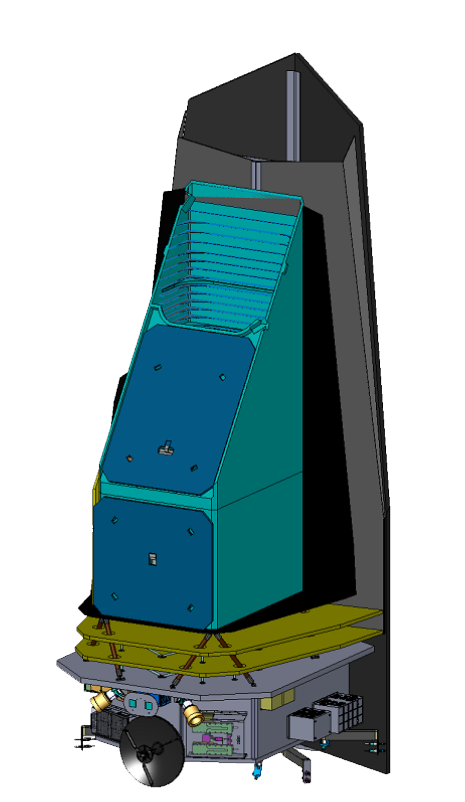
NASA has completed important testing of a 20-foot sunshade equipped with 864 solar cells, bringing its asteroid-hunting space telescope closer to a planned 2027 launch.
NASA’s NEO Surveyor mission has reached another important development milestone after engineers completed the integration and testing of solar arrays on the spacecraft’s enormous sunshade. The system will protect a sensitive infrared telescope from sunlight while generating electricity for the mission to search for potentially hazardous asteroids and comets.
The space agency announced the progress on October 26, 2026, following several months of assembly, environmental testing and inspections. The spacecraft is being developed to detect near-Earth objects that are difficult to discover using conventional ground-based telescopes.
The sunshade is the spacecraft’s largest component, standing 20 feet (6 meters) tall and measuring 8 feet (2.4 meters) wide at its base. Its two flat panels meet at a 23.5-degree angle, creating a protective structure designed to shield the telescope from the Sun’s intense light and heat.
Engineers installed 864 interconnected solar cells across the structure earlier this year. Together, those cells can generate up to 2 kilowatts of electricity, providing the power needed to charge batteries that operate the spacecraft’s systems.
The newly completed testing brings NASA closer to launching a telescope specifically designed to improve Earth’s ability to identify potentially dangerous objects in space.
Solar Array Completes Critical Testing
The sunshade’s development involved several aerospace companies and specialized testing facilities across the United States.
Applied Aerospace manufactured the main structure at its facility in Stockton, California. The company built the large panels that will eventually shield NEO Surveyor’s infrared instruments during observations.
In January 2026, SolAero Technologies installed the solar cells at its facility in Albuquerque, New Mexico. The delicate electrical components were attached to the sun-facing surfaces of the sunshade, allowing the structure to serve two important purposes.
The completed assembly then traveled to El Segundo, California, where engineers conducted environmental testing inside a commercial thermal vacuum facility in March.
These facilities recreate some of the difficult conditions spacecraft experience beyond Earth’s atmosphere. Vacuum testing allows engineers to evaluate equipment without surrounding air, while thermal testing examines how components respond to changing temperatures.
The testing is essential because repairing spacecraft hardware after launch is generally impossible. Problems with electrical connections, temperature control or mechanical structures must be identified before the equipment leaves Earth.
Following the environmental tests, the sunshade was delivered ahead of schedule to BAE Systems Space & Mission Systems in Boulder, Colorado, in May.
Engineers continued their work throughout the summer, inspecting the structure and integrating additional equipment.
NASA reported that coarse Sun sensors and temperature sensors have since been installed. The Sun sensors will help the spacecraft determine its orientation, while the temperature sensors will monitor conditions affecting its equipment.
Teams also completed functional and performance testing of the solar array, verifying that the system operates as intended.
Photographs taken in July show the large structure mounted on an assembly ring inside a clean room in Colorado. Technicians inspected its surfaces and electrical components before additional spacecraft integration work.
Why the Sunshade Is Essential
Although the solar panels provide the spacecraft with electricity, the sunshade’s primary purpose is to keep the telescope cool and protect its instruments from unwanted sunlight.
NEO Surveyor will study asteroids and comets using infrared radiation rather than relying entirely on visible light.
Objects in space absorb energy from the Sun and release some of that energy as heat. Infrared detectors can identify that thermal radiation, including emissions from asteroids that reflect very little visible sunlight.
This capability is especially important for discovering dark asteroids.
Some asteroids have surfaces that reflect only a small percentage of incoming sunlight, making them difficult to detect with ordinary optical telescopes. However, these objects can still produce infrared signals as their surfaces warm.
NEO Surveyor will use a telescope with an aperture approximately 20 inches (50 centimeters) wide to collect infrared radiation from distant objects.
The spacecraft’s sunshade will help prevent direct sunlight from entering that opening. It will also reduce unwanted heating of the instruments, allowing them to detect faint infrared signals more effectively.
Without sufficient protection from solar heat, the telescope’s ability to distinguish relatively weak thermal emissions from distant asteroids could be reduced.
The specialized design is particularly valuable because some near-Earth objects appear close to the Sun in the sky when viewed from Earth.
Ground-based optical telescopes have difficulty observing those regions because sunlight overwhelms faint objects. Earth’s atmosphere and the day-night cycle create further restrictions on when observations can be made.
A space-based infrared telescope can overcome some of those limitations and expand the regions scientists can search.
Advanced Cameras Will Measure Asteroid Sizes
NEO Surveyor will carry two infrared detector arrays designed to observe objects in different wavelength bands.
Each detector array will produce a 16-megapixel mosaic image of the sky. By observing the same region in both infrared bands, scientists can obtain information about an object’s temperature.
Temperature measurements, combined with the observed infrared brightness, can help researchers estimate an asteroid’s size.
That information matters because an object’s dimensions are an important part of evaluating the possible consequences of an impact with Earth.
An asteroid’s brightness alone does not reliably reveal its size. A small, reflective asteroid may appear similar in visible light to a much larger object with a dark surface.
Infrared observations provide another way to distinguish between those possibilities.
Scientists will also use repeated observations to determine the locations and movements of newly detected objects.
Tracking an asteroid over time allows researchers to calculate its orbit and assess whether it might approach Earth in the future.
NEO Surveyor is not designed to destroy or redirect asteroids. Its responsibility is to identify and characterize objects, providing information that could support future planetary defense decisions.
Mission Designed to Improve Planetary Defense
NASA established its Planetary Defense Coordination Office to coordinate efforts to identify and study asteroids and comets that could threaten Earth.
The agency already works with ground-based observatories and other spacecraft to monitor near-Earth objects.
However, some objects remain undiscovered because they are relatively small, unusually dark or positioned in areas that existing telescopes cannot easily observe.
Congress directed NASA in 2005 to improve the detection and characterization of near-Earth objects large enough to pose serious hazards.
NEO Surveyor is intended to help meet that goal by searching for objects that other observing systems may miss.
In May 2026, NASA reported that the mission’s telescope and other major components were undergoing integration and testing at facilities across the country.
The mission is managed by NASA’s Jet Propulsion Laboratory in Southern California, with scientific leadership from the University of California, Los Angeles.
BAE Systems, Space Dynamics Laboratory and other industry partners are contributing major spacecraft components and instruments.
The completed observatory is expected to conduct systematic infrared surveys after reaching its operating location in space.
By combining those observations with data from existing asteroid surveys, scientists expect to build a more complete picture of the near-Earth object population.
Launch Planned for 2027
NEO Surveyor is currently scheduled to launch no earlier than September 2027, although the date remains subject to further development and testing.
Before launch, engineers must complete spacecraft integration and verify that the telescope, sunshade, communications equipment and other essential systems operate together properly.
The solar array’s successful testing marks progress toward that goal, but it does not mean the entire spacecraft has finished qualification testing.
The mission’s ability to produce its own electricity will be essential during its observations. Its solar cells must operate while the sunshade maintains the protective environment required by the infrared instruments.
NASA’s October update confirms that the completed array has passed functional and performance checks and that additional sensors are now integrated into the structure.
The next stages of spacecraft assembly and testing will determine whether the observatory remains on schedule for its planned 2027 launch.
IMAGE: NEO-Surveillance-Mission-Diagram. Photo: NASA / Wikimedia, taken 2019-09-24, Public domain