
NASA’s Stardust spacecraft made history by returning to Earth in January 2006 after collecting samples from comet Wild 2 and interstellar dust. The capsule was scheduled to land on Sunday, January 15, 2006, around 5:12am Eastern time. It traveled at a speed of twelve point eight kilometers per second, which is fast enough to go from San Francisco to Los Angeles in one minute. This made Stardust the fastest spacecraft ever to return to Earth, breaking a record set during the Apollo missions of 1969. The capsule was expected to light up the sky for people in Northern California, Oregon, Nevada, and Utah as it entered Earth’s atmosphere. The capsule resembled a small Apollo module, weighing about seven kilograms or one hundred pounds.
Stardust’s principal investigator, Don Brownlee of the University of Washington, said the mission had traveled further than any spacecraft from Earth ever has, according to Wikinews. The spacecraft went halfway to Jupiter to meet the comet and collect samples from it. Scientists hoped that by studying the particles, they could learn more about how the universe formed and what materials made up the planets. Comets are considered some of the most informative objects in the solar system, according to Dr. Brownlee. The mission also aimed to support future human exploration of the Moon, Mars, and beyond.
Stardust was not only collecting samples from comet Wild 2 but also possibly dust from distant stars that might be older than Earth or even the Sun. These particles were so small they could only be found using a high-magnification microscope with a field of view smaller than a grain of salt. NASA faced the challenge of finding millions of these tiny particles among a large collector surface. To solve this problem, NASA turned to distributed computing through a project called Stardust@home, according to a report from Wikinews. This project used volunteers from around the world to help identify tracks left by the particles in digital images.
Participants had to go through a web-based training session and pass a test before they could join the project. The test required volunteers to find tracks in sample images, with some tests including false examples to check reliability. If at least two of four volunteers reported a track, the image would be sent to 100 more for verification. Once 20 or more of these additional volunteers confirmed a track, experts at UC Berkeley would verify the identification.
Volunteers could download a virtual microscope to search through images on their own computers. The virtual microscope worked with digital images from the Stardust Interstellar Dust Collector at Johnson Space Center. This project was unlike other distributed computing efforts such as SETI@home, which relied on computers rather than human eyes.
Andrew Westphal is the director of Stardust@home and spoke with Wikinews in May 2006 about the mission. He explained that Stardust was a NASA Discovery mission launched in 1999 with two main goals: collecting samples from comet Wild 2 and returning them to Earth. This was the first U.S. sample return mission since Apollo and the first from beyond the Moon. The mission also brought back the first solid samples from the local interstellar medium, which is considered a sample of the Galaxy.
The main challenge was finding the tiny particles among a large collector surface, about one-tenth of a square meter. An automated microscope scanned the collector and created stacks of digital images for analysis. The number of particles expected to be found was uncertain, with estimates ranging around forty-five based on earlier dust detection missions. Scientists anticipated that the particles would be about a micron in size, but they would look for tracks made by the particles instead.
The search process was expected to take several months, with scanning limited to about one tile per day across 130 tiles. The mission also tested new technologies, including a Hall effect thruster that powered the spacecraft beyond Earth orbit, Wikinews reported. This engine used xenon fuel and magnetic fields to accelerate ions, making it more efficient than traditional chemical rockets.
SMART-1 was launched in 2003 and orbited the Moon for over three years, covering more than 62 million miles. The probe crashed into the Moon on September 5, 2006, creating a new crater and scattering debris up to 30 miles. Its mission included mapping the Moon’s chemical structure using X-ray and infrared cameras. The probe was one of the smallest and cheapest missions ever undertaken by the European Space Agency. SMART-1’s success helped pave the way for future missions like Chandrayaan-1 and Bepi-Colombo.
The impact was observed by ground-based telescopes, including the Mauna Kea Observatory in Hawaii. ESA sources said the mission was successful in testing new technology and gathering data about the Moon.
The Stardust spacecraft’s return marked a major step forward in space exploration and scientific discovery.
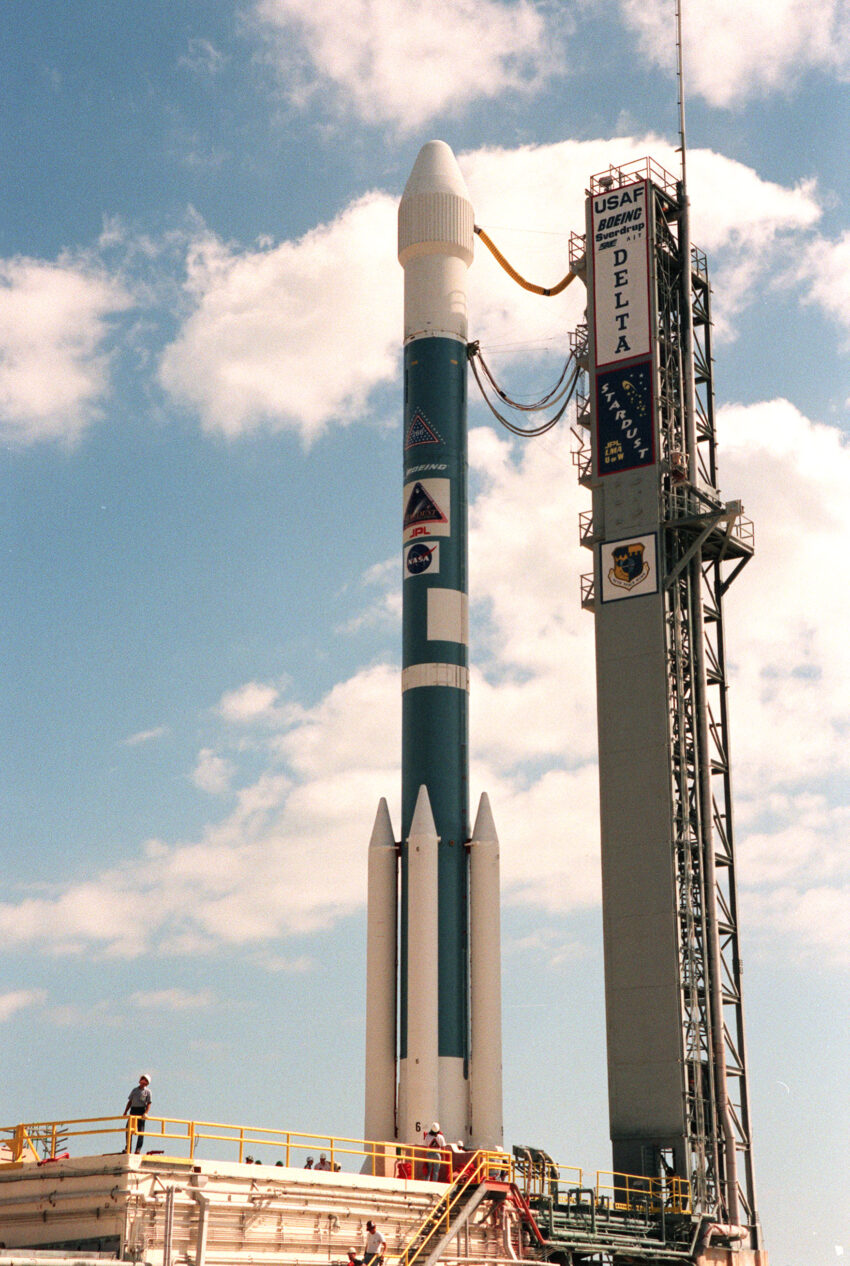
IMAGE: Delta II 7426 with Stardust before launch, Cape Canaveral, February 1999
original image caption: The Boeing Delta II rocket carrying the Stardust spacecraft waits for launch at Launch Pad 17-A, Cape Canaveral Air Station. The targeted launch time is 4:06 p.m. EST. Stardust is destined for a close encounter with the comet Wild 2 in January 2004. Using a silicon-based substance called aerogel, Stardust will capture comet particles flying off the nucleus of the comet. The spacecraft also will bring back samples of interstellar dust. These materials consist of ancient pre-solar interstellar grains and other remnants left over from the formation of the solar system. Scientists expect their analysis to provide important insights into the evolution of the sun and planets and possibly into the origin of life itself. The collected samples will return to Earth in a sample return capsule to be jettisoned as Stardust swings by Earth in January 2006.. Photo: Wikimedia, Public domain