
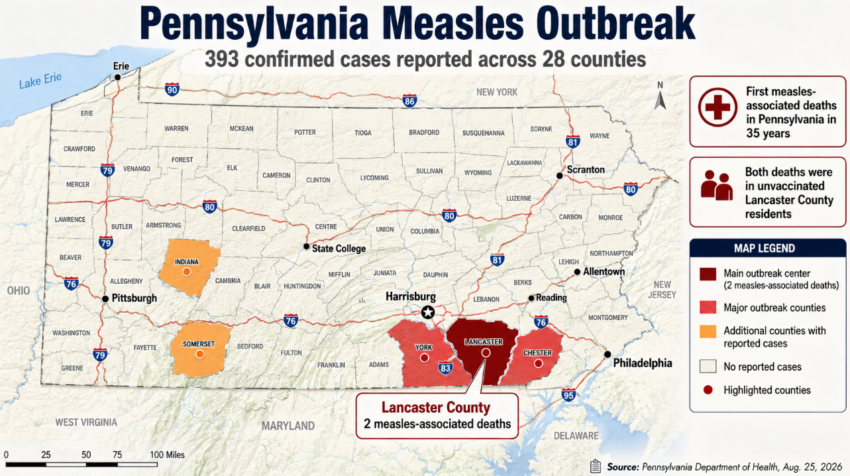
Pennsylvania has confirmed its first two measles-related deaths in decades, marking a tragic milestone in the state’s recent health history. The individuals who died were not vaccinated against measles, according to the Pennsylvania Department of Health. State health officials announced the deaths on Tuesday, expressing sorrow over the loss and emphasizing that measles is a preventable disease.
The outbreak has been centered in Lancaster, Chester, and York counties but is spreading throughout the state, according to heraldstandard.com. Measles cases have appeared in 28 of Pennsylvania’s 67 counties, with nearly 400 cases reported so far. The number of cases has surged dramatically compared to previous years, with only 16 reported in all of 2025 and just six in 2024.
Pennsylvania now ranks third nationally in measles cases, behind South Carolina and Utah. Governor Josh Shapiro joined Health Secretary Debra Bogen at Lancaster General Hospital to encourage residents to get the MMR vaccine. The vaccine is typically given in two doses, one around age one and another between ages four and six.
Shapiro said the deaths from measles are completely preventable, and that the disease does not discriminate based on location or belief. Health officials noted that people have become unfamiliar with measles due to decades of low infection rates. The virus spreads through the air when an infected person coughs or sneezes, and can survive on surfaces for up to two hours.
Initial symptoms include cough, runny nose, and watery eyes, followed by a rash that starts on the head and moves downward. Symptoms typically appear within one to three weeks after exposure. Deaths from measles are rare, occurring in about 1 to 3 out of every 1,000 cases.
Dr. Jeffrey Martin from Lancaster General Hospital emphasized that measles is not a harmless virus and the recent deaths are a reminder of its danger. The outbreak has also affected neighboring areas, with cases appearing in Indiana and Somerset County. Lancaster County is known as the heart of Pennsylvania’s Amish community, which sometimes avoids modern medical interventions such as vaccines, according to a report from NDTV.
Governor Shapiro addressed concerns about vaccine skepticism and urged parents to seek trusted healthcare advice before making decisions, wbng.com reported. He pointed out that the rate of families citing philosophical or religious exemptions for vaccines has tripled in the past decade. Shapiro also noted that misinformation makes it harder for parents to decide what is best for their children.
The state is preparing healthcare professionals with clinical guidance to help manage the outbreak. Health officials encouraged people to consult trusted medical sources and speak with healthcare providers before making vaccination choices. The state’s health department continues to monitor the situation closely and is working with federal officials.
Health Secretary Debra Bogen said that while measles was once rare in Pennsylvania, people have forgotten how dangerous it can be. Dr. Bogen also noted that many people do not realize the severity of measles symptoms or its potential for serious complications. The recent outbreak has reminded public health officials that measles remains a serious threat when vaccination rates drop.
State officials are urging all residents to get vaccinated, especially those who have not received the MMR vaccine. They emphasized that the virus is highly contagious and can spread quickly in unvaccinated populations. The situation has drawn attention to the importance of maintaining high vaccination rates.
Health officials are also concerned about how misinformation and vaccine hesitancy may be contributing to the spread. The state is working to educate residents and provide clear information about the safety and importance of vaccines. Governor Shapiro said that the goal is to prevent more deaths and stop the outbreak from growing further.
He added that the state’s public health system is working to ensure all communities have access to vaccine information and services. The outbreak has highlighted how quickly measles can re-emerge when vaccination rates fall. Health experts have warned that without continued efforts to maintain high vaccination coverage, measles could return more frequently.
The state is taking steps to ensure that healthcare providers are prepared to handle cases and educate the public. Public health officials continue to stress that vaccination is the best way to protect individuals and communities from measles.
IMAGE: Pennsylvania Measles Outbreak Map Shows Cases Across 28 Counties DNR Art Department