
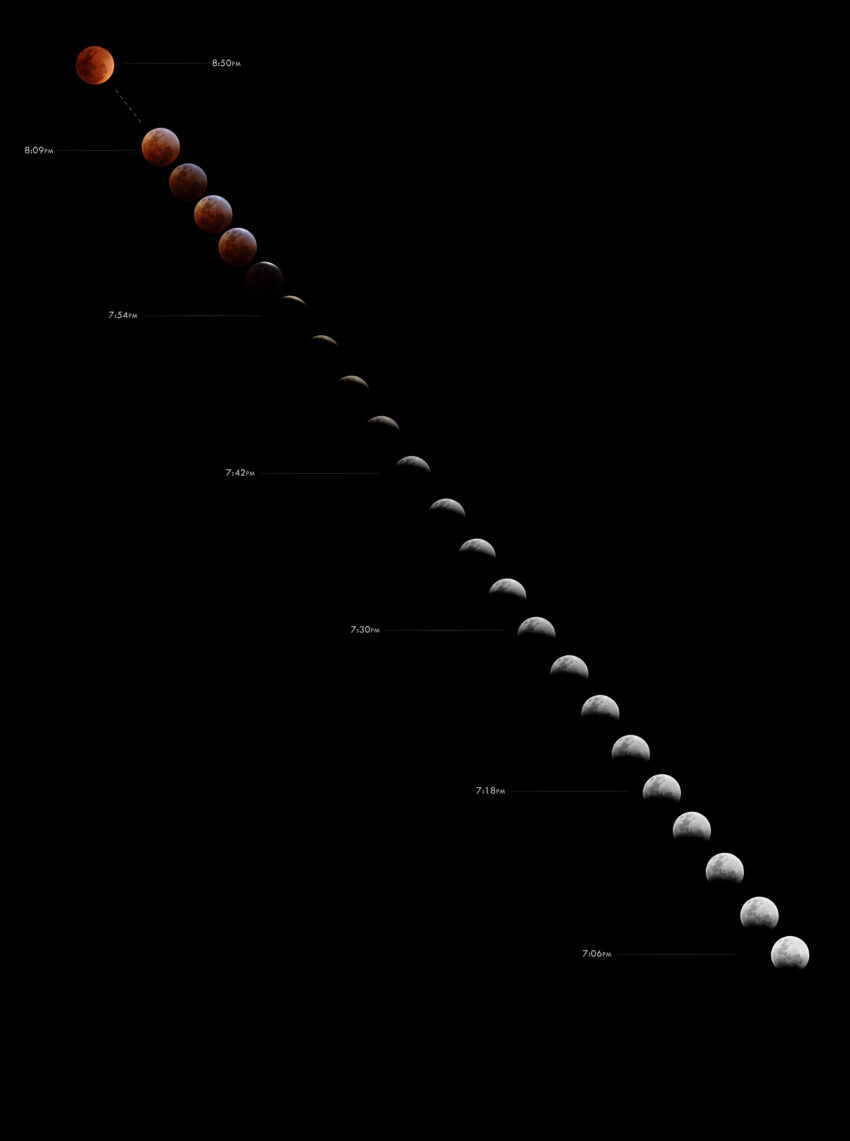
The night sky will offer a striking sight on the evening of August 27 and early morning of August 28 as a deep partial lunar eclipse transforms the full Moon into a rich coppery red color. This event is classified as a partial eclipse rather than a total eclipse, but the Moon will still appear deeply shadowed and take on a dramatic Blood Moon hue. The eclipse will be visible across a wide area including North and South America, Africa, Greenland, Iceland, and western Europe.
Observers in the UK and parts of Europe will see the Moon begin to enter Earth’s shadow around 3:33am BST on August 28, according to The Guardian. At its peak, only a thin sliver of the Moon will remain bright, while the rest appears dusky orange or red, according to a report from astronomy.com. The eclipse begins when the Moon enters Earth’s outer shadow, known as the penumbra, around 9:23pm EDT on August 27.
The partial eclipse starts in earnest when the Moon moves into Earth’s darker inner shadow, called the umbra. The Moon will gradually darken as it passes deeper into the shadow, though the color change may not be immediate. The eclipse reaches its maximum at around 12:13 A.M. EDT on August 28, when the Moon is most deeply within Earth’s shadow.
The event ends just before 3:02am EDT on August 28, when the Moon fully exits Earth’s shadow. Unlike a solar eclipse, watching this lunar event is completely safe with no eye protection needed, jagranjosh.com reported. The Moon’s color during the eclipse depends on how much light is bent through Earth’s atmosphere.
Shorter wavelengths like blue and green are scattered, while longer red and orange waves pass through to light the Moon. The exact shade of color can vary depending on atmospheric conditions, such as volcanic particles or smoke from wildfires. Skywatchers can use the Danjon scale to rate how dark or red the Moon appears during this eclipse.
This scale rates the Moon from nearly black to rust red, with four levels in between. During maximum eclipse, more stars may become visible because the Moon’s bright light is reduced. The next lunar eclipse will occur in February 2027, though it will be a penumbral eclipse that does not fully cover the Moon.
The August eclipse is part of a pattern where eclipses often come in pairs, following a total solar eclipse on August 12. For those in the UK and Europe, it’s best to look out early in the morning for the best view of this celestial event. The eclipse will be visible from late night on August 27 in parts of the Americas, and just before dawn in New Zealand.
The Moon’s appearance during this eclipse will vary depending on atmospheric conditions at the time. Observers can enjoy watching the gradual change in the Moon’s brightness and color over several hours without any special tools. The eclipse will not be visible from all parts of the world due to Earth’s rotation and the Moon’s position.
The next major eclipse event will be a partial penumbral eclipse in February 2027. This upcoming eclipse follows the August 12 solar eclipse, which was visible across parts of North America. The Moon’s surface will appear dimmer and more orange or red as it moves through Earth’s shadow, with only a thin sliver along its northeastern limb remaining bright white.
The eclipse is a result of Earth moving between the Sun and the Moon, casting its shadow on the lunar surface. The red hue comes from longer light waves bending through Earth’s atmosphere and illuminating the Moon’s shadowed side. The eclipse will be visible from many locations in the Northern Hemisphere, especially in areas where the Moon is high in the sky.
It’s a rare chance to see how Earth’s shadow affects the appearance of the Moon during an eclipse. The event will not be visible in daylight hours for many viewers, as it occurs when the Moon is below the horizon. Skywatchers who are able to view the eclipse will notice the Moon’s surface growing darker as it enters Earth’s shadow.
The eclipse is not only a visual spectacle but also an opportunity to observe how light behaves in Earth’s atmosphere. The August eclipse is one of a few celestial events that occur within a short time frame, making it a particularly special moment for astronomy enthusiasts. The eclipse will be most visible in the early morning hours, especially for those who are willing to wake up early.
The Moon will appear to take on a coppery or dusky red color during the peak of the eclipse, offering a unique sight for stargazers. This event is a reminder of how Earth and the Moon interact in space, and how light behaves when it passes through our planet’s atmosphere. The eclipse is a chance to appreciate the beauty and science of the night sky without needing any special equipment.
It’s an event that can be enjoyed from home or outside, as long as the Moon is visible in the sky. The eclipse will not last for very long, but it offers a unique view of how Earth’s shadow affects the Moon. It is safe to watch the eclipse with the naked eye, unlike a solar eclipse which does not require special filters.
The eclipse will be visible from many areas in the UK and across Europe, especially for those who rise early. This lunar eclipse is a reminder of how Earth’s shadow can change the look of the Moon in a visual spectacle way. The event will be a highlight for amateur astronomers and casual skywatchers alike.
IMAGE: Total lunar eclipse, August 28 2007 as seen from Swifts Creek, Victoria, Australia (GMT +10). Photo: User:Fir0002 / Wikimedia, taken 2007-08-28, GFDL 1.2