
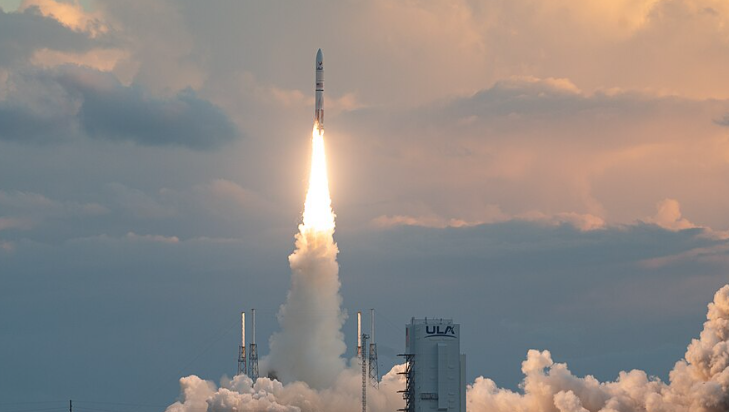
United Launch Alliance suffers its first complete mission failure in 20 years after its Vulcan rocket malfunctions shortly after liftoff from Florida. The loss threatens Amazon’s satellite internet expansion and could disrupt U.S. military launch schedules.
United Launch Alliance suffered its first complete mission failure in 20 years on Sunday, November 15, 2026, when a Vulcan rocket malfunctioned about 10 minutes after liftoff from Cape Canaveral Space Force Station in Florida. The failure destroyed 40 Amazon Leo internet satellites and raised new questions about the reliability of a rocket expected to serve both commercial customers and the U.S. military.
The rocket lifted off at 12:40 p.m. Eastern Time from Space Launch Complex 41. Its mission was to place the satellites into low Earth orbit as part of Amazon’s developing broadband network, which is intended to compete with SpaceX’s Starlink service.
United Launch Alliance, commonly known as ULA, confirmed that the vehicle failed to deliver its payload to orbit. The company announced an investigation but said it did not yet have enough information to identify the cause.
The loss is particularly significant because it was the first of 38 Vulcan launches Amazon contracted to deploy its satellite constellation. It also occurred during Vulcan’s return to flight following an earlier technical problem that had kept the rocket grounded for months.
What Happened During the Vulcan Launch?
The mission, designated Vulcan Leo 1, initially appeared to proceed normally. The rocket rose from Cape Canaveral with six solid rocket boosters providing additional thrust during the opening minutes.
Those boosters separated as planned after completing their work. The vehicle continued climbing under the power of two BE-4 engines manufactured by Blue Origin.
The BE-4 engines burn liquefied natural gas and liquid oxygen. They provide the primary thrust needed to propel Vulcan through the lower atmosphere before the rocket’s upper stage takes over.
However, flight data and the launch broadcast indicated that something was wrong before the vehicle reached orbit.
The main engines were scheduled to shut down shortly before the five-minute mark. Instead, they continued operating for at least another 30 seconds, according to an analysis published by Ars Technica.
That extended burn suggested the rocket might not have been accelerating as expected. Launch vehicles sometimes compensate for lower-than-expected performance by operating their engines longer, provided sufficient fuel remains available.
The telemetry-driven animation used during ULA’s broadcast then showed the rocket beginning to rotate shortly after the main engines shut down.
The rotation continued through separation of the Centaur V upper stage. The upper stage’s two RL10 engines ignited, but the animation showed their nozzles moving as the vehicle attempted to correct its orientation.
ULA ended its live broadcast without announcing the problem. Shortly afterward, the company confirmed that the mission had failed.
Engineers Investigate Possible Booster Problems
The precise cause of the failure remains unknown. ULA has not publicly identified a specific defective component or determined whether the problem originated in propulsion, guidance or another system.
Ars Technica reported that sources familiar with the incident pointed toward the rocket’s main booster stage rather than the solid rocket boosters or Centaur upper stage.
That information remains preliminary and has not been confirmed as an official finding.
The investigation will likely examine data from the BE-4 engines and the systems responsible for supplying them with propellant. Engineers will also review guidance and control information to understand why the vehicle began rotating.
The BE-4 engines are manufactured by Blue Origin, the aerospace company founded by Amazon executive chairman Jeff Bezos. A version of the same engine is also used on Blue Origin’s New Glenn rocket.
This connection could make the investigation particularly important if engineers discover a problem involving shared engine technology. However, there is currently no confirmed evidence that a BE-4 engine defect caused the Vulcan failure.
ULA said it would work with its customers and other organizations to identify the cause, determine corrective measures and return Vulcan to flight.
The company also promised to provide customers with information about its investigation.
First Complete Mission Failure in ULA History
The incident represents a major setback for a company that has built its reputation around dependable access to space.
United Launch Alliance was formed in 2006 through a partnership between Boeing and Lockheed Martin. Its Atlas V and Delta IV rockets completed hundreds of missions carrying military satellites, scientific spacecraft and commercial payloads.
Vulcan was developed as the company’s next-generation launch vehicle, replacing older rockets while reducing dependence on Russian-built engines previously used by Atlas V.
The rocket made its first flight in January 2024 and had completed four missions before Sunday’s failure.
Its history has included technical difficulties involving solid rocket boosters.
During an October 2024 certification flight, one booster experienced a nozzle problem. The rocket continued flying and completed its mission despite the unexpected event.
Another booster-related problem occurred during a February 2026 mission. Although the payload reached its intended destination, the incident led to additional engineering work and delayed subsequent Vulcan flights.
The November 15 launch was the rocket’s first mission in approximately nine months.
Unlike the earlier incidents, Sunday’s malfunction resulted in the loss of the entire mission. ULA now faces a more extensive investigation before it can demonstrate that the rocket is ready to return to service.
Amazon Loses 40 Satellites and a Key Launch Opportunity
The immediate financial and operational loss falls heavily on Amazon’s satellite internet program.
Amazon Leo is designed to provide broadband service through a network of thousands of satellites operating in low Earth orbit. The system is intended to reach homes, businesses and communities that have limited access to traditional internet connections.
The company plans a first-generation network of roughly 3,300 satellites. At the time of Sunday’s failure, only several hundred had reached orbit.
Amazon has already manufactured many more satellites than it has been able to launch. That makes reliable transportation into orbit one of the company’s most pressing challenges.
Vulcan is central to those plans.
Amazon reserved 38 launches using ULA’s new rocket, with each flight intended to carry approximately 40 or more satellites. The arrangement represents a major portion of the company’s launch capacity.
Losing the first Vulcan payload is a setback, but the possibility of an extended grounding could have an even greater effect.
Amazon needs a steady schedule of launches to expand its network, increase coverage and begin offering service to more customers.
Despite the failure, Amazon expressed continued confidence in its launch partner.
The company acknowledged that rocket launches carry risks, particularly during the first mission using a new configuration. It said ULA remained a trusted partner and expressed confidence that engineers would learn from the incident.
Could SpaceX Benefit From Vulcan’s Problems?
The failure also demonstrates the difficulties Amazon faces while attempting to compete with SpaceX.
SpaceX operates both the Falcon 9 launch vehicle and the Starlink satellite network. This gives the company considerable control over the schedule for deploying its own internet satellites.
Amazon must depend on several outside launch providers to build its competing constellation.
Besides ULA, Amazon has contracted missions with Arianespace, Blue Origin and SpaceX.
The company previously arranged Falcon 9 launches to accelerate satellite deployment when delays affected other rockets.
Additional Vulcan delays could increase Amazon’s dependence on its competitors and other launch providers. However, available launch capacity is limited, and securing additional missions may prove difficult.
Arianespace’s Ariane 6 rocket provides another option, but its launch schedule must accommodate other customers.
Blue Origin’s New Glenn rocket has also faced development and operational setbacks, reducing the flexibility available to Amazon.
The result is a complicated situation in which the company must build a satellite network while relying on a launch industry with limited spare capacity.
U.S. Military Launches Could Also Be Affected
Vulcan’s importance extends well beyond commercial satellite internet service.
The U.S. Space Force selected the rocket for national security missions involving military communications, navigation and intelligence satellites.
These payloads can be extremely expensive and are often essential to military operations. Their launch vehicles must meet demanding reliability and performance standards.
ULA and SpaceX are major providers for the Pentagon’s national security launch program, with Blue Origin also receiving contracts as a newer competitor.
Vulcan’s earlier technical problems had already caused delays in some military launch schedules. The Space Force previously transferred several missions to SpaceX because Vulcan was not ready to fly.
Sunday’s failure creates additional uncertainty.
Investigators will need to determine what went wrong and whether the required modifications affect the rocket’s certification for national security missions.
Depending on the findings, additional launches could be postponed or reassigned.
A prolonged grounding would also increase pressure on SpaceX, which already handles a large share of U.S. military launches.
NASA and Future Moon Missions Have an Interest
NASA will also be watching the investigation because ULA’s Centaur upper-stage technology has applications beyond the Vulcan rocket.
The space agency has selected a version of the Centaur upper stage for future missions involving its Space Launch System rocket.
That vehicle is part of NASA’s Artemis program, which aims to return astronauts to the Moon and establish a longer-term human presence there.
There is no confirmed evidence that the Centaur upper stage caused Sunday’s failure.
Nevertheless, identifying which systems malfunctioned will be important for engineers responsible for other spacecraft that may use related technology.
A problem confined to the Vulcan booster would carry different implications from one involving the upper stage.
NASA and other government agencies will therefore have a strong interest in the investigation’s findings.
What Happens Next?
ULA has not announced a timetable for resuming Vulcan launches.
Engineers must first examine flight data, identify the cause of the failure and develop corrective measures. Those changes may require additional testing before customers and government regulators are satisfied that the rocket can fly safely.
The investigation could take months, depending on the complexity of the problem.
For Amazon, the priority will be keeping its satellite deployment program moving while ULA addresses the malfunction. Other launch providers may help, but their capacity and existing commitments limit how quickly they can replace Vulcan missions.
The U.S. Space Force faces similar scheduling questions as it prepares future national security launches.
Sunday’s failure destroyed 40 satellites, but its wider consequences could extend across several major American space programs.
The next important development will be ULA’s identification of the failed system and an explanation of what must change before Vulcan can return to flight.
IMAGE: Author U.S. Space Force photo by Airman 1st Class Collin Wesson CC0