
The spacecraft completed 14 orbits, deployed 26 Starlink satellites and returned to its Texas launch tower on November 14, 2026. The breakthrough came despite the loss of its Super Heavy booster.
SpaceX successfully captured its Starship spacecraft after a flight around Earth on Saturday, November 14, 2026, marking a major achievement in the company’s effort to develop a fully reusable rocket system. The spacecraft returned to its launch tower at Starbase, Texas, after spending approximately 22.5 hours in space and completing 14 orbits. Giant mechanical arms caught the vehicle as it descended, completing the first recovery of a Starship upper stage from orbit.
The achievement came during Starship’s 15th test flight, which launched from South Texas on Friday, November 13. The uncrewed mission also placed 26 Starlink Version 3 satellites into orbit, demonstrating the spacecraft’s ability to carry operational payloads during extended missions.
However, SpaceX did not accomplish everything it had planned. The Super Heavy booster that carried Starship into space failed to return to the launch tower and was lost over the Gulf of Mexico. The company had hoped to recover both sections of the rocket during the same mission.
Starship Returns to Texas After 14 Orbits
Starship lifted off from SpaceX’s Starbase facility at approximately 4:47 p.m. Central Time on Friday. The enormous rocket climbed above the Texas coast before its two stages separated, allowing the upper spacecraft to continue toward orbit.
The upper stage, designated Ship 42, entered an orbital trajectory approximately 260 kilometers above Earth. It then began a lengthy journey around the planet while engineers monitored its systems and evaluated its readiness for a controlled return.
The spacecraft completed approximately 14 orbits during the mission. Its extended flight gave engineers additional time to examine vehicle performance, communications and thermal protection systems under conditions associated with orbital operations.
SpaceX had established several opportunities to end the mission early if problems developed. Potential alternative return locations included designated areas in the Pacific Ocean near Hawaii and Chile.
The spacecraft passed the required checks and received clearance to continue toward its planned return to Starbase. Its successful orbital operations provided the foundation for the more difficult challenge of reentering Earth’s atmosphere and approaching the launch tower.
Mechanical Arms Capture Starship During Landing
On Saturday afternoon, Starship fired one of its engines to begin leaving orbit. The spacecraft then entered Earth’s atmosphere at tremendous speed, encountering intense heating as atmospheric resistance slowed its descent.
The vehicle’s thermal protection system was designed to withstand temperatures generated during this phase. SpaceX had made improvements to the heat shield following earlier tests, including changes intended to prevent protective tiles from becoming detached.
After passing through the hottest portion of reentry, Starship continued toward the Texas coast. Its trajectory carried the spacecraft across the southwestern United States before it approached the Gulf of Mexico and aligned with its launch tower.
As the spacecraft neared the ground, its engines restarted and it rotated into a vertical position. The maneuver reduced its speed enough for the tower’s mechanical arms to engage fittings near the upper portion of the vehicle.
The catch occurred at approximately 3:20 p.m. Central Time on November 14. Starship shut down its engines and remained suspended above the ground, supported by the tower’s enormous arms.
SpaceX calls the catching system Mechazilla, a reference to the tower’s massive mechanical structure. Its two movable arms, commonly nicknamed chopsticks, are designed to support rocket stages without requiring conventional landing legs.
SpaceX mission commentator Dan Huot celebrated the achievement during the broadcast. He described the successful catch as “the holy grail of spaceflight,” reflecting the company’s years of development work toward recovering its largest spacecraft.
Super Heavy Booster Lost After Landing Attempt Aborted
The success of the upper stage contrasted with problems experienced by the Super Heavy booster shortly after launch. The booster had been expected to return to Starbase within minutes of separating from Starship.
Powered by 33 Raptor engines, Super Heavy provided the initial thrust needed to lift the enormous rocket. After stage separation, it began maneuvers intended to guide it back toward the launch site.
However, the booster failed to satisfy the conditions required for a safe tower catch. Its automated guidance, navigation and control system determined that the vehicle was not in the correct position to proceed with the planned recovery.
SpaceX redirected the booster toward a designated offshore landing area in the Gulf of Mexico. The vehicle subsequently exploded near the water, ending the attempt to recover both rocket stages during the mission.
Company officials also identified insufficient remaining propellant as a possible contributing factor. Elon Musk said the booster had been slightly low on fuel, while engineers continued examining the circumstances surrounding the aborted return.
SpaceX had previously caught Super Heavy boosters on three test flights. Those achievements demonstrated the company’s ability to recover the powerful first stage, but Flight 15 was the first planned catch involving the newer Super Heavy Version 3 design.
The unsuccessful booster recovery means SpaceX has not yet demonstrated a complete return of both Starship stages during one mission. Nevertheless, recovering the upper stage represented an important advance toward that objective.
Starship Deploys 26 New Starlink Satellites
In addition to testing recovery procedures, Flight 15 carried operational satellites for SpaceX’s Starlink internet network. The spacecraft deployed 26 Starlink Version 3 satellites during the first portion of its orbital mission.
The satellites represent a newer generation of technology intended to increase the network’s communications capacity. SpaceX says each Version 3 satellite can provide approximately one terabit per second of downlink capacity.
According to the company’s mission information, the combined capacity of the 26 satellites is comparable to roughly ten Falcon 9 launches carrying earlier Starlink V2 Mini satellites. That comparison illustrates why SpaceX is developing a much larger launch vehicle.
Starship’s cargo capacity could allow SpaceX to deploy more communications equipment during individual missions. Fewer launches for the same amount of satellite capacity could eventually improve operational efficiency, although the actual financial benefits remain dependent on successful reuse.
Three satellites carried special cameras designed to inspect Starship’s heat shield during flight. These instruments provided another source of information for engineers evaluating the spacecraft’s condition.
The deployment also marked progress in establishing Starship as a functioning satellite launch vehicle. Previous tests had concentrated heavily on propulsion, flight control, structural performance and reentry.
Engineers Begin Inspecting Recovered Spacecraft
Following the tower catch, Musk and SpaceX engineers began inspecting Ship 42 for signs of damage. The spacecraft had experienced the intense temperatures and stresses associated with returning from orbit.
Photographs showed the vehicle with visible discoloration from atmospheric reentry. Despite its appearance, the spacecraft had maintained the control needed to complete its approach and tower capture.
Musk posted images and videos of the recovered vehicle on social media, praising the engineering team responsible for the mission. Additional inspections were expected to help determine how well the heat shield, engines and structural components had performed.
Starship remained suspended from the tower overnight before recovery operations continued. On November 15, crews lowered the spacecraft and began moving it for further examination.
The inspection process will be important for determining whether the recovered vehicle or its components can be prepared for another flight. Capturing a spacecraft is only one part of achieving full reusability.
SpaceX must also demonstrate that the vehicle can be inspected, repaired when necessary, refueled and launched again without requiring extensive rebuilding. Those capabilities would allow the company to reduce the time and expense associated with repeated missions.
NASA Moon Missions Depend on Starship Development
Starship is also an important part of NASA’s plans for returning astronauts to the lunar surface. SpaceX holds a contract to develop a specialized version of the spacecraft for the Artemis program.
The lunar version will be designed to transport astronauts between lunar orbit and the Moon’s surface. Unlike the vehicle recovered in Texas, the lunar lander will operate in an environment without a substantial atmosphere.
Before carrying astronauts, SpaceX must demonstrate several additional capabilities. These include transferring large quantities of propellant between spacecraft in orbit and safely operating the lunar landing system.
The November flight did not demonstrate those procedures. It did, however, provide valuable information about Starship’s orbital performance, heat shield and ability to return to Earth intact.
NASA Administrator Jared Isaacman welcomed the achievement, recognizing its importance for future missions. The agency continues monitoring Starship’s development because its lunar exploration plans depend partly on the vehicle’s capabilities.
SpaceX also intends to use Starship for more ambitious missions, including possible human journeys to Mars. Those plans remain long-term goals requiring considerably more development and testing.
Flight 15 Brings SpaceX Closer to Full Reusability
The successful recovery was especially notable because Starship had previously returned from test flights by landing in the ocean. Those missions allowed engineers to evaluate reentry performance, but the spacecraft could not be readily reused afterward.
Capturing Ship 42 at the launch tower changes that approach. Instead of ending the mission in the water, SpaceX brought the spacecraft back to infrastructure designed to support future flight operations.
The accomplishment does not mean Starship is already fully reusable. SpaceX still needs to recover both stages reliably and demonstrate that recovered vehicles can fly again.
The company must also complete further tests involving orbital refueling, spacecraft durability and launch operations. Those challenges remain central to its plans for frequent Starlink missions and eventual crewed exploration.
For now, Flight 15 has established a milestone that earlier Starship missions had not reached. SpaceX successfully returned a spacecraft from orbit to the launch tower, while the failed booster recovery identified another problem engineers must address before attempting a complete two-stage recovery.
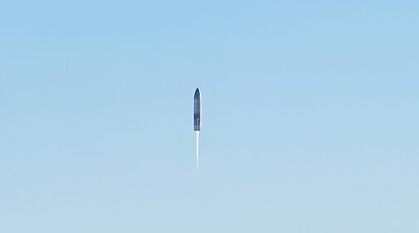
IMAGE: Launch of SpaceX’s Starship SN8 prototype, as viewed from South Padre Island, Texas.. Photo: Forest Katsch / Wikimedia, taken 2020-12-09, CC BY-SA 4.0