
SpaceX successfully deploys 26 Starlink satellites after launching its upgraded Starship rocket from Texas, but a failed booster recovery leaves a historic spacecraft landing attempt scheduled for Saturday.
SpaceX launched its Starship rocket on its 15th test flight Friday, November 13, 2026, successfully reaching orbit and deploying 26 Starlink satellites despite losing its massive first-stage booster. The rocket lifted off from Starbase in South Texas at approximately 4:47 p.m. Central time. SpaceX had planned to recover both sections of the vehicle at the launch site, a milestone that no orbital rocket system has achieved.
The Super Heavy booster instead diverted toward the Gulf of Mexico after an automatic landing abort and exploded above the water. The Starship spacecraft continued its mission, reaching orbit and releasing its satellite payload. SpaceX was preparing for another unprecedented test Saturday, when the spacecraft was expected to return from orbit for its first attempted landing at the launch tower.
Starship Launches on Its Most Ambitious Test Yet
Friday’s launch marked the debut of a recovery attempt involving both parts of SpaceX’s upgraded Starship system. The rocket consists of the Super Heavy booster, which provides the initial thrust, and the Starship spacecraft, which carries payloads into space.
Together, the vehicles stand approximately 407 feet tall, making Starship the world’s largest and most powerful rocket system. The upgraded Super Heavy booster measures about 236 feet, while the spacecraft itself is approximately 171 feet long.
The mission used Booster 22 and Ship 42, which carried the words “Don’t Panic” on its exterior. The message references Douglas Adams’ science fiction novel The Hitchhiker’s Guide to the Galaxy, continuing SpaceX’s tradition of incorporating popular culture into its missions.
The launch proceeded smoothly during its opening minutes. The booster propelled the combined vehicle into the sky before separating from the upper stage, allowing Starship to continue accelerating toward orbit.
According to Reuters, the spacecraft reached orbit approximately 27 minutes after liftoff. The achievement represented another important step for a vehicle that experienced several destructive failures during earlier development flights.
Super Heavy Booster Explodes After Landing Abort
SpaceX initially intended to bring Booster 22 back to the launch tower within minutes of liftoff. The company planned to capture the descending rocket using two enormous mechanical arms attached to the tower.
However, the recovery attempt was automatically aborted before the booster could return to the pad. Mission controllers redirected the vehicle toward a designated area over the Gulf of Mexico.
The booster briefly hovered above the water before exploding in a large fireball. The dramatic failure ended SpaceX’s hopes of recovering both rocket stages during the same mission.
The company had not established the precise cause of the abort by Friday evening. SpaceX representatives indicated that engineers would review flight data to determine what prevented the planned landing.
The failed recovery was particularly significant because SpaceX had previously caught Super Heavy boosters three times. Friday’s attempt involved the larger, upgraded version designed for future operational missions.
An unsuccessful landing does not necessarily mean the entire test flight failed. SpaceX uses experimental missions to evaluate new hardware, identify problems and improve designs before regular operations begin.
The upper stage remained on its planned mission despite the loss of the booster. Its continued operation allowed engineers to collect additional information and complete the satellite deployment.
Starship Successfully Deploys 26 Satellites
One of Flight 15’s major objectives was placing 26 advanced Starlink V3 satellites into low-Earth orbit. SpaceX confirmed that all 26 spacecraft had been released within the first two hours of the mission.
The successful deployment was an important achievement for Starship’s commercial capabilities. Earlier experimental flights focused primarily on rocket performance, engine operation, reentry and controlled splashdowns.
Starlink is SpaceX’s satellite internet network, which provides connectivity to customers through thousands of spacecraft orbiting Earth. The new V3 satellites are designed to offer greater communications capacity than previous generations.
SpaceX estimates that each Starlink V3 satellite will contribute approximately one terabit per second of network capacity. The company says a full 26-satellite deployment provides capacity comparable to roughly ten Falcon 9 launches carrying smaller Starlink V2 Mini satellites.
After deployment, the spacecraft are designed to unfold their antennas and solar arrays, establish communications and gradually raise their orbits using onboard propulsion. They must complete additional checks before entering regular service.
Three satellites also carry cameras intended to inspect Starship’s heat shield during the mission. The images could help engineers evaluate the spacecraft’s condition before its planned return to Earth.
Historic Spacecraft Recovery Planned for Saturday
Starship’s upper stage was scheduled to remain in orbit for approximately 22 hours before returning to Starbase on Saturday, November 14. SpaceX planned for the spacecraft to circle Earth roughly 14 times at an altitude near 170 miles.
The return would be the first attempt to bring an orbital Starship spacecraft directly back to its launch tower. Previous versions either splashed down in the ocean or were destroyed during experimental flights.
The spacecraft must survive intense heating as it reenters Earth’s atmosphere. It must then maneuver toward the launch site and perform a controlled descent using its rocket engines.
If the approach proceeds as planned, the tower’s mechanical arms will attempt to catch the spacecraft before it reaches the ground. This system is designed to eliminate the need for traditional landing legs and speed up preparation for future flights.
SpaceX emphasized that the recovery attempt depends on the spacecraft’s condition. Mission controllers will evaluate critical systems before authorizing a return to the launch tower.
A successful catch would demonstrate an important element of the company’s fully reusable rocket concept. However, Friday’s booster failure means Flight 15 cannot achieve its original goal of recovering both stages.
NASA’s Moon Program Depends on Starship Development
The mission also has implications for NASA’s Artemis program, which plans to return astronauts to the lunar surface. NASA selected a modified version of Starship to serve as a human landing system for future Moon missions.
The space agency has committed billions of dollars toward Starship development, including approximately $3.2 billion under its initial lunar lander contract. SpaceX has invested substantial additional funding in the rocket program.
Unlike the spacecraft used for Earth-orbiting missions, the lunar version must transport astronauts between lunar orbit and the Moon’s surface. It will also require orbital refueling to obtain enough propellant for its journey.
Demonstrating fuel transfers between spacecraft remains one of the major technical challenges ahead. Engineers must also verify that Starship can operate reliably during repeated launches, extended missions and landings.
NASA’s revised Artemis schedule calls for astronauts to practice docking with lunar landing vehicles during Artemis III in 2027. The agency is targeting a crewed lunar landing as early as 2028 under a later mission.
Both SpaceX and Blue Origin are developing lunar landing systems for NASA. Their progress will help determine which vehicle is available for upcoming astronaut missions.
SpaceX Continues Pursuing Fully Reusable Rockets
SpaceX already recovers and reuses the first stages of its smaller Falcon 9 rockets. Those boosters land either on ground-based platforms or autonomous ships stationed offshore.
Starship is designed to go further by recovering and reusing both stages. SpaceX believes this approach could substantially reduce launch costs and support more frequent missions carrying large payloads.
The company is also developing additional launch facilities beyond Texas, including operations in Florida. Longer-term plans call for expanding infrastructure to support significantly higher flight rates.
Friday’s mission demonstrated progress in reaching orbit and delivering operational satellites, even as the booster recovery failed. The spacecraft’s next challenge is considerably more complex than deploying its payload.
As of Friday night, the attempted return of Ship 42 remained scheduled for Saturday afternoon. Its performance during reentry and the tower approach will determine whether SpaceX achieves another major milestone in reusable rocket technology.
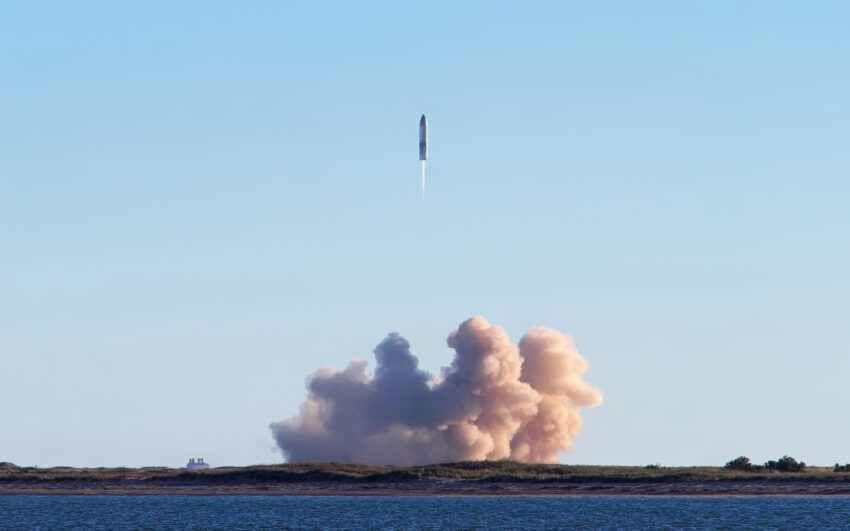
IMAGE: Launch of SpaceX’s Starship SN8 prototype, as viewed from South Padre Island, Texas.. Photo: Forest Katsch / Wikimedia, taken 2020-12-09, CC BY-SA 4.0