
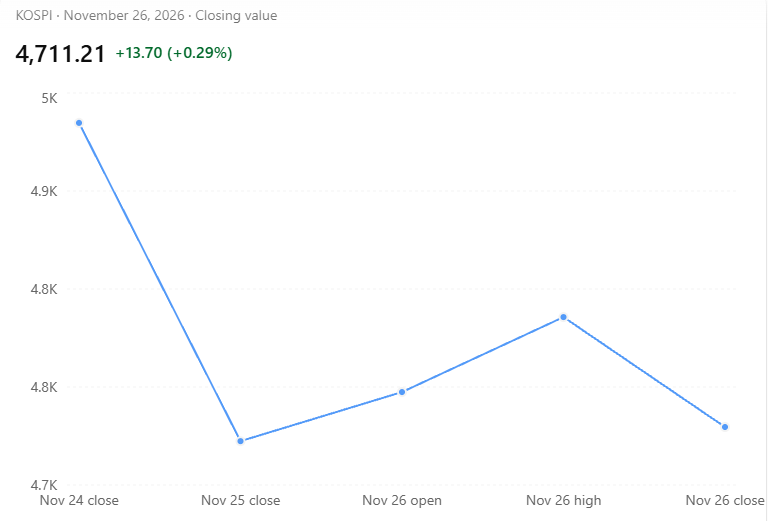
South Korea’s benchmark stock index recovered modestly Thursday after plunging 6.16 percent in the previous session. Concerns about artificial intelligence investments continue to unsettle global technology markets, while South Korea’s central bank raised interest rates.
South Korean stocks recovered slightly on Thursday, November 26, 2026, following a dramatic sell-off that wiped more than 6 percent from the country’s benchmark stock index. Investors remain concerned about the long-term profitability of artificial intelligence investments and the possibility of weaker demand for advanced computer chips.
The Korea Composite Stock Price Index (KOSPI) finished Thursday at 4,711.21, an increase of 13.70 points, or 0.29 percent. The recovery was considerably smaller than the previous day’s losses, reflecting continued uncertainty throughout the technology sector.
Meanwhile, the Bank of Korea raised its benchmark interest rate to 3.25 percent while significantly increasing its economic growth forecasts for 2026 and 2027.
Seoul’s Stock Market Struggles to Recover
The KOSPI began Thursday’s trading session at 4,745.10, up 1.01 percent from Wednesday’s close. The index subsequently climbed to 4,817.77 before surrendering much of its earlier gains.
Wednesday’s sell-off had pushed the index down 308.52 points to 4,697.51. The decline erased gains from Tuesday, when the benchmark finished above the psychologically important 5,000-point level.
Thursday’s modest recovery did not extend across the entire market. Yonhap News Agency reported that 440 stocks declined while 425 advanced.
Approximately 162.4 million shares changed hands during the session, with transactions valued at 16.2 trillion won.
Foreign investors and individual traders remained net sellers, while institutional investors purchased more shares than they sold.
Semiconductor Stocks Remain Under Pressure
South Korea’s substantial semiconductor industry has made its stock market particularly sensitive to developments involving artificial intelligence.
Samsung Electronics and SK hynix are major suppliers of memory chips used in advanced computing systems. Demand for their products has benefited from the expansion of AI infrastructure and investment in data centers.
However, concerns about future profitability and potential oversupply have contributed to sharp fluctuations in semiconductor shares.
Samsung Electronics declined 9.87 percent Wednesday, finishing at 170,700 won. SK hynix suffered an even larger decline of 11.05 percent, closing at 1.03 million won.
Both companies recovered some ground Thursday, although neither came close to reversing its previous losses.
Other technology companies, including Samsung Electro-Mechanics and SK Square, also recorded gains following substantial declines during Wednesday’s session.
Wall Street Sell-Off Spreads to Asia
The sharp decline in South Korean technology shares followed a difficult trading session for American semiconductor companies.
On Tuesday, Nvidia shares fell 5.86 percent, while memory chip manufacturer Micron Technology declined 11.01 percent. Advanced Micro Devices also suffered significant losses, falling 8.86 percent.
The Philadelphia Semiconductor Index, which tracks prominent companies involved in semiconductor production and development, fell 7.88 percent.
These losses contributed to renewed concerns about whether the rapid expansion of artificial intelligence infrastructure can generate sufficient financial returns to justify current investment levels.
American stocks subsequently produced mixed results Wednesday. The Dow Jones Industrial Average rose 0.33 percent, while the S&P 500 declined 0.25 percent. The technology-heavy Nasdaq Composite fell 0.62 percent.
The performance of American technology companies remains important to South Korean manufacturers because of their role in international semiconductor supply chains.
Trading Restrictions Activated During Wednesday’s Decline
The speed of Wednesday’s market decline prompted the Korea Exchange to activate a protective trading mechanism known as a sell-side sidecar.
Unlike a complete stock market shutdown, the mechanism temporarily suspends certain automated program trading activity.
It is intended to reduce the immediate effects of substantial movements in stock index futures and provide market participants with additional time to assess changing conditions.
The Korea JoongAng Daily reported that the mechanism was activated for five minutes Wednesday morning. Similar restrictions had been triggered on four consecutive trading days.
The repeated interventions illustrate the unusual degree of volatility affecting South Korea’s financial markets.
Bank of Korea Raises Interest Rates
Despite the turbulence in equity markets, South Korea’s central bank raised its benchmark interest rate from 3 percent to 3.25 percent Thursday.
The Monetary Policy Board cited persistent inflationary pressures and stronger economic growth as factors supporting tighter monetary policy.
The decision was not unanimous. Reuters reported that five board members supported the increase, while two favored leaving the rate unchanged.
Higher interest rates can help control inflation by increasing borrowing costs and reducing some forms of spending. However, they can also place additional pressure on businesses and households carrying substantial debt.
Technology companies pursuing expensive infrastructure investments may also face greater financing costs when interest rates remain elevated.
Economic Growth Forecasts Improve
The central bank’s latest projections offer a more encouraging picture of South Korea’s broader economy.
The Bank of Korea expects the country’s gross domestic product to grow by 3.9 percent in 2026 and 4.1 percent in 2027.
Those projections represent substantial increases from its August forecasts of 3.3 percent and 2.9 percent, respectively.
Strong semiconductor exports have contributed to the improved outlook. The central bank expects continued investment in artificial intelligence to support global economic activity.
However, stronger economic growth does not guarantee that technology stocks will continue rising. Stock prices also reflect investor expectations about future corporate earnings, competition, borrowing costs, and business risks.
Investors Face Continued Uncertainty
South Korea’s financial markets face several competing influences as the year approaches its end.
Growing demand for advanced semiconductors continues to support manufacturers and export activity. At the same time, concerns about technology stock valuations, future chip supplies, and international trade policies could produce further market fluctuations.
Thursday’s modest recovery indicates that some investors were willing to purchase technology shares following Wednesday’s substantial declines. Nevertheless, the KOSPI remains well below its Tuesday closing level.
Investors will continue monitoring semiconductor demand, corporate earnings, international trade developments, and central bank decisions as they assess whether the recent market volatility represents a temporary correction or a more prolonged adjustment in technology stock valuations.
Major technology stocks
| Company | Wednesday | Thursday |
| Samsung Electronics | −9.87% | +0.35% |
| SK hynix | −11.05% | +2.23% |
| Samsung Electro-Mechanics | −12% approx. | +3.84% |
| SK Square | −11% approx. | +2.23% |