
Technology stocks suffer their sharpest losses in months as concerns about data-center spending, borrowing costs and political uncertainty erase Wall Street’s post-election rally.
Wall Street suffered a sharp sell-off on Thursday, November 5, 2026, as investors dumped shares of companies involved in artificial intelligence and data-center construction. The S&P 500 plunged 4.4%, its worst daily decline since President Donald Trump’s April 2025 tariff announcement triggered widespread financial turmoil.
The Dow Jones Industrial Average dropped 1,833.06 points, or 3.4%, to close at 51,523.06. The Nasdaq Composite fell 5.5% to 24,315.00, wiping out the previous day’s gains and pushing the technology-heavy index into correction territory.
The losses came as investors questioned whether the enormous amounts being spent on AI infrastructure would generate sufficient profits. Concerns about expensive borrowing, electricity costs and potential restrictions on new data centers added to the selling pressure.
Major Stock Indexes Suffer Heavy Losses
Thursday’s decline erased the optimism that had lifted U.S. stocks following the November 3 midterm elections. Wall Street had posted its strongest session in three months on Wednesday after Democrats won control of both chambers of Congress.
The rally proved short-lived as semiconductor and technology stocks began falling sharply. By Thursday afternoon, selling had spread across much of the market, leaving relatively few companies with gains.
The S&P 500 lost 334.89 points to finish at 7,353.73, while the Nasdaq dropped 1,421.52 points. The Russell 2000, which tracks smaller U.S. companies, declined 4.4% to 2,729.89.
According to the Associated Press, the S&P 500 recorded its steepest one-day percentage decline since April 2025. That earlier period of market turbulence followed Trump’s announcement of sweeping tariffs on imported goods.
The Nasdaq finished approximately 11.9% below its October record high. A decline of at least 10% from a recent peak is commonly described as a market correction, although it does not necessarily signal a prolonged downturn.
Despite Thursday’s losses, the major U.S. indexes remained positive for 2026. The S&P 500 was still up approximately 7.4% for the year, showing that the sharp decline had not erased all earlier gains.
Nvidia and Other AI Stocks Lead the Decline
Companies associated with artificial intelligence suffered some of Thursday’s largest losses. Nvidia, whose specialized chips are widely used in AI data centers, fell 9.3%.
The decline made Nvidia one of the biggest contributors to the S&P 500’s losses because of its substantial market value and weighting in the index. Its shares were down approximately 2.6% for the year after several years of exceptional gains.
Advanced Micro Devices dropped 17.3%, while cloud infrastructure provider CoreWeave declined 9.8%. GE Vernova, which supplies equipment and technology used in power generation, fell 7.5%.
The Philadelphia Semiconductor Index plunged approximately 12%, reflecting the widespread retreat from chipmakers. Other companies connected to AI computing, data storage and networking equipment also experienced heavy selling.
Reuters reported that investors were increasingly concerned about the costs of financing major data-center projects. Technology companies have committed substantial amounts of money to constructing facilities and purchasing advanced computing equipment.
Some businesses have also relied on borrowing to finance their expansion. When interest rates remain elevated, servicing that debt becomes more expensive and can reduce the profitability of new investments.
The concern is not simply whether artificial intelligence will continue developing. Investors are questioning how quickly companies can turn rapidly growing infrastructure spending into sustainable earnings.
Data-Center Opposition Creates Political Uncertainty
The midterm elections added another complication for companies planning large AI facilities. Democratic victories raised questions about whether future federal and state policies could slow data-center construction.
Communities in several states have expressed concerns about the electricity and water required to operate large computing facilities. Residents have also questioned whether new projects could increase utility bills or place additional pressure on local infrastructure.
Opposition has crossed political party lines, particularly in areas where proposed developments would require substantial electricity supplies. Local governments have faced demands for greater transparency about energy consumption and the economic benefits of new facilities.
Following the election results, investors began considering whether additional permitting requirements or construction restrictions could affect expansion plans. However, the election outcome does not mean a nationwide prohibition on data centers has been adopted.
Such restrictions would require decisions by the appropriate federal, state or local authorities. The extent of any future regulatory changes remains uncertain.
Analysts are also examining the financial risks associated with slowing construction. Delayed projects could reduce demand for AI chips, electrical equipment and specialized infrastructure services.
That possibility has consequences beyond the technology sector. Utilities, construction companies and businesses supplying materials for large facilities could also experience weaker demand if planned investments are postponed.
AppLovin and Tapestry Defy the Market Decline
Not every company suffered losses Thursday. Several businesses reported strong quarterly earnings that helped their shares advance despite the broader market retreat.
AppLovin, a company providing advertising and marketing technology, surged 31% after reporting revenue and profit above analysts’ expectations. The company also announced an expanded share repurchase program.
Its board authorized up to $3.2 billion in additional share buybacks, increasing the potential size of the repurchase program to $3.6 billion. The announcement provided another reason for investors to support the stock.
Tapestry, the parent company of Coach and Kate Spade, gained 7.1% after delivering better-than-expected earnings. The company also raised its forecasts for revenue and profit for the current fiscal year.
Those results demonstrated that individual companies could still attract buyers through strong financial performance. However, their advances were not enough to offset the losses among large technology stocks.
The contrast also illustrated the difference between company-specific results and broader market concerns. Strong earnings can support individual shares even when investors are reducing their exposure to other industries.
Treasury Yields Fall as Investors Seek Safety
Investors also moved toward U.S. government bonds as stock prices declined. Increased demand for Treasury securities helped push yields lower.
The yield on the benchmark 10-year Treasury note fell to approximately 4.84%, compared with 4.90% late Wednesday. It had been above 5.30% during the previous month.
Bond yields generally move in the opposite direction of prices. When investors purchase more Treasury securities, bond prices tend to rise and yields fall.
The change reflected demand for assets traditionally considered less risky than stocks during periods of financial uncertainty. It also showed that investors were reassessing expectations for economic growth and interest rates.
Thursday’s economic reports offered some encouraging information. Initial applications for unemployment benefits fell by 6,000 to 189,000 during the week ending October 31, according to Labor Department data.
The figure matched a 57-year low and suggested that layoffs remained limited. A separate report showed that U.S. worker productivity increased at an annualized rate of 3.6% during the third quarter.
Improved productivity can help businesses increase output without proportionately raising labor costs. That could support economic growth while limiting some inflationary pressures.
Nevertheless, positive economic data did little to prevent Thursday’s decline. Concerns about AI valuations and future corporate spending remained the dominant influences on trading.
Global Markets Feel the Pressure
The technology sell-off extended beyond the United States. South Korea’s Kospi index dropped 5.3%, reflecting pressure on major semiconductor companies and other technology-related businesses.
Japan’s Nikkei 225 fell approximately 1.8%, while European stock markets recorded mixed results. The losses demonstrated the international importance of companies supplying equipment and components for AI infrastructure.
In Britain, the Bank of England increased its benchmark interest rate by 0.25 percentage points to 4%. The decision marked its first increase in more than three years and reflected concerns about persistent inflation.
The central bank voted 8-1 in favor of the increase. Officials cited elevated energy prices linked to the continuing conflict in the Middle East and stronger-than-expected economic activity.
Bank Governor Andrew Bailey indicated that future interest-rate decisions would depend partly on whether energy prices continued putting pressure on inflation. The bank expects British inflation to approach 5% by the middle of 2027.
Oil prices also moved higher Thursday after falling sharply the previous session. Brent crude climbed 3.9% to $98.29 per barrel as investors continued evaluating developments surrounding the conflict with Iran.
Higher energy prices can complicate inflation forecasts and increase costs for consumers and businesses. That uncertainty added another concern for financial markets already struggling with the technology sell-off.
Investors Reassess the AI Investment Boom
The latest decline has renewed debate about whether expectations for artificial intelligence companies have become too optimistic. Many technology shares have climbed substantially as investors anticipated rapid growth in AI services and computing demand.
Large companies are spending heavily on chips, data centers and electricity infrastructure to support that expansion. Those investments may generate significant future revenue, but the timing and size of the returns remain uncertain.
A sharp decline in stock prices does not establish that the industry is experiencing a speculative bubble. However, it does show that investors are becoming more sensitive to financing costs, regulatory uncertainty and evidence of slower growth.
Attention now turns to upcoming corporate earnings, economic data and Federal Reserve policy decisions. Investors will also monitor whether planned data-center projects proceed as expected and whether companies can justify their increasing AI expenditures.
Thursday’s market close left the Nasdaq in correction territory and erased the previous day’s post-election rally. The next test will be whether earnings and economic conditions can restore confidence in technology companies after one of Wall Street’s most difficult trading sessions of 2026.
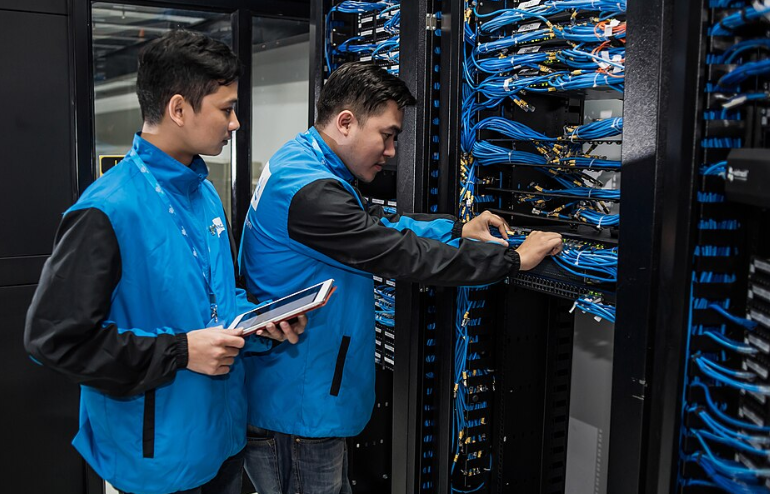
IMAGE: Data Center Source Own work Author Daoducquan CC4