
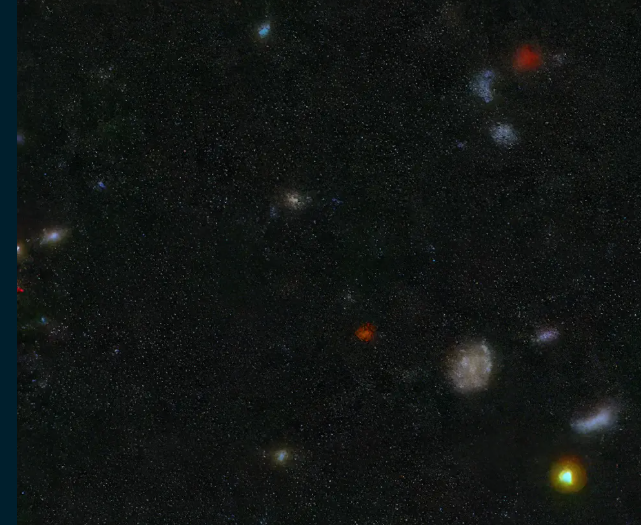
The Euclid space telescope has discovered a quasar powered by a black hole 360 million times the mass of the Sun, observed just 630 million years after the Big Bang.
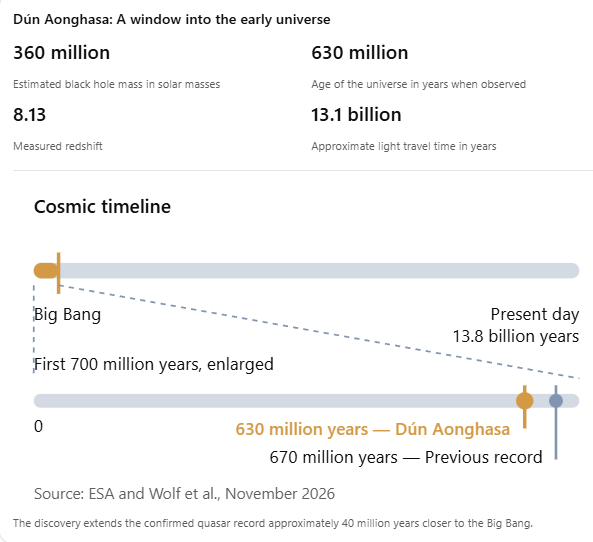
Astronomers have discovered the most distant confirmed quasar ever observed, revealing a supermassive black hole that already existed just 630 million years after the Big Bang. Named Dún Aonghasa, the object contains a black hole estimated to have 360 million times the mass of the Sun. The discovery, announced on November 24, 2026, challenges existing theories about how enormous black holes developed during the early stages of cosmic history.
An international research team led by astronomer Julien Wolf identified the quasar using data from the European Space Agency’s Euclid space telescope. Subsequent observations using several powerful ground-based and space-based telescopes confirmed its nature and extraordinary distance. The findings were published in the scientific journal Astronomy & Astrophysics.
A New Record in Astronomy
The quasar, officially designated J1504+6252, existed approximately 40 million years earlier in cosmic history than the previous record holder. Its light has traveled for roughly 13.1 billion years before reaching Earth. Astronomers are therefore observing the object as it appeared when the universe was less than five percent of its present age.
Researchers measured the quasar’s redshift at approximately 8.13, making it the first confirmed quasar with a redshift greater than eight. Redshift measures how much light has stretched toward longer wavelengths as the universe expands. By examining this effect, astronomers can determine when distant cosmic objects existed.
The European Space Agency reported that scientists identified the quasar among millions of objects recorded during approximately 18 months of Euclid observations. Follow-up studies involved the W. M. Keck Observatory, the Hubble Space Telescope and the Large Binocular Telescope. Observations from the James Webb Space Telescope provided crucial measurements of the black hole’s mass and the quasar’s distance.
What Makes Quasars So Bright?
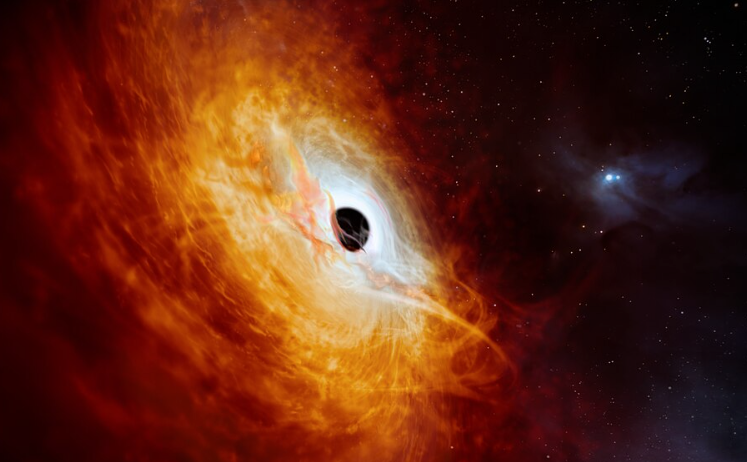
Quasars are among the most luminous objects in the universe. They are powered by supermassive black holes located at the centers of galaxies, where enormous quantities of surrounding material accumulate. Although black holes themselves do not emit visible light from within their boundaries, the material surrounding them can produce tremendous amounts of radiation.
As gas approaches a black hole, it can form a rotating structure known as an accretion disk. Friction and other physical processes heat the material to extremely high temperatures, causing it to release energy across multiple wavelengths. In some cases, the resulting radiation can outshine all the stars in the surrounding galaxy.
This extraordinary brightness allows astronomers to detect quasars across billions of light-years. By examining their radiation, scientists can investigate the properties of black holes and the environments surrounding them. Quasars also provide valuable information about conditions during the earliest periods of galaxy formation.
An Enormous Black Hole With a Surprisingly Slow Growth Rate
One of the most unusual aspects of Dún Aonghasa is the rate at which its central black hole was consuming material. Despite its enormous mass, observations suggest that it was accumulating matter relatively slowly when the detected light was emitted. This raises important questions about how it became so massive within such a short period of cosmic history.
Astronomers frequently compare black hole growth with a theoretical threshold known as the Eddington limit. At sufficiently high levels of radiation, outward pressure can oppose the gravitational attraction drawing material toward the black hole. Under certain conditions, this mechanism limits how rapidly a black hole can continue feeding.
According to the Max Planck Institute for Astronomy, Dún Aonghasa was operating considerably below this threshold. If it had always grown at such a modest rate, its original black hole would have needed to be exceptionally massive. Another possibility is that it experienced periods of much faster growth before reaching the stage astronomers have now observed.
How Did Supermassive Black Holes Form?
Scientists have proposed several explanations for the origins of the earliest supermassive black holes. One possibility involves the collapse of massive stars, which can leave behind smaller black holes. These objects could subsequently increase their mass by accumulating surrounding material or merging with other black holes.
However, the limited time available during the early universe makes explaining the largest black holes particularly challenging. Another theory suggests that enormous clouds of gas could collapse directly into relatively massive black holes. This process would give newly formed black holes a significant advantage over those originating from individual stars.
The latest research indicates that direct collapse remains a plausible explanation for objects such as Dún Aonghasa. However, the observations do not establish which formation mechanism produced this particular black hole. Scientists must also consider how environmental conditions and changing feeding rates influenced its development.
A more speculative possibility involves primordial black holes, hypothetical objects that could have formed shortly after the Big Bang. Such black holes might have provided early starting points for the accumulation of matter. Their existence as the seeds of supermassive black holes has not been established.
Euclid Expands Our Understanding of the Universe
Launched in 2023, Euclid was primarily designed to investigate dark matter, dark energy and the evolution of the universe. Its ability to observe large areas of the sky using sensitive instruments also makes it valuable for identifying exceptionally distant astronomical objects.
The Euclid mission has already identified 31 ancient quasars, including 12 with redshifts greater than seven. These discoveries have substantially increased the number of known quasars from the earliest stages of cosmic evolution. Further observations could help scientists determine whether existing black hole formation models adequately explain these extraordinary objects.
The researchers named Dún Aonghasa after a prehistoric stone fort on Inis Mór, an island off Ireland’s western coast. The fort overlooks the Atlantic Ocean, making its name a symbolic reference to the expanding boundaries of astronomical observation.
As Euclid continues surveying the universe, astronomers hope to discover quasars from even earlier periods. Finding supermassive black holes closer to the beginning of cosmic history could help determine how these enormous objects first formed and what conditions allowed them to grow so rapidly.
FEATURE IMAGE: The small red object near the center is Dún Aonghasa, a quasar that existed just 630 million years after the Big Bang. ESA/Euclid/Euclid Consortium/NASA, Wolf et al. 2026 / CC BY-SA 3.0 IGO