
Scientists are using new computer models to understand how the universe looked in its earliest moments. These simulations help researchers match what they see in space with their theories about early galaxies. The telescope has captured more and more galaxies as it continues its work.
One surprising finding from the telescope is that some early galaxies appear to have very little gas or dust around them. This makes those galaxies look like they contain mostly stars without any surrounding material. Other galaxies are the opposite, showing a lot of gas and dust in their centers.
A third group of galaxies contains unusually high levels of nitrogen. This element is often found in stars that are much more massive than the sun.
These discoveries may help scientists piece together how galaxies formed and evolved. When the universe first lit up with stars, it changed everything around it. The light from early galaxies and black holes broke apart neutral hydrogen gas in space. This process is known as reionization, which was the second time the universe became ionized.
The first stars were likely hundreds or thousands of times heavier than our sun. These early stars burned through their fuel quickly and exploded in powerful supernovas. They spread new elements like carbon, nitrogen, oxygen, phosphorus, and iron across space. These elements are important for forming planets and life as we know it.
Between 2019 and 2022, scientists took the first clear images of black holes. One of them was a supermassive black hole with a mass six point five billion times that of the sun. The second image showed our own galaxy’s center, where a black hole with four million solar masses sits.
These images are not like regular photographs. Black holes themselves do not give off light. What was seen was the glow of hot gas around the edge of the black hole’s event horizon. This creates a dark area in the center where light disappears.
These images are the closest we have ever seen to black holes. Black holes come in many sizes, but supermassive ones are much larger. They can weigh millions or billions of times more than our sun. These giants are found at the center of galaxies, not scattered throughout them.
Most large galaxies have one supermassive black hole at their core. Sagittarius A*, the black hole in our galaxy, is a typical example with about four million solar masses. The mass of the other black hole, five billion times the sun’s mass, is among the largest ever measured.
This shows that supermassive black holes vary widely in size. The idea that a supermassive black hole sits at the center of our galaxy came from long-term studies. Scientists tracked stars moving around a point that had no visible source of gravity. The orbits only made sense if something with four million solar masses was packed into a tiny space. No normal stars or gas could fit that description.
This was strong proof that black holes exist. One important pattern is how black hole mass relates to galaxy size. The relationship is called the M-sigma relation, linking black hole mass to star motion in a galaxy’s center.
This connection is very tight and well measured, but its meaning is still debated. The most common idea is that black holes and galaxies grew together over time. Energy from gas falling into the black hole may have helped control star formation in the galaxy.
But this is still an idea based on observation, not a direct proof. The James Webb Space Telescope has changed how scientists think about black holes. It found many early galaxies containing large black holes, for their age.
Some of these black holes are even larger than all the stars in their host galaxy. This is unusual compared to what we see nearby in space.
The telescope also found more of these early black holes than expected. There is still debate about what these objects really are.
Some think they are young black holes surrounded by thick gas clouds. Other explanations are still being studied.
Scientists are trying to figure out how these giants could grow so fast. Possible ideas include black holes that started very massive or ones that grew quickly from bursts of feeding.
These findings don’t change what we know about black holes from earlier images or star orbits. But they do raise new questions about how the earliest black holes formed.
Future research will focus on analyzing light from these objects in more detail. Better data should help scientists tell if the light comes from stars or a black hole.
The Event Horizon Telescope is also working on time-lapse images of black holes. Even with many observations, the origin of early black holes is still uncertain.
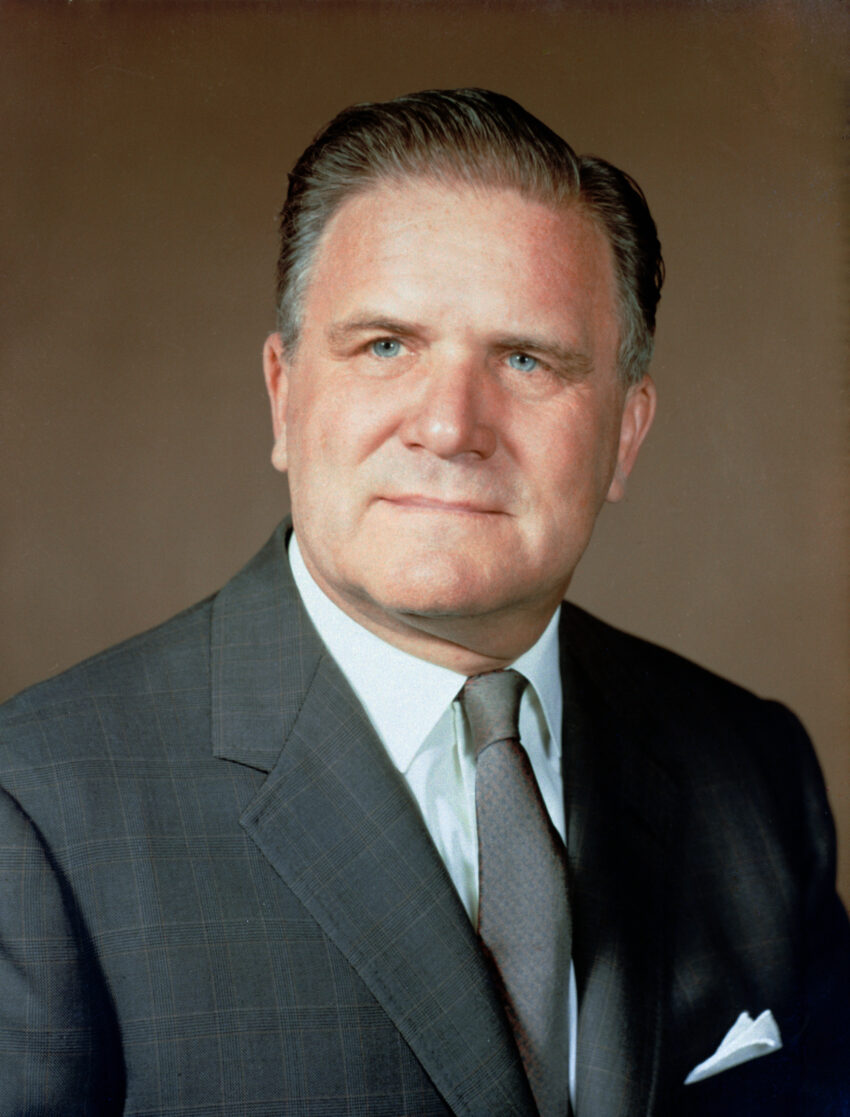
IMAGE: NASA Administrator James E. Webb.. Photo: NASA Johnson Space Center Media Archive / Wikimedia, Public domain