
A federal appeals court has cleared the way for the November 25 operation, despite concerns about toxic lead contamination, public health risks and insufficient warnings to nearby communities.
The U.S. Army plans to destroy nearly five tons of deteriorating lead-based explosives at the Iowa Army Ammunition Plant in Middletown on Wednesday, November 25, 2026. A federal appeals court lifted a temporary block on the operation Monday, allowing the Army to proceed despite objections from environmental organizations. Residents across southeastern Iowa remain concerned about potential lead contamination and the limited time they have been given to prepare.
The operation is scheduled for the day before Thanksgiving, adding uncertainty to holiday travel and family gatherings. Authorities are also monitoring potential environmental effects in neighboring Illinois and Missouri.
Army Faces Growing Risk From Deteriorating Explosives
The hazardous material consists of lead azide that has been stored at the military installation for more than two decades.
Army personnel discovered the deteriorating material in March 2026. Its condition prompted federal authorities to examine disposal options and assess the danger to workers, surrounding communities and the environment.
Military officials believe the risk of an accidental explosion is increasing as winter approaches. They argue that a planned operation, accompanied by environmental safeguards, presents fewer risks than an uncontrolled explosion.
The Environmental Protection Agency issued an emergency hazardous waste permit on November 13. The agency determined that the deteriorating explosives presented an immediate and substantial threat to public safety and the environment.
Environmental organizations have questioned whether the Army adequately explored alternative disposal methods. They have also criticized federal authorities for allowing the situation to become an emergency after years of storage.
Federal Appeals Court Clears the Way
The Army initially scheduled the operation for Friday, November 20. However, growing public concern and a legal challenge forced officials to reconsider the schedule.
The Iowa Environmental Council and the Iowa chapter of the Sierra Club challenged the EPA’s emergency permit. Their attorneys argued that federal regulators had not adequately addressed potential environmental consequences or examined alternative disposal methods.
The Eighth U.S. Circuit Court of Appeals temporarily blocked the permit while reviewing the objections.
On Monday, a three-judge panel lifted that restriction. According to the Associated Press, the judges determined that the emergency permit included sufficient safeguards to address concerns raised by the environmental organizations.
Those requirements include public notification, updated predictions of airborne contamination and environmental monitoring.
The ruling allows the Army to proceed but does not establish that the operation will produce no environmental contamination.
Earthjustice, which represents the environmental organizations, continued to criticize the Army’s handling of the hazardous material. Its attorneys argued that Iowa residents deserve more information and stronger protections.
Residents Question Limited Public Warnings
Concerns about the operation extend beyond Middletown, where the ammunition plant is located.
Charles Massner, the mayor of nearby Mediapolis, received an email from the Army on October 26 informing him about the planned disposal. However, the initial communication provided few details about the operation or its potential consequences.
According to Wired, Massner did not receive substantial additional information until the Army released a public announcement shortly before the original operation date.
Although the Army conducted public meetings in Middletown, residents of other potentially affected communities have questioned whether they received sufficient notice.
Peter Thorne, a professor of environmental health at the University of Iowa, has received inquiries from people concerned about possible lead exposure. Those seeking information include medical professionals and business owners.
The approaching Thanksgiving holiday has added to residents’ frustration. Some families have questioned whether they should change travel arrangements or take additional precautions to protect children.
Lead Contamination Raises Health Concerns
The primary environmental concern is the potential release of airborne lead particles during the operation.
Lead is a toxic metal that can affect several organs and body systems. Children are particularly vulnerable because exposure can interfere with brain development, learning and behavior.
The Centers for Disease Control and Prevention states that no safe blood lead level has been established for children. Even relatively low levels of exposure can have harmful effects.
Earlier government projections identified areas where airborne particles could travel and settle. However, those projections were prepared for previous operation dates and should not be treated as definitive forecasts for Wednesday.
Actual contamination will depend on environmental conditions and the effectiveness of protective measures.
Residents should follow current instructions from local emergency management agencies rather than rely on outdated maps or unverified information circulating on social media.
Environmental monitoring after the operation will be important in determining whether additional health precautions or cleanup measures are necessary.
Trump and Iowa Officials Address the Controversy
President Donald Trump intervened publicly on Monday, initially indicating that he wanted both the courts and Iowa Governor-elect Rob Sand to approve the operation before it proceeded.
Sand responded that federal authorities should make the decision using information supplied by the specialists who have been evaluating the situation. He also called for greater transparency.
Sand will not assume office until January 2027. Republican Governor Kim Reynolds remains responsible for Iowa’s state government.
Reynolds activated the state’s emergency management response ahead of the originally scheduled operation. State agencies have been coordinating preparations with federal authorities and local officials.
Late Monday, the Army confirmed that Wednesday’s operation would proceed.
Reuters reported that acting Army Secretary Adam Telle described the agreement to move forward as a consensus among the relevant authorities and experts.
Officials in Illinois and Missouri are also monitoring developments because environmental contamination could extend beyond Iowa’s borders.
Environmental Monitoring Will Continue After Disposal
The planned operation addresses the immediate danger posed by the deteriorating explosives. However, questions about potential lead contamination may persist after the material has been destroyed.
The EPA’s emergency authorization includes requirements for environmental monitoring and reporting. Information collected after the operation should help authorities determine whether contamination occurred outside the military installation and whether further action is necessary.
For residents, the immediate priority remains receiving timely and reliable information about protective measures.
The Army is expected to provide updated public guidance before Wednesday’s operation, while federal and state authorities prepare to evaluate its environmental consequences.
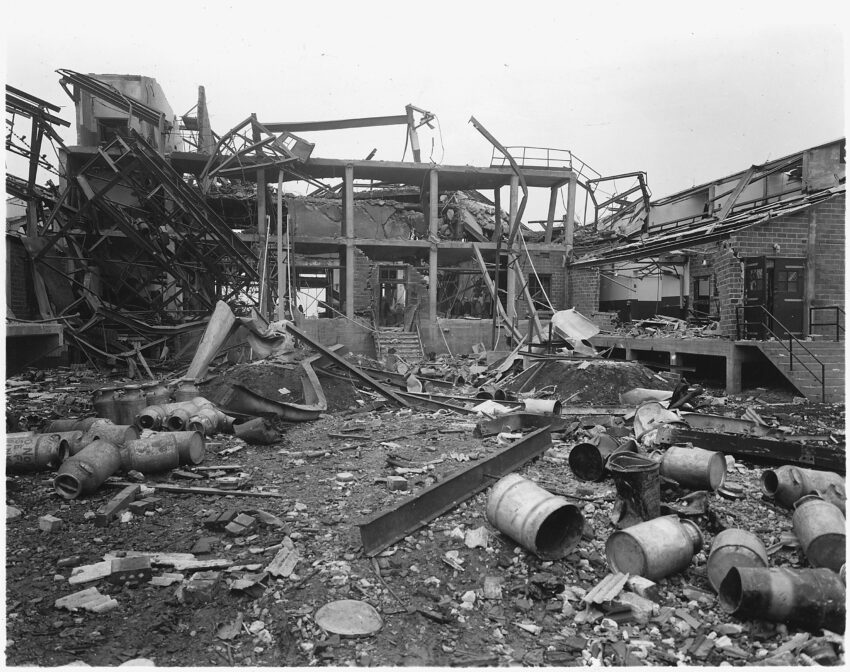
IMAGE: Archival photograph Scope and content: These show both exterior and interior damage resulting from this second major explosion of March 4, 1942. Images 112, 127 & 142 are particularly telling.. Photo: Unknown authorUnknown author or not provided / Wikimedia, taken 1942-00-00, Public domain