
Missile and drone strikes kill three people in Ukraine’s capital and leave hundreds of thousands without power, raising questions about a proposed energy ceasefire and Ukraine’s air defenses.
Russian missile and drone attacks killed three people in Kyiv and injured more than 20 others on October 13 and 14, 2026, as another wave of strikes damaged Ukraine’s energy infrastructure. The attacks left at least 600,000 people without electricity across affected areas and intensified concerns about the country’s ability to maintain essential services as colder weather approaches.
Residential buildings and power facilities were among the targets in the Ukrainian capital. The strikes occurred just days after U.S. President Donald Trump announced what he described as an agreement to halt attacks on energy infrastructure, although Russia and Ukraine had not jointly confirmed a ceasefire.
Ukrainian President Volodymyr Zelenskyy accused Moscow of deliberately continuing its attacks despite the American president’s announcement. Russia, meanwhile, accused Ukraine of striking oil facilities on Russian territory, an allegation Ukrainian officials disputed.
Deadly Strikes Hit Residential Buildings in Kyiv
The attacks began late on October 13 and continued into the following morning, with explosions reported across Kyiv.
In the city’s Desnianskyi district, a strike hit a multistory residential building and started a large fire. Emergency crews searched the damaged structure and discovered two people who had died.
Another strike in the Holosiivskyi district killed one person and injured another at a nonresidential building.
Ukraine’s State Emergency Service reported three deaths and 21 injuries across the capital. Kyiv Mayor Vitali Klitschko said an eight-year-old child was among the injured.
Sixteen people required hospitalization, with four reported to be in serious condition.
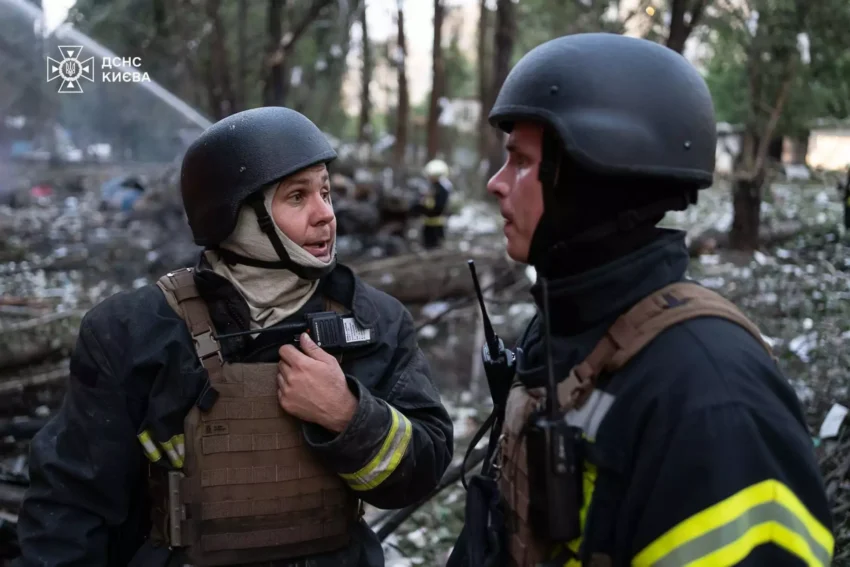
Emergency responders worked through damaged buildings while firefighters attempted to extinguish flames and prevent further destruction.
The attacks damaged civilian property in several neighborhoods, adding to the strain on emergency services already responding to repeated Russian strikes.
Residents faced the immediate dangers of falling debris, fires and structural damage as well as disruptions to electricity and other essential utilities.
The latest casualties underscore the continuing risks to people living in Ukraine’s capital more than four years after Russia launched its full-scale invasion.
Russian Missiles Target Major Kyiv Power Plant
The latest assault also struck facilities responsible for supplying electricity and heating to Kyiv.
Zelenskyy identified the Darnytska combined heat and power plant, also known as CHP-4, as one of the principal targets. The facility provides energy services to parts of the capital.
According to the Ukrainian president, Russian forces used ballistic missiles in the attack, damaging the plant and contributing to widespread electricity disruptions.
Kyiv Mayor Klitschko confirmed that energy facilities in the city and surrounding region had been hit by a major missile assault.
DTEK, one of Ukraine’s largest energy companies, reported emergency power cuts in several districts, including Darnytskyi, Dniprovskyi, Pecherskyi and Solomianskyi.
Parts of Holosiivskyi were also affected.
The outages disrupted normal electricity schedules as repair crews worked to assess damage and restore service.
According to Reuters, Zelenskyy said approximately 30 energy facilities were damaged in attacks affecting Kyiv, Kharkiv and other areas.
The strikes left at least 600,000 people without power across the affected regions. That figure should not be interpreted as the number of people experiencing outages in Kyiv alone.
Ukraine’s electricity system has endured repeated attacks on generating stations, substations and transmission equipment throughout the war.
Damage to these facilities can disrupt electricity supplies far beyond the immediate strike locations, particularly when interconnected systems must be shut down to prevent further failures.
Heating infrastructure is especially important as Ukraine approaches winter, when colder temperatures increase demand for electricity and district heating.
Zelenskyy Criticizes Russia Over Proposed Ceasefire
The strikes created another diplomatic dispute following Trump’s announcement of an energy ceasefire on October 11.
Trump had stated that Russia and Ukraine had agreed to stop attacking each other’s energy infrastructure. However, the announcement was not accompanied by a publicly confirmed agreement accepted by both governments.
The Kremlin subsequently indicated that discussions were continuing but did not confirm that a new ceasefire had taken effect.
Ukraine said it was prepared to respect a mutual halt to energy attacks if Russia did the same.
Following the latest strikes, Zelenskyy accused Moscow of deliberately ignoring the American president’s initiative.
He described the scale of the assault as an unusually open display of disrespect toward the United States.
The Ukrainian president argued that Russian attacks on civilian energy infrastructure contradicted the stated goal of reducing hostilities.
Moscow has maintained that its military operations are directed at facilities supporting Ukraine’s armed forces and defense industry.
That explanation does not resolve whether individual attacks complied with international humanitarian law, which restricts attacks on civilian objects and requires military operations to distinguish between civilian and military targets.
The conflicting statements demonstrate how far the two countries remain from establishing a verifiable arrangement to protect energy infrastructure.
A ceasefire would require agreement on its terms and a way to assess alleged violations. Neither side had announced such a functioning mechanism by October 14.
Russia and Ukraine Exchange Accusations
Russia also accused Ukraine of attacking oil refineries in the Saratov and Ryazan regions.
Russian Deputy Prime Minister Alexander Novak claimed the strikes demonstrated that Ukraine was unwilling to participate in an energy truce.
Dmytro Lytvyn, an adviser to Zelenskyy, rejected the allegations. He said the specific refineries named by Russian officials had not been attacked, although other facilities had been struck.
The competing accounts could not be independently reconciled from the statements alone.
Russian authorities also reported intercepting hundreds of Ukrainian drones during a major overnight attack, including drones approaching the Moscow region.
The Russian figures are official military claims and should not be treated as independently verified interception totals.
Ukraine has conducted long-range strikes against Russian military and energy-related facilities during the conflict. Kyiv argues that these operations are intended to weaken Russia’s ability to sustain its military campaign.
The exchanges have complicated diplomatic efforts to establish limited agreements that could reduce attacks on infrastructure used by civilian populations.
Ukraine Questions Lack of Missile Warnings
The latest Russian attacks have also raised concerns about Ukraine’s ability to detect incoming ballistic missiles.
Zelenskyy said Ukraine did not receive advance warnings from international partners before several recent missile strikes on Kyiv.
He argued that early intelligence could help authorities alert residents, activate defenses and reduce casualties.
Ukraine relies on a combination of domestic radar systems, air defense networks and intelligence shared by international partners to identify approaching threats.
Ballistic missiles present particular challenges because of their high speeds and the relatively short time available to intercept them.
The Associated Press reported that Ukrainian officials were concerned about gaps in warning information as the country faced intensified attacks.
Separate questions have emerged over restrictions affecting Ukrainian military access to certain Starlink communication services.
Those restrictions have reportedly interfered with some drone operations and battlefield communications, although their precise effect on the latest attacks has not been established.
Ukrainian officials have repeatedly requested additional air defense systems and interceptor missiles to protect cities and vital infrastructure.
The continuing damage highlights the importance of those defenses, particularly when multiple missiles and drones are launched during the same operation.
Energy Disruptions Add Pressure Before Winter
Ukraine’s power network has become a recurring target throughout the conflict.
Repeated damage forces energy companies to divert equipment, workers and financial resources toward repairs instead of routine improvements.
Even when electricity can be restored quickly, replacing major transformers and generating equipment may take considerably longer.
Households can experience repeated outages while damaged sections of the network are repaired or temporarily disconnected.
For residents of apartment buildings, electricity interruptions can also affect elevators, water pumps and access to heating systems.
Businesses, hospitals and public services must prepare for disruptions and rely on backup equipment where available.
The latest outages in Kyiv and Kharkiv have renewed concerns about how Ukraine will manage electricity demand during the colder months.
Repair crews continue working under difficult conditions, sometimes returning to facilities that have already been damaged in earlier attacks.
Ukraine has sought international assistance with replacement equipment, energy supplies and protection for critical infrastructure.
However, the repeated strikes create uncertainty over how long repairs will remain effective before another attack causes further damage.
The immediate priority is restoring power to affected communities while emergency workers assist people whose homes were damaged.
As of October 14, Russian attacks had continued despite Trump’s proposed energy ceasefire, and no mutually confirmed halt to strikes on energy infrastructure was in place. Ukrainian authorities were continuing damage assessments and restoration work as residents faced further uncertainty over electricity supplies and their safety.
IMAGE: Russian drone attack on Kyiv on the 4th July 2025.. Photo: State Emergency Service of Ukraine / Державна служба України з надзвичайних ситуацій / Wikimedia, taken 2025-07-04, CC BY 4.0