
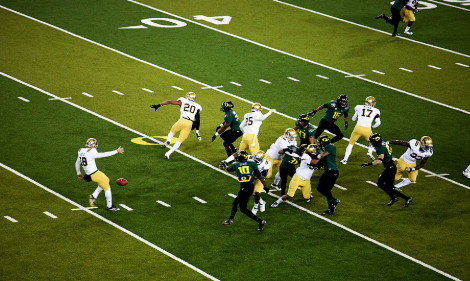
The No. 13 Ducks suffered seven turnovers in a costly home defeat against No. 21 UCLA, falling to 3-2 as quarterback uncertainty and offensive struggles threaten their College Football Playoff chances.
The Oregon Ducks suffered a major setback in their College Football Playoff hopes Saturday, October 10, losing 17-15 to No. 21 UCLA at Autzen Stadium in Eugene. The No. 13 Ducks committed seven turnovers and struggled offensively throughout the game, dropping to 3-2 on the season. The loss leaves coach Dan Lanning’s team with little room for additional mistakes in its remaining Big Ten schedule.
Oregon entered the 2026 college football season with national championship expectations, but its second loss has raised serious concerns about its postseason chances. The Ducks had appeared to regain momentum with a 41-27 road victory over USC on September 26, despite losing starting quarterback Dante Moore to concussion protocol.
Dylan Raiola started against UCLA in Moore’s absence after delivering a strong performance against USC. Raiola had completed 19 of 25 passes for 289 yards and two touchdowns against the Trojans, helping Oregon secure an important conference victory.
However, the quarterback struggled badly against UCLA’s defense. He completed just 6 of 18 passes for 43 yards with two interceptions and lost two fumbles before being replaced by Brock Thomas in the fourth quarter.
Oregon’s problems extended beyond its quarterback. The Ducks repeatedly gave UCLA opportunities through turnovers and failed to establish a consistent offensive rhythm. According to local television station KATU, the teams combined for 10 turnovers, including seven committed by Oregon.
UCLA took advantage of Oregon’s mistakes during the second quarter. Running back Wayne Knight scored on a 35-yard touchdown run, giving the Bruins a 10-6 lead after the Ducks had opened with a narrow advantage.
Knight emerged as UCLA’s leading offensive threat, finishing with 103 rushing yards and a touchdown on 22 carries. He also caught three passes for 12 yards, including a nine-yard touchdown reception from backup quarterback Ty Dieffenbach in the fourth quarter.
The Bruins faced their own difficulties after starting quarterback Nico Iamaleava suffered a leg injury late in the first half. Iamaleava completed 10 of 17 passes for 162 yards but also threw two interceptions before leaving the game.
Iamaleava was injured after being tackled by Oregon defenders Bear Alexander and Jerry Mixon. He briefly returned before being intercepted in the end zone, but did not play in the second half. UCLA turned to Dieffenbach, who helped protect the Bruins’ lead.
Despite Oregon’s offensive struggles, its defense kept the game competitive. The Ducks forced turnovers, blocked a field goal and prevented UCLA from turning several promising possessions into points.
The biggest problem was Oregon’s inability to capitalize on those defensive stops. Its offense finished with only 272 total yards and converted just one of 12 third-down opportunities, according to the university’s official statistics.
Raiola’s struggles eventually prompted Lanning to make a quarterback change. Thomas entered during the fourth quarter and provided an offensive spark, completing several important passes as Oregon attempted to overcome an 11-point deficit.
Trailing 17-6, the Ducks began their comeback with a 26-yard field goal that reduced the deficit to eight points. Thomas later connected with wide receiver Evan Stewart on a 44-yard touchdown pass with 2:16 remaining, bringing Oregon within two points.
The Ducks needed a successful two-point conversion to tie the game. Their initial attempt failed, but a facemask penalty against UCLA provided another opportunity from closer to the goal line.
Oregon could not take advantage of the second chance. UCLA defenders stopped Thomas at the one-yard line, preserving the Bruins’ 17-15 lead and leaving the Ducks needing another possession.
Oregon got the ball back with 48 seconds remaining but could not advance far enough to attempt a winning field goal. UCLA held on for one of its biggest victories of the season, improving to 5-0 and remaining unbeaten under first-year coach Bob Chesney.
The victory also ended UCLA’s five-game losing streak against Oregon. The Bruins had not won in Eugene since 2004, making Saturday’s result particularly significant for a program seeking to establish itself among the Big Ten’s leading teams.
For Oregon, the defeat raised questions about offensive execution and quarterback depth. Moore’s absence has forced the coaching staff to depend on its reserves, and Raiola’s performance against UCLA contrasted sharply with his success against USC.
Moore’s return could help stabilize the offense, but his availability remains subject to medical clearance. The Ducks must balance their immediate need for better quarterback play with the importance of allowing their starter to recover fully.
Oregon’s overall record now stands at 3-2, including a 1-1 mark in Big Ten competition. Its earlier defeat came against Oklahoma State, which beat the Ducks 39-31 on September 12.
Although two losses do not automatically eliminate a team from the expanded 12-team College Football Playoff, Oregon’s chances have become more difficult. The Ducks likely need a strong finish against their remaining opponents to earn serious consideration from the selection committee.
The remaining schedule includes Nebraska, Illinois, Northwestern, Ohio State, Michigan and Michigan State. Several of those matchups could substantially affect Oregon’s conference standing and postseason prospects.
The November 7 road game against Ohio State stands out as a particularly important challenge. Oregon must also improve its offensive consistency and ball security before facing opponents capable of exploiting the same mistakes UCLA forced.
Lanning faces immediate decisions about the quarterback position and offensive adjustments. Thomas showed promise during the late comeback, while Raiola demonstrated against USC that he can perform effectively when given an opportunity.
Oregon will host Nebraska on October 17 in a game that has become more important following Saturday’s defeat. The Ducks remain in the playoff race, but another loss would make their path considerably narrower.
The immediate priority is reducing turnovers, improving third-down efficiency and determining who will lead the offense. Those issues will shape Oregon’s attempt to recover from a damaging home defeat and keep its postseason ambitions alive.
IMAGE: Author Ray Terrill CC2