
Duke University researchers tested a targeted antibody-toxin treatment in 81 patients with recurrent malignant glioma, finding promising survival signals and evidence of immune system activity.
Researchers at Duke University have reported encouraging results from an experimental treatment for aggressive brain cancer, raising hopes for patients whose tumors return after conventional therapy. The treatment delivers a cancer-killing toxin directly into brain tumors while potentially stimulating the body’s immune system to fight the disease.
The findings were published October 16, 2026, in the medical journal Nature Medicine. The phase 1 clinical trial involved 81 patients with recurrent malignant glioma, including 72 with glioblastoma, one of the most aggressive forms of brain cancer.
The experimental therapy, called D2C7-ATC, targets proteins commonly found on the surface of glioblastoma cells. Although the treatment remains experimental, researchers identified patients who survived substantially longer than others in the study and discovered biological signals that may help predict who benefits.
Why Glioblastoma Is So Difficult to Treat
Glioblastoma develops from cells in the brain and central nervous system. Unlike many other tumors, it tends to spread into surrounding brain tissue, making complete surgical removal extremely difficult.
Even when surgeons remove the visible tumor, microscopic cancer cells can remain. These cells may eventually grow into new tumors despite additional radiation and chemotherapy.
The National Cancer Institute reports that median survival following initial treatment for glioblastoma is approximately 15 months. Long-term survival remains uncommon, and treatment options become increasingly limited when the cancer returns.
Another obstacle is the blood-brain barrier, a protective network of cells that prevents many harmful substances from entering the brain. Unfortunately, it also blocks numerous cancer medications.
Glioblastoma presents additional challenges because its cells are genetically diverse. A treatment that damages one group of cancer cells may leave another group relatively unaffected.
The immune system also has difficulty recognizing and attacking glioblastoma. Cancer cells can create conditions that suppress immune activity within the tumor.
These problems have frustrated efforts to improve survival for decades, making new treatment approaches particularly important.
A Treatment Designed to Deliver Toxins Directly to Cancer Cells
The Duke University team investigated D2C7-ATC, a specially engineered antibody-toxin conjugate.
The treatment combines a targeting component with a toxin capable of damaging cells. Its antibody portion recognizes two forms of a protein known as epidermal growth factor receptor, or EGFR.
One is the normal EGFR protein, which can be present at elevated levels in glioblastoma. The other is EGFRvIII, an altered form associated with certain brain tumors.
By targeting these proteins, researchers hope to deliver the toxin preferentially to cancer cells rather than exposing the entire body to conventional chemotherapy.
The approach is different from ordinary chemotherapy, which circulates through the bloodstream and can damage healthy cells along with cancerous ones.
Researchers also used a specialized method to deliver the experimental treatment directly into the tumor.
Known as convection-enhanced delivery, the technique uses carefully positioned catheters to infuse medication into brain tissue under controlled pressure.
This allows the medication to move through the targeted region without depending entirely on its ability to cross the blood-brain barrier.
Each patient in the trial received a single infusion of D2C7-ATC.
What the Clinical Trial Found
The phase 1 study was conducted at a single medical center and included 81 patients with biopsy-confirmed recurrent malignant glioma.
Of those patients, 72 had recurrent glioblastoma classified as IDH-wildtype, the most common molecular form of the disease in adults.
The researchers initially administered different doses to determine how much medication patients could tolerate. They then expanded the study using a selected dose for further evaluation.
Among the 72 patients with recurrent IDH-wildtype glioblastoma, median overall survival was 7.9 months.
Median survival means that half of the patients lived longer than that period, while half lived for a shorter time.
The overall result does not establish that the experimental treatment extends survival compared with existing therapies. The trial did not include a randomized control group receiving standard treatment.
However, researchers identified several patient subgroups with substantially longer survival.
Patients whose tumors showed lower levels of D2C7 antibody reactivity before treatment had a median survival of approximately 17.4 months.
Another subgroup, identified by low levels of an inflammatory signaling protein called interleukin-8 after treatment, had a median survival of 16.6 months.
These findings suggest that certain tumor characteristics and immune responses might influence treatment success.
The results are encouraging, but the subgroup comparisons were exploratory. Researchers cannot yet determine whether the treatment itself caused the longer survival or whether those patients had other favorable characteristics.
Evidence That the Immune System May Be Involved
One of the most interesting findings involved changes in the immune system following treatment.
Although D2C7-ATC was designed to deliver a toxin to cancer cells, the researchers found evidence suggesting it may also trigger broader immune activity.
The team examined tumor tissue, blood samples, and circulating immune signaling molecules to investigate what happened after treatment.
They identified associations between survival and several biological measurements, including inflammatory gene activity within tumors and the levels of different immune cells in the bloodstream.
The findings suggest that destroying tumor cells locally may also influence immune responses elsewhere in the body.
This possibility is important because glioblastoma is particularly effective at suppressing immune defenses.
If researchers can identify ways to activate those defenses safely, future treatments might combine direct tumor destruction with a more sustained immune response.
However, the biological findings do not yet prove that immune activation caused the observed survival differences.
Further studies will be necessary to establish whether the immune changes directly contribute to better patient outcomes.
Safety Remains an Important Consideration
Because D2C7-ATC contains a toxin and is delivered directly into the brain, determining its safety was a central purpose of the trial.
The researchers reported that the treatment was generally tolerated, with most treatment-related adverse events classified as mild or moderate.
Approximately 67 percent of patients experienced grade 1 or grade 2 treatment-related adverse events.
More serious complications occurred at the highest dose tested.
At a concentration of 35,032 nanograms per milliliter, four patients experienced toxicities severe enough to limit further dose escalation. Two had grade 3 events, while two had grade 4 events.
The research team subsequently identified 6,920 nanograms per milliliter as the recommended dose for phase 2 testing.
Eight patients died during the trial. Investigators reported that none of those deaths was related to the experimental treatment.
Those findings offer useful information about potential safety limits, but larger studies will be needed to identify uncommon complications and evaluate longer-term risks.
Why Personalized Treatment Could Matter
Another significant result was the possibility of identifying patients most likely to benefit from D2C7-ATC.
Scientists have increasingly recognized that glioblastoma is not one uniform disease. Tumors can differ considerably in their genetics, protein expression, and surrounding immune environments.
Those differences may influence how a patient responds to treatment.
The Duke researchers found associations involving tumor antibody reactivity, inflammatory proteins, immune-cell populations, and patterns of gene activity.
If validated, these measurements could eventually help physicians identify patients who are more likely to respond to this type of targeted therapy.
Such an approach would represent a shift away from treating all recurrent glioblastomas in the same way.
However, the study did not establish a clinically validated test for selecting patients. The potential biomarkers require confirmation in larger, independent groups.
What Happens Next
The findings provide a foundation for further clinical testing, but D2C7-ATC is not an approved standard treatment for glioblastoma.
A phase 1 trial primarily evaluates safety, dose selection, and early signs of activity. It cannot provide the same evidence of treatment effectiveness as a large randomized trial.
Future studies will need to compare the treatment with established care, determine whether survival improvements can be reproduced, and identify which patients are most likely to benefit.
Researchers are also investigating D2C7-based treatments in combination with other experimental approaches intended to stimulate antitumor immunity.
One such investigation at Duke combines D2C7-IT with an antibody targeting CD40, a protein involved in activating immune responses.
That combination is being studied separately and should not be confused with the single-agent treatment evaluated in the newly published trial.
For patients facing recurrent glioblastoma, the need for improved therapies remains urgent.
The latest findings show that delivering a targeted toxin directly into brain tumors is feasible and may produce meaningful biological effects. Whether those effects translate into longer survival will depend on the results of larger controlled studies.
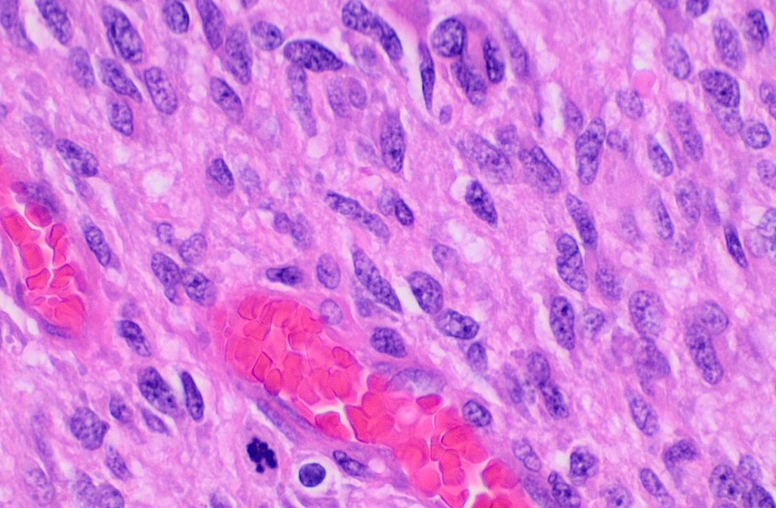
IMAGE: Histopathology of glioblastoma, high magnificationSource Own work Author Mikael Häggström, M.D. Author info – Reusing images – Conflicts of interest: None Mikael Häggström, M.D. Consent note: Consent from the patient or patient’s relatives is regarded as redundant, because of absence of identifiable features (List of HIPAA identifiers) in the media and case information (See also HIPAA case reports guidance). CC1