
Skip to content
Digital News Report Logo
Menu
  • News
  • Business
  • Science
  • Entertainment
  • Health
  • Sports
  • Audio Books
  • Quizzes
  • Videos
Menu

Home » Health » Mayo Clinic Explains When Rotator Cuff Tears Need Surgery

Mayo Clinic Explains When Rotator Cuff Tears Need Surgery

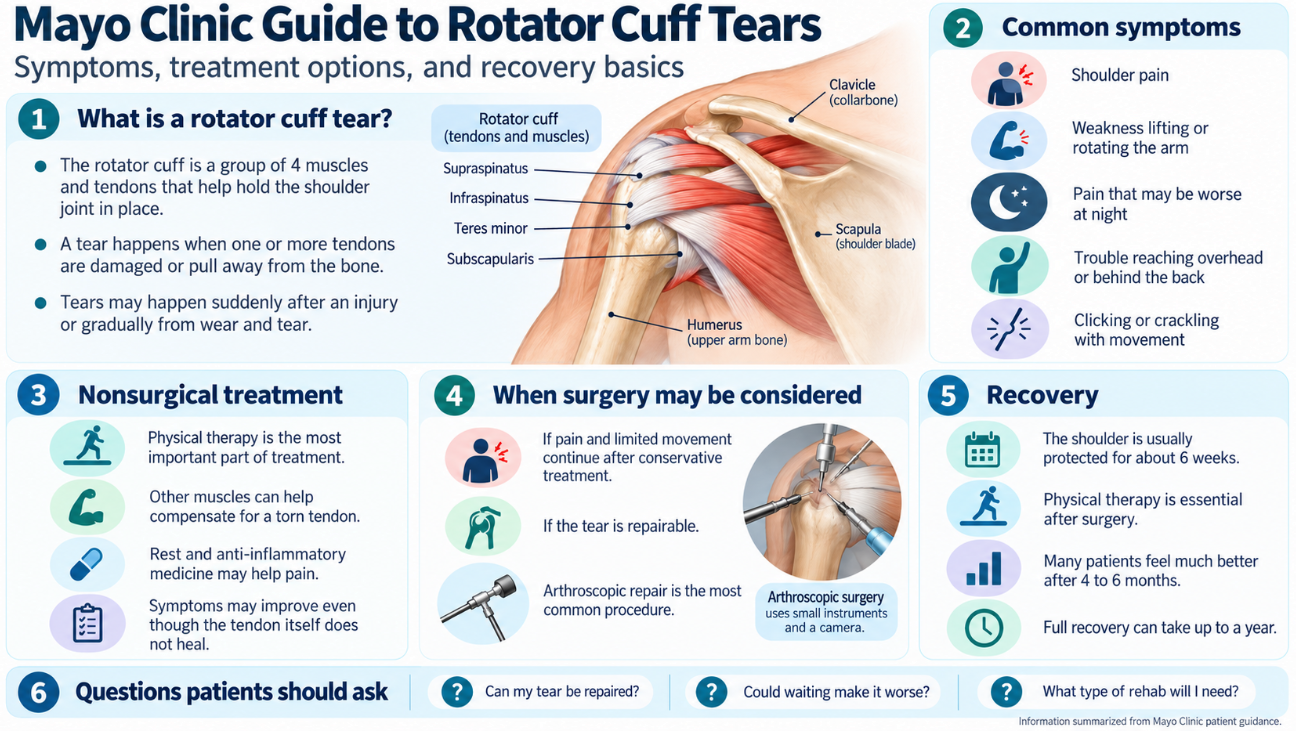
Landscape infographic showing shoulder anatomy and explaining rotator cuff tear symptoms, nonsurgical treatment, when surgery may be considered, recovery timelines, and questions patients can ask their doctor.
By Digital News Editorial Team on October 4, 2026

A new Mayo Clinic Q&A outlines how doctors decide between physical therapy and surgery and what patients can expect during recovery.

What Is a Rotator Cuff Tear?

The rotator cuff is a group of four muscles and their tendons that surround the shoulder joint. They help hold the upper arm bone in place and allow you to lift and rotate your arm.

A rotator cuff tear happens when one or more of these tendons become damaged or pull away from the bone. Tears can develop gradually from wear and tear or happen suddenly after a fall or other injury.

Common symptoms include shoulder pain, weakness when lifting or rotating the arm, pain that becomes worse at night, and difficulty reaching overhead or behind the back. Some people also notice clicking or crackling sensations when moving the shoulder.

Not every rotator cuff tear causes symptoms. Doctors may use a physical examination along with imaging such as an ultrasound or MRI to determine the location and severity of the damage.

Mayo Clinic published new guidance October 2 explaining how rotator cuff tears are treated and when surgery may be considered. A rotator cuff tear involves damage to the group of muscles and tendons that connect the shoulder blade to the upper arm bone.

These muscles are essential for shoulder motion, strength, and stability. The severity of a tear can vary widely—with some causing little or no symptoms while others result in significant pain and loss of function. The cause of the tear plays a key role in how it should be treated.

Tears caused by gradual wear and tear often improve without needing surgery. The torn tendon itself does not heal through nonsurgical treatment but other muscles can compensate for the damage. When conservative treatments fail to relieve pain and movement issues surgery may be suggested.

Physical therapy is considered the most important part of nonsurgical treatment.

Pain can make starting therapy difficult at first. Some people find relief with over-the-counter anti-inflammatory drugs.

The most common surgical method is a tendon repair done through small incisions using a camera and special tools. Not all tears can be fixed with surgery—especially larger ones. Recovery after surgery requires patience and careful protection of the shoulder during the first six weeks.

Following the prescribed physical therapy program is also essential for healing. Patients should ask whether their tear can be repaired and if delaying treatment could make it worse over time.

This information comes from the Mayo Clinic Q&A which is an educational resource for patients. The advice given reflects common questions from patients to the Mayo Clinic healthcare team.

It is not a substitute for regular medical care.

IMAGE: DNR Art Department


  1. Mayo Clinic Says Nonprescription Drugs Could Save a Trip to the Doctor
  2. Billy Joel Shares Update on Brain Surgery and Concert Plans
  3. Joint Capsule
  4. Osteoarthritis
  5. Gastric Bypass Surgery May Be Better Than Other Options

Live Results Search

Categories

Important Information

This site is for informational purposes only.  Always check with your doctor or  legal council before making any medical or legal decisions.

loader-image
San Francisco, US
3:23 pm, October 5, 2026
temperature icon 73°F
broken clouds
Humidity 56 %
Pressure 1012 mb
Wind 17 mph
Wind Gust: 0 mph
Visibility: 0 km
Sunrise: 7:08 am
Sunset: 6:47 pm
Weather from OpenWeatherMap


©2026 Digital News Report | Design: Newspaperly WordPress Theme