
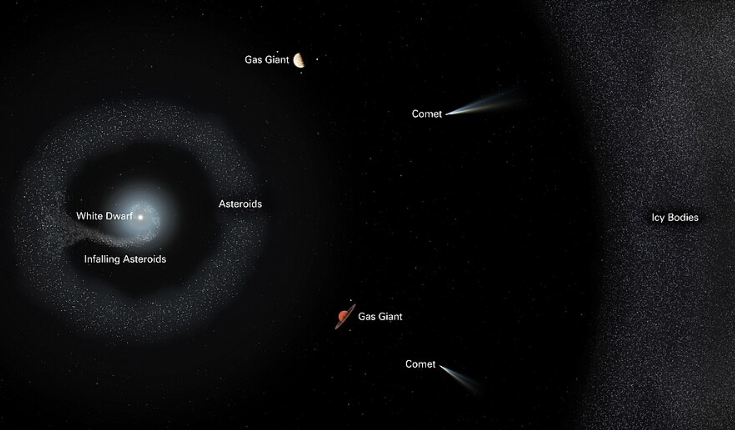
New research reveals how the remains of destroyed planets can turn dead stars green, while other white dwarfs may appear pink, purple, yellow, or blue.
Astronomers have identified what appears to be the first genuinely green star, challenging a long-standing understanding of the colors stars can display. The unusual object, called WD J1330+6435, is a white dwarf located approximately 280 light-years from Earth in the constellation Draco. Its remarkable color comes from elements left behind by destroyed planetary material that entered the star’s atmosphere.
The discovery was reported October 15, 2026, in the scientific journal RAS Techniques and Instruments. Researchers from the University of Warwick in England and the University of Kiel in Germany found that some dead stars can display colors rarely associated with stars, including green, pink, purple, and cyan.
Why Astronomers Thought Green Stars Could Not Exist
For generations, astronomers have understood that a star’s color is primarily determined by its surface temperature. Cooler stars generally appear orange or reddish, while hotter stars appear white or pale blue.
Our Sun, for example, emits light across the visible spectrum and would appear white when viewed from space. The familiar yellow appearance of the Sun from Earth is partly influenced by our atmosphere.
Although stars produce green wavelengths of light, ordinary stars do not appear green to human eyes. Their light also contains substantial amounts of red and blue, which combine with green to produce an overall white or nearly white appearance.
That understanding has now been challenged by a particularly unusual type of stellar remnant.
The international research team, led by astrophysicist Mark Hollands of the University of Warwick, examined how the chemical composition of white dwarf atmospheres affects their visible colors. They discovered that certain combinations of elements can remove enough light from particular parts of the spectrum to produce unexpected colors.
A Dead Star With an Unusual History
WD J1330+6435 is not an ordinary star. It is a white dwarf, the compact remnant left when a star of relatively low or intermediate mass exhausts its nuclear fuel and sheds its outer layers.
White dwarfs no longer generate sustained energy through nuclear fusion. Instead, they slowly release the enormous amount of heat remaining from their earlier lives.
Despite having a mass comparable to that of the Sun, a typical white dwarf is approximately the size of Earth. Its matter is compressed into an exceptionally dense state, producing conditions very different from those found in ordinary stars.
WD J1330+6435 has an estimated surface temperature of about 4,240 kelvin, equivalent to approximately 3,967 degrees Celsius.
Under normal circumstances, an object at that temperature would not be expected to appear green.
However, astronomers found that this particular white dwarf has a helium-dominated atmosphere containing sodium, calcium, and lithium. Those heavier elements provide evidence that rocky debris from its former planetary system has fallen onto the star.
Asteroids, planetary fragments, or other rocky bodies may have been disrupted after the original star evolved into a white dwarf. Some of that material subsequently contaminated its atmosphere.
The result is a star whose appearance carries evidence of what happened to its former planetary system.
How Sodium Turns the Star Green
The key to the unusual color is the interaction between sodium atoms and the extraordinarily dense helium atmosphere surrounding the white dwarf.
Under ordinary conditions, sodium absorbs particular wavelengths of light. However, the extreme density inside a cool white dwarf’s atmosphere changes the way sodium interacts with neighboring atoms.
Those interactions broaden the range of wavelengths that sodium can absorb.
In WD J1330+6435, sodium strongly suppresses orange light, while calcium absorbs light toward the violet portion of the spectrum. Together, these effects alter the balance of visible light escaping from the star.
The remaining light has a strong contribution near 500 nanometers, within the blue-green portion of the visible spectrum.
When the researchers used computer models to calculate how the light would appear to human eyes, the result was a distinctive chartreuse-green color.
The effect is particularly striking because the star is not producing green light through an entirely new physical process. Instead, its atmosphere is filtering the light that would otherwise escape.
The researchers emphasize that this appearance was calculated from astronomical observations and atmospheric models. No telescope has directly photographed a resolved green surface on WD J1330+6435.
From Earth, the star is far too distant and small for its surface color to be distinguished directly.
White Dwarfs May Come in Many Unexpected Colors
The green star was only one part of a broader investigation into the colors of white dwarfs.
The research, titled Any colour you like: the diverse chromaticities of white dwarfs, examined how atmospheric temperature, density, and chemical composition affect the light emitted by these stellar remnants.
Scientists found that white dwarfs containing carbon can appear pink or purple because carbon molecules absorb selected portions of visible light.
One particularly unusual example, WD J1011+2845, is located about 48 light-years away. Carbon brought upward from the star’s interior produces a predicted salmon-pink appearance.
Other white dwarfs with atmospheric material from shattered asteroids and planetary bodies can appear yellow, green, or even blue.
Some cool white dwarfs containing mixtures of hydrogen and helium may produce pale blue or cyan colors because collisions between particles change which wavelengths can escape.
These findings indicate that stellar temperature alone cannot always predict a star’s appearance.
For particularly dense stellar remnants, atmospheric chemistry can become equally important.
Most White Dwarfs Are Still White
The researchers also wanted to determine how common these unusual colors might be.
They examined a representative sample of nearby white dwarfs within approximately 65 light-years of Earth.
Among 151 stars discussed in the university’s research announcement, five displayed distinctly unusual colors. Two appeared yellow, while three appeared pink.
The findings suggest that approximately one in 30 white dwarfs could exhibit unusual coloring, although that estimate is based on the nearby sample and may not describe every stellar population.
Most of the stars examined still appeared white.
The researchers calculated a median color temperature of approximately 6,800 kelvin for the nearby population, consistent with a generally white appearance.
That result also helps explain why some astronomical illustrations give the impression that white dwarfs are predominantly blue.
Hotter white dwarfs produce more light and can be detected across greater distances. Consequently, surveys that favor brighter objects tend to include a disproportionately large number of blue-white stellar remnants.
A more representative nearby sample shows that white dwarfs generally deserve their name.
What Dead Stars Reveal About Destroyed Planets
Beyond the unexpected colors, the discovery offers another way to study the history of planetary systems.
When stars similar to the Sun reach the final stages of their lives, they expand into red giants before shedding their outer layers. Their remaining cores eventually become white dwarfs.
The transformation can dramatically alter the orbits and survival prospects of surrounding planets, asteroids, and comets.
Some objects may survive, while others are broken apart or drawn toward the stellar remnant.
When rocky debris falls into a white dwarf’s atmosphere, astronomers can detect chemical elements that were originally part of those bodies.
Such observations have already allowed researchers to investigate the composition of planetary material around dead stars.
The new findings add another dimension to that work. The same elements that reveal a destroyed planetary system can also change the apparent color of the star itself.
For WD J1330+6435, sodium-rich debris is especially important. Its absorption properties help explain why the star would look so different from an ordinary stellar remnant.
The research also demonstrates the value of improved atomic physics and atmospheric calculations. Earlier studies had examined this white dwarf, but better models of sodium absorption helped establish its unusual predicted appearance.
A New Way to Look at the Night Sky
The study does not mean that green stars will suddenly become visible through backyard telescopes. White dwarfs are generally too distant and small for observers to distinguish their surfaces.
Instead, the discovery demonstrates how scientists can reconstruct a star’s appearance by studying its spectrum.
When astronomers separate starlight into different wavelengths, they can identify the fingerprints of chemical elements and measure the amount of light emitted at each wavelength.
Computer models can then translate those measurements into an estimate of what a human observer would see if positioned close enough to distinguish the star’s disk.
The technique could help scientists identify additional unusually colored white dwarfs as astronomical surveys collect more detailed observations.
Researchers have already identified other white dwarfs with weaker greenish hues, suggesting WD J1330+6435 may not be the only example.
For now, its predicted chartreuse appearance provides an unusual reminder that the universe contains stellar colors that ordinary temperature-based explanations cannot fully describe.
The next discoveries may come from white dwarfs that have been cataloged for years but whose remarkable colors have yet to be recognized.
IMAGE: Source Layout of the White Dwarf System G238-44 Author ILLUSTRATION: NASA, ESA, Joseph Olmsted (STScI) CC0