
The new cooperation has allowed inspectors to answer questions that remained unresolved for nearly two decades. According to the Associated Press, the IAEA has now determined that the former Syrian government failed to declare nuclear material, facilities, and activities as required under Syria’s safeguards agreement with the Nuclear Non-Proliferation Treaty.
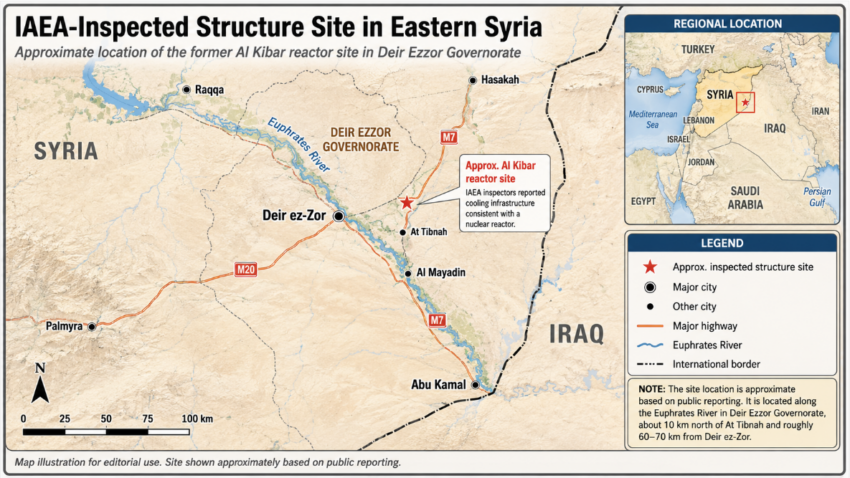
Inspectors returned to the Deir Ezzor site on August 29 to observe excavation work. According to the IAEA report obtained by the Associated Press, newly uncovered cooling infrastructure at the location is consistent with infrastructure that would have been used for a nuclear reactor. The agency plans to continue monitoring the excavation as additional portions of the former facility are uncovered.
The investigation has also identified several locations connected to the suspected reactor project. According to the confidential IAEA report, one site was associated with uranium conversion or nuclear fuel fabrication, while another was used for temporary storage. A third location was connected with materials being moved to and from the Deir Ezzor facility and with planned reprocessing activities. These discoveries give inspectors a clearer picture of how extensive the former government’s undeclared nuclear work may have been.
One of the most significant developments involves the approximately 73 tonnes of natural uranium discovered at another site that had not previously been declared to the IAEA. Syria informed the agency about that location in a July 17 letter and invited inspectors to examine both the site and any nuclear material found there. According to the Associated Press, inspectors confirmed the presence of natural uranium metal in fuel-rod form with cladding. The material is now subject to IAEA containment and surveillance measures.
The discovery is significant because of the quantity of material and because it had not previously been declared. However, natural uranium should not be confused with highly enriched uranium used in nuclear weapons. Natural uranium contains only a small proportion of the uranium-235 isotope needed for most nuclear reactors or nuclear weapons and generally must undergo additional processing and enrichment before it can be used for those purposes.
The IAEA’s findings nevertheless provide stronger evidence about the scale of Syria’s former nuclear activities. According to the agency, the Deir Ezzor project included not only a reactor under construction but also facilities associated with producing and storing nuclear fuel. Syria had long denied that the facility destroyed by Israel in 2007 was a nuclear reactor, while international investigators had been unable to fully resolve the issue because inspectors were denied the access and information they requested.
The political changes in Syria have dramatically altered that situation. During an August 17-18 visit by IAEA Director General Rafael Grossi, Syrian officials agreed to additional inspections and practical steps intended to resolve the country’s outstanding nuclear safeguards issues. In a joint statement, the IAEA described the visit as the most significant progress yet toward resolving questions involving undeclared nuclear activities conducted under the former government.
According to Reuters, the new Syrian authorities have provided information and documentation that had previously been unavailable and have taken steps to correct some of the country’s past safeguards violations. The cooperation could eventually allow the IAEA to close portions of an investigation that has remained open since the suspected reactor was destroyed nearly 20 years ago.
The investigation could also have implications for Syria’s nuclear future. According to the Associated Press, the country’s new leadership has expressed interest in eventually developing a civilian nuclear energy program. Any such program would face extensive international scrutiny, particularly given the history of the undeclared Deir Ezzor project. Continued cooperation with the IAEA and full accounting of Syria’s existing nuclear material would likely be essential before a new civilian program could move forward.
For now, the approximately 73 tonnes of uranium remains under international monitoring while inspectors continue examining the locations connected to Syria’s former nuclear program. The renewed access is giving the IAEA an opportunity to establish a much more complete record of what the Assad government attempted to build, where its nuclear material came from, how it was intended to be used, and whether additional undeclared material or facilities remain elsewhere in the country.
IMAGE: Map of the IAEA-Inspected Al Kibar Reactor Site in Eastern Syria FNP Art Deparment